How Hard a Springer Spaniel Dual Championship Is Today
A Springer Spaniel dual champion has succeeded in two demanding arenas: the show ring and field trials. The challenge is not simply teaching one dog two sets of skills; it is finding a Springer with the structure, temperament, stamina, and trainability to meet very different standards. This guide explains what the title means, why it is so difficult, and what the pursuit involves.
What a Springer Spaniel dual championship means
The title depends on the country and registry
“Dual champion” generally describes a dog that has earned a championship in conformation shows and a championship in field competition. The precise title and requirements depend on the country and the organization overseeing the events. In the United States, for example, the American Kennel Club’s Dual Champion designation is associated with a dog holding both a conformation Champion title and a Field Champion title. In Britain, people may use “dual champion” to describe a Springer with show and field trial championships, but the terminology and route to recognition differ.
That distinction matters when you read a pedigree, breeder description, or old breed history. A dog described as a dual champion in one country may not have earned an identical pair of titles under another registry’s rules. Before treating the phrase as a specific credential, check which show title and field title the dog actually holds, and under which governing body.
It is also worth separating a dual championship from simply being a versatile dog. A Springer might be a keen hunter, have a good show record, and perform well in training without earning either championship. The title describes formal competitive achievements, not a general judgment that the dog is better than other Springers.
Show and field success ask for different strengths
In conformation, judges assess how closely a dog matches the breed standard. That includes its overall balance, movement, coat, head, and other physical characteristics. The dog must also be comfortable being examined and shown in a busy ring, often around unfamiliar dogs, people, and noise. A championship is built through competition and consistency, not just a single attractive appearance.
Field trials assess a different kind of performance. A Springer is expected to work purposefully through cover, use its nose, respond to handling, and show the control and athletic ability required by the particular trial format. That means the dog must do more than look fit and enthusiastic. It needs to work effectively with a handler amid exciting scent, terrain, and activity.
The difficulty lies in excelling at both, rather than being merely adequate in each. The traits that make a dog especially successful in a field setting do not automatically translate into a show-ring advantage, and a show-winning outline does not guarantee the stamina, drive, and field performance needed for trial success.
Why earning both championships is so difficult
The breed has diverged into field and show types
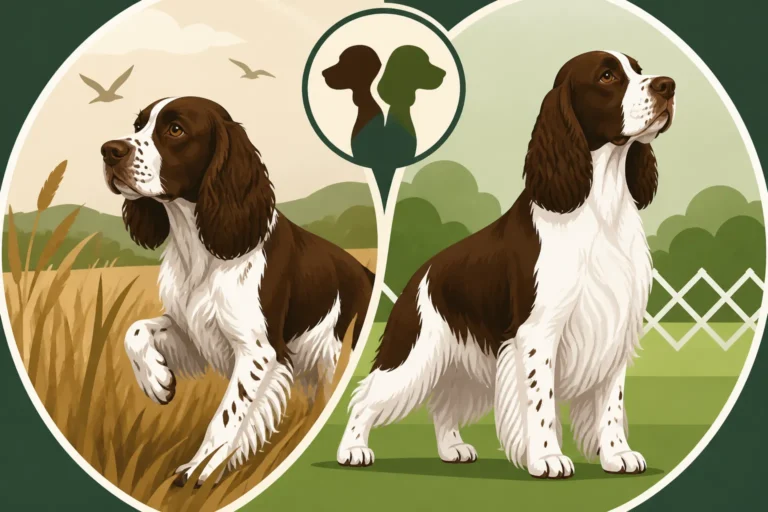
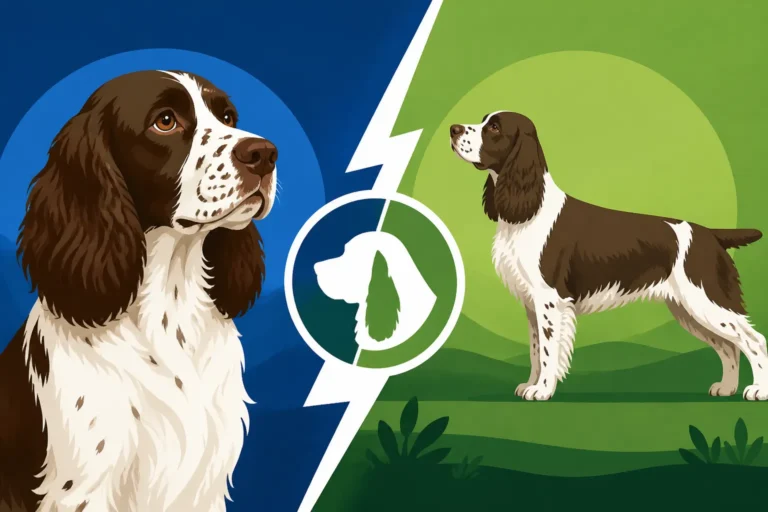
English Springer Spaniels are registered as one breed, but many decades of selection for different purposes have created noticeable differences between field-bred and show-bred dogs. The divide is not absolute: individual dogs vary, and there are breeders who value ability and appearance together. Still, the two types can differ in size, coat, build, energy, and the priorities emphasized in their breeding programs. How the Field and Show Springer Spaniel Diverged
A field-bred Springer is often selected for practical work and athletic performance. A show-bred Springer is selected to meet the conformation standard and succeed in the ring. That does not mean show dogs cannot hunt or field dogs cannot be shown. It means that a breeder aiming for one kind of success may make different choices from a breeder aiming for the other.
A dual-championship prospect has to come from a dog whose qualities genuinely bridge those priorities. The dog needs a suitable conformation, but also the physical capacity and working character to perform in the field. Finding that combination is difficult before training even begins. The challenge is especially clear when comparing the two paths in How Different the Two Springer Spaniel Types Look and Whether the Two Springer Spaniel Types Interbreed.
Competition rewards sustained quality, not promise
A puppy may show early promise in both settings, but promise is not a title. The dog must mature into the physical and behavioral qualities required for each discipline, remain sound enough to train and compete, and perform well against strong competition. One good day in the field or one impressive ring appearance cannot substitute for the repeated results needed along the way.
The handler also has to manage two training environments. Field work develops hunting skills, responsiveness, control, and the ability to work with purpose. Show preparation involves ring skills, presentation, movement, coat maintenance, and confidence with handling. Those activities can fit together, but they require planning. A dog that is tired from demanding field work may not be at its best in the ring; a dog whose schedule is dominated by show preparation may get less time for the work it needs to develop in the field.
And there is no guarantee that effort will produce a championship. The dog may lack a particular quality, lose interest in one discipline, sustain an injury, or simply encounter competition that is stronger on the day. A sensible owner sees the titles as an ambitious goal, not an outcome that can be secured by purchasing the “right” puppy.
The practical demands on dog and handler
Training takes time, skill, and flexibility
A dual-championship campaign is not a single training program. It is a long-term commitment involving separate skills, regular practice, competition experience, and a handler who can adjust the plan as the dog develops. Some owners work with different mentors for field training and conformation handling because expertise in one area does not automatically cover the other.
For field work, the dog needs more than exercise. It must learn to search cover, respond to cues, remain connected to its handler, and work with control around game and distractions. A dog with natural drive may still need patient training to channel that energy. The fundamentals in Teaching a Springer Spaniel to Hunt Within Gun Range and Whistle Work: The Language a Springer Spaniel Learns illustrate how much communication and consistency can matter.
Show training has its own demands. Dogs need to be comfortable standing for examination, moving at a suitable pace, and staying composed in a ring. The handler must learn how to present the dog without masking its natural movement or creating unnecessary stress. Training sessions should be matched to the dog: a sensitive Springer may lose confidence if pushed too hard, while an energetic one may need short, structured practice to stay focused.
Care, travel, and recovery are part of the campaign
The less glamorous work can be just as important as training. Regular conditioning, sensible rest, routine veterinary care, coat maintenance, and attention to feet and ears all help support a dog that spends time in both show and field environments. A dog working in cover or getting wet may need a careful check afterward, while a dog with more coat may need extra brushing and grooming to prevent tangles.
Practical supplies can help keep routines manageable. Some owners use retailers such as Chewy for everyday grooming or care items, while choosing veterinary guidance for health concerns and equipment suited to their specific activities. A show coat and a working coat may call for different handling, so a routine that works for one Springer is not automatically right for another.
Travel adds another layer: competition days can involve early starts, unfamiliar places, waiting between events, and the need to keep the dog comfortable and settled. A handler has to plan for food, water, safe transport, recovery time, and weather. Chewy may be a convenient option for replenishing ordinary care supplies before a busy stretch, but the important part is having a consistent, dog-appropriate routine rather than buying a particular product. For owners balancing coat care and active work, Two Coats, Two Routines: Field and Show Springer Spaniel Grooming offers useful context.
How to judge whether the goal is realistic
Start with the individual dog, not the title
The most realistic starting point is an honest assessment of the dog in front of you. Does the dog enjoy training? Is it confident in new environments? Does it have the physical qualities to work comfortably and the temperament to handle both field activity and ring handling? A pedigree may offer clues, but it cannot guarantee that a puppy will thrive in both disciplines.
Talk with breeders about the goals behind their breeding decisions, and ask about the parents’ health, temperament, work, and show history. A breeder who understands both settings should be able to explain the strengths and compromises in a litter without promising a dual champion. It is also useful to meet adult relatives where possible, because seeing the grown dogs can offer a more grounded picture than relying on puppy appearance alone. The broader question of how breeding goals shape the breed is explored in The Push to Breed Springer Spaniels for Temperament.
A dog that turns out to be suited to only one discipline has not failed. It may be happier and more successful focusing on field work, showing, or another activity altogether. The best plan is one that responds to the dog’s actual abilities and welfare, rather than trying to force it into a prestigious label.
Treat dual titles as a demanding possibility, not a purchase promise
Before committing to a dual-championship campaign, consider your own time, experience, access to training, travel tolerance, and budget. You may need to learn unfamiliar skills, seek qualified help, and spend substantial time practicing between competitions. Even a dedicated handler cannot control every factor: a dog’s development, health, motivation, and competitive results all matter.
A useful way to think about the challenge is to compare the demands involved:
| Area | What the dog must demonstrate | What the handler must provide |
|---|---|---|
| Conformation | Breed-appropriate structure, movement, and composure | Ring preparation, presentation, and grooming |
| Field work | Hunting ability, stamina, responsiveness, and control | Consistent training, handling, and suitable opportunities |
| Health and condition | Fitness and comfort across both settings | Conditioning, rest, routine care, and attention to injuries |
| Competition | Reliable performance under pressure | Planning, travel, patience, and realistic expectations |
If your main hope is to enjoy a versatile Springer, you can pursue both disciplines without making a dual championship the measure of success. A dog can have a rich life through field training, showing, or other suitable activities without earning both titles. For some people, understanding the different demands first—such as in How a Springer Spaniel Fares in a Hunt Test and How a Field Springer Spaniel Fares in the Ring—makes it easier to choose a path that fits the dog and household.
The title is hard because it asks one dog to meet two distinct standards while remaining healthy, motivated, and competitive. A dual champion is an exceptional outcome, but the day-to-day value is in building a capable partnership and following the dog’s strengths. Chewy can be one practical source for routine supplies, but no product replaces thoughtful training, good care, and a realistic plan.
Disclaimer
This article is for general informational purposes only and does not constitute professional advice. Laws, prices and regulations vary by location and change over time. Consult a qualified professional for guidance on your specific situation.