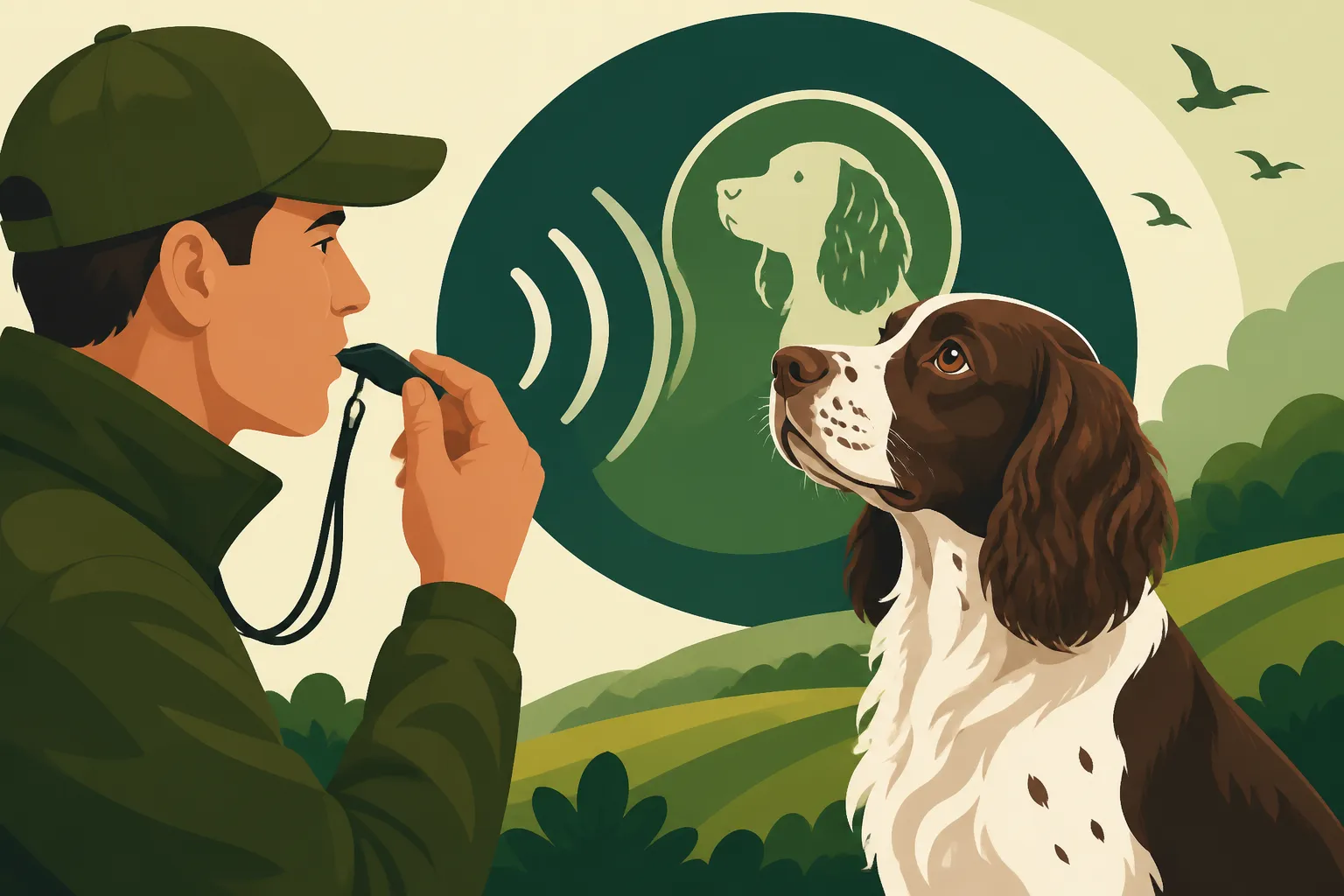
Whistle Work: The Language a Springer Spaniel Learns
There's nothing quite like the boundless energy and keen nose of an English Springer Spaniel. But let's be honest, that same drive and enthusiasm can make them a handful, especially when they're twenty yards out in the field, nose to the ground, and your voice is just a distant murmur to them. Many a Springer owner has felt that familiar frustration of shouting themselves hoarse, only to have their beloved dog continue its focused mission. This guide is here to introduce you to the transformative power of whistle work, a silent, precise language that cuts through distractions and builds an unbreakable bond of communication with your Springer.
Why the Whistle is Your Springer Spaniel's Best Friend
If you've ever tried calling your Springer Spaniel back from an exciting scent trail or an impromptu chase, you know how quickly your voice can lose its impact. The world is full of fascinating smells and movements, and your dog's ears, while excellent, can often be "turned off" to verbal commands when something more enticing grabs their attention. This is where the training whistle steps in, becoming an indispensable tool for clear, consistent communication that truly resonates with your dog's instincts and drive.
The Power of Consistency and Clarity
One of the biggest hurdles in verbal dog training is our own inconsistency. We use different tones, different volumes, and even slightly different words for the same command, depending on our mood or the situation. "Come," "Get over here," "Buddy, let's go!" – to us, these mean the same thing, but to our Springer, they're a jumble of sounds that lack precise meaning. A whistle, on the other hand, produces the exact same sound, every single time. It's an unambiguous signal that eliminates human error and provides your dog with crystal-clear direction. This consistency is the bedrock of effective training, especially for a smart, eager-to-please breed like the Springer Spaniel. They thrive on knowing exactly what you want, and the whistle delivers that certainty. When you're trying to establish fundamental behaviors, that unwavering signal is priceless, laying the groundwork for more complex training later on.
Imagine trying to teach a child a new language, but every time you say a word, your accent, speed, and pronunciation shift dramatically. It would be incredibly confusing! The same applies to our dogs. A single, distinct whistle blast for "sit" or a specific trill for "come" bypasses all that human variability. This isn't about making your dog a robot; it's about providing them with a universally understood cue from you, one that they can rely on, whether you're calm or feeling a little frazzled. This clarity is what allows a Springer to learn How Fast a Springer Spaniel Learns new commands efficiently, building a strong association between the sound and the desired action.
Cutting Through the Noise: Distance and Distractions
Another critical advantage of the whistle is its ability to penetrate environmental noise and travel farther than the human voice. Picture this: your Springer is twenty yards away, nose deep in a hedgerow, completely engrossed in a fascinating scent. A gust of wind blows, cars drive by on a nearby road, and birds are chirping excitedly. Your voice, no matter how loud, is likely to be lost in the cacophony. A high-pitched whistle, however, cuts through these distractions with remarkable efficiency. Its distinct frequency can often be heard clearly over distances and competing sounds where your voice would simply fade away.
This is especially vital for a breed like the English Springer Spaniel, which was bred to work out of sight, often "springing" game from heavy cover. Their natural inclination to put Why a Springer Spaniel Puts Its Nose to the Ground and Vanishes and follow a scent means they can quickly move out of comfortable verbal range. The whistle becomes your lifeline, ensuring that even when your dog is fully engaged in their "job," they can still receive your commands. For a dog that thrives on working, having that reliable communication channel is not just convenient; it's essential for their safety and for maintaining control in challenging environments. It means you can confidently give them more freedom, knowing you have a tool to bring them back. This reliability can be the difference between a successful outing and a stressful search, making a strong argument for why Whether a Springer Spaniel's Recall Can Be Trusted largely depends on clear, audible commands like those from a whistle.
Preserving Your Voice and Your Relationship
Beyond the practical benefits, using a whistle also has a profound impact on your relationship with your Springer Spaniel. When you're constantly yelling, "Buddy, come! COME HERE! I SAID COME!", your voice can quickly become associated with nagging, frustration, or even punishment. This can erode the positive bond you share and make your dog less likely to respond to you, not more. They might even learn to associate your voice with negative emotions, leading to reluctance rather than eager compliance.
A whistle, used consistently and paired with positive reinforcement, avoids this pitfall entirely. It remains a neutral, clear signal that carries no emotional baggage. You're not nagging; you're simply communicating. This helps maintain a positive training environment and protects the joyful, willing partnership you have with your Springer. Think of it as a clean slate for every command. When you blow the whistle, it's a calm, direct instruction, not an exasperated plea. This preservation of your voice and the positive nature of your interactions is especially important for The Soft Springer Spaniel That Shuts Down If You Shout, ensuring they remain confident and engaged in training. It fosters a sense of collaboration rather than confrontation, making training a much more enjoyable experience for both of you.
Choosing the Right Whistle for Your Springer Spaniel
Selecting the perfect whistle might seem like a small detail, but it can make a big difference in your training journey. Just like finding the right leash or collar, the whistle you choose needs to be comfortable for you to use and effective for your dog to hear and respond to. There's a surprising variety out there, and understanding the nuances will help you make an informed decision for your unique Springer.
Pea Whistles vs. Pea-less Whistles
When you start looking at dog training whistles, you'll quickly notice two main types: pea whistles and pea-less whistles.
Pea whistles are what most people think of as a traditional whistle, often associated with sports coaches or referees. They contain a small cork or plastic "pea" that rattles inside the chamber, creating a trilling, rolling sound when air passes through it. The sound tends to be louder and more varied in tone due to the pea's movement.
- Pros: Often very loud, making them easily heard over long distances or in noisy environments. The trilling sound can be quite attention-grabbing.
- Cons: The pea can get wet, freeze in cold weather, or even get stuck with dirt, affecting the sound or making it unreliable. The sound can also be quite sharp, which some dogs (and people!) find harsh. The variability of the sound, while attention-grabbing, can also be less consistent than a pea-less whistle.
Pea-less whistles, on the other hand, have no internal moving parts. They produce a consistent, clear, sharp tone because the sound is generated purely by the shape of the chamber and the airflow. These are very popular with gundog trainers, particularly for breeds like the Springer Spaniel.
- Pros: Extremely reliable in all weather conditions; no moving parts to get stuck or freeze. The sound is highly consistent, which is crucial for precise command delivery. Many gundog whistles, like those from Acme or SportDOG, are pea-less and specifically designed for dog training.
- Cons: Some people find them slightly less loud than pea whistles, though this often depends on the specific model and how hard you blow. The tone can be very piercing, so you'll need to learn to modulate your breath.
For consistent, reliable gundog work, most trainers lean towards pea-less whistles because of their robust nature and unwavering sound quality. A good place to start looking for these is on a platform like Amazon, where you can read reviews and compare different brands and models.
The Importance of a Consistent Sound
Regardless of whether you choose a pea whistle or a pea-less one, the most critical factor is that the whistle you select consistently produces the same sound when you use it. This might seem obvious, but if your whistle sometimes produces a loud blast and other times a weak squeak, or if the tone varies based on how you hold it, it will create confusion for your Springer Spaniel. Dogs rely on very precise auditory cues, and any variation can make it harder for them to learn and distinguish between commands.
Think of it like this: if you're teaching your Springer a short, sharp blast means "sit" and two quick toots mean "come," you need those whistle sequences to sound identical every single time you deliver them. This means choosing a high-quality whistle that is well-made and durable. It also means practicing your own whistle technique to ensure you're blowing it with consistent force and air pressure. A good training partner or even recording yourself can help you assess your consistency. Investing in a reliable whistle from a reputable brand designed for dog training is money well spent, as it forms the very foundation of this unique communication system.
Finding Your Springer's Frequency
While most dog whistles operate within a range that dogs can hear, there's a subtle art to finding a whistle that truly resonates with your particular Springer. Some dogs seem to respond better to higher frequencies, others to slightly lower ones. This isn't usually about "silent" whistles (which are often too quiet for practical distance training), but rather about the specific pitch and timbre of the audible whistle you choose.
Manufacturers like Acme produce a wide range of gundog whistles with different frequencies (e.g., the Acme 210.5, 211.5, or 212). These numbers denote the pitch, and while all are audible to dogs, some trainers swear that certain frequencies carry better in particular environments or are preferred by individual dogs. Experimenting, if possible, can be beneficial. You might find a particular whistle that your Springer seems to "tune into" more readily.
Start with a common gundog whistle frequency, perhaps an Acme 210.5 or 211.5, as these are widely used and recommended. As you begin training, observe your dog's initial reactions. Do they prick their ears? Do they look to you immediately? If you're consistently struggling with their attention even at close range, you might consider trying a whistle with a slightly different pitch. Remember, the goal is not just for them to hear it, but for them to instantly recognize it as a command from you. The distinct, consistent sound of a quality pea-less whistle will serve you far better than a cheap, inconsistent one, helping you teach your Springer Teaching a Springer Spaniel Whistle Commands effectively from the start.
Laying the Foundation: Introducing the Whistle
Introducing the whistle isn't about simply blowing it and expecting your Springer to understand. It's about creating a positive association with the sound, making it a cue for good things, and gradually attaching specific meanings to different whistle blasts. This early stage is crucial for building a strong, reliable response that will last a lifetime.
Making the Whistle a Positive Experience
The absolute first step in whistle training is to make the sound itself a predictor of something wonderful. You want your Springer Spaniel to hear the whistle and immediately think, "Oh joy! Good things are coming!" This is done through a process called classical conditioning, much like Pavlov's dogs.
Start in a quiet environment with no distractions. Blow a single, short blast on your chosen whistle, and immediately follow it with a high-value treat your dog absolutely adores. Don't add any verbal cues; just the whistle and the treat. Repeat this about 10-15 times in a session, then take a break. Do a few short sessions like this over a day or two. The goal is for your dog to turn their head, perk their ears, or even look at you expectantly the moment they hear the whistle. They should see the whistle not as a demand, but as a promise. It’s an upbeat, positive signal. This positive association is paramount, especially for The First Year With a Springer Spaniel Puppy, as you're shaping their entire view of training. You want to instill enthusiasm, not apprehension.
You can vary the rewards, too. Sometimes it’s a delicious treat, other times a quick game with a favorite toy, or even just effusive praise and a good ear scratch. The key is that every whistle sound, in these initial stages, is followed by something your dog highly values. Never use the whistle to scold or interrupt unwanted behavior at this stage; it must remain a purely positive signal. If you find your Springer looking confused or apprehensive, you're likely moving too fast or not using a high enough value reward. Go back to basics and rebuild that positive link. Remember, What a Springer Spaniel Will Work For often involves delicious food and enthusiastic praise.
The "Come" Command: Your Most Important Whistle Cue
Once your Springer has a strong positive association with the whistle, it's time to introduce your first, and arguably most important, command: the recall, or "come" command. For gundogs, a reliable recall is non-negotiable, a matter of safety and control. The whistle recall tends to be much more dependable than a verbal one, especially when your dog is engrossed in an exciting scent.
For the recall, a common whistle cue is a series of short, sharp pips – usually 3-5 quick blasts in succession (e.g., pip-pip-pip-pip-pip). Choose a sequence that is distinct from any other whistle cues you plan to use. Again, start in a quiet, low-distraction environment. Blow your chosen recall sequence, and immediately run backward, encouraging your dog to follow you with enthusiasm. As they reach you, praise them lavishly and reward them with that high-value treat. Make it a party every time they come.
Gradually increase the distance and introduce very mild distractions. Practice in your yard, then a quiet park on a long line. If your Springer hesitates or doesn't come, don't repeat the whistle command endlessly. Instead, go back to a less distracting environment, or a shorter distance, and rebuild their confidence. Never punish your dog for a slow recall; that will only teach them to associate coming back with something unpleasant. The goal is to make coming to the whistle the most rewarding thing they can do, making Whether a Springer Spaniel's Recall Can Be Trusted a resounding "yes!" It’s crucial to make it a game, filled with joy and rewards, so your Springer is always eager to race back to you.
The "Sit" or "Stop" Whistle: A Cornerstone of Control
The second foundational whistle command is often the "sit" or "stop" whistle. This is vital for controlling your Springer's enthusiastic drive, especially in the field where you might need them to stop immediately before flushing game, or at home where you want them to settle. A common cue for this is a single, long, sustained blast on the whistle.
Begin again in a calm, distraction-free setting. Ask your Springer to sit using your verbal command and hand signal as you normally would. As they are in the act of sitting, blow your long, sustained whistle blast. Immediately reward them for sitting. Repeat this many times. The idea is to pair the whistle with the action of sitting, and then holding that sit for a moment.
Once they start associating the long blast with sitting, you can try blowing the whistle first, then giving your verbal cue if needed. Eventually, your goal is for the whistle alone to prompt an immediate sit. This "stop" whistle is incredibly powerful. Imagine your Springer is quartering ahead, covering ground enthusiastically, and you see something up ahead you don't want them to flush. A single, clear whistle blast can freeze them in their tracks, giving you control and time to assess the situation. This command is an absolute game-changer for managing a high-drive Springer, allowing you to effectively Teaching a Springer Spaniel to Stay in Range by halting their forward momentum and bringing their focus back to you. It gives you an incredible amount of control, allowing you to manage their natural instinct to What Quartering Means in a Springer Spaniel across large areas.
Mastering Core Whistle Commands for the Field and Home
Once your Springer Spaniel understands the "come" and "sit/stop" whistles, you've got the basics down. But a Springer, especially one bred for work, thrives on more nuanced communication. Mastering additional whistle commands can transform your dog's capabilities, whether they're working in the field or simply navigating a busy park. These commands leverage their natural instincts and intelligence, allowing for a deeper partnership.
The "Turn" or "Change Direction" Whistle
A crucial command for a working Springer, especially in uneven terrain or thick cover, is the "turn" or "change direction" whistle. This allows you to guide your dog's quartering pattern, ensuring they systematically cover an area without missing game or running off-line. For this, a commonly used cue is two short, sharp pips (pip-pip). This is often paired with a hand signal, where you swing your arm in the direction you want them to go.
Start by practicing this in an open, low-distraction area. Have your Springer moving forward a short distance, then blow two pips and simultaneously swing your arm to the left or right. As they turn their body and start moving in the new direction, reward them. The key is to be consistent with both the whistle and the hand signal. Initially, they'll be following your hand signal, but they will quickly learn to associate that visual cue with the distinct sound of the two pips.
As they improve, gradually increase the distance and add slight distractions. You'll soon find that you can direct your Springer to sweep left, then right, covering ground methodically, just like a well-oiled machine. This command is invaluable for ensuring they efficiently search an area, maximizing their natural abilities without allowing them to range too wide or become fixated on one patch of cover. It's a key part of turning their innate desire to hunt into a structured and productive search pattern.
The "Seek" or "Hunt On" Whistle
The "seek" or "hunt on" whistle is essentially your signal for your Springer to continue working, to extend their search, or to dive into heavier cover. This command encourages their natural hunting drive and tells them that it's okay, even desirable, for them to go out and use their nose. A good cue for this is often a series of enthusiastic, continuous pips or a trill that conveys encouragement (e.g., pip-pip-pip-pip-pip quickly, or a rolling trill if your whistle allows).
Introduce this command when your Springer is already in a "working" mindset. Perhaps they've just retrieved an item, or they've paused briefly after covering a patch of ground. Blow the "seek" whistle with an encouraging tone, and gesture forward. As they move forward and begin to hunt, praise them. You want this whistle to be highly motivating, almost like saying, "Yes! Go get 'em! Find that scent!"
This command is particularly useful when you need your Springer to enter thick brambles, push through dense reeds, or extend their search beyond their immediate vicinity. It's a green light for their hunting instincts, and when paired with their natural quartering ability, it makes them a truly effective hunting partner. This whistle is all about channeling their immense energy and drive into productive work, reinforcing that their natural behaviors, when directed by you, are exactly what you want.
The "Down" or "Lie Down" Whistle for Steadiness
While the "sit" whistle is great for an immediate stop, the "down" or "lie down" whistle is a more advanced command that demands a higher level of steadiness and control, especially crucial for a gundog. This means your Springer not only stops but lies completely down, remaining still and quiet. This is invaluable when you need them to be unseen, or when you need them to hold steady while game is flushed or shots are fired. For this, a longer, deeper, and perhaps slightly lower-pitched single blast (if your whistle has that range) or simply a very firm, sustained single blast is often used.
Teaching this follows a similar pattern to the "sit" whistle. Start with your Springer in a sit or standing position. Give your verbal "down" command and hand signal (patting the ground). As they go into the down position, immediately blow your chosen "down" whistle cue. Reward them for staying down. Practice holding the "down" for increasing periods, gradually adding minor distractions.
The ultimate goal for a working Springer is to be "steady to flush" and "steady to shot," meaning they remain down and still even when birds burst from cover or guns are fired. The "down" whistle is a vital part of achieving this steadiness. It teaches them patience and control amidst high excitement, preventing them from chasing game prematurely. It's a critical safety command, both in the field and in everyday life, ensuring that your Springer can be reliably controlled in any situation. A strong "down" command, whether verbal or whistle-based, is central to managing a working dog's instincts and ensuring they don't break prematurely. Many training programs, like those offered by BAXTER & Bella, emphasize the importance of a solid "down" as a cornerstone for advanced obedience.
Troubleshooting Common Whistle Work Challenges
Even with the best intentions and the right whistle, training a Springer Spaniel with whistle commands isn't always smooth sailing. These intelligent, high-energy dogs can present their own unique set of challenges. Understanding and preparing for these common hurdles will help you navigate them with patience and confidence, ensuring your whistle work remains effective.
When Your Springer Pretends Not to Hear You
Ah, the selective hearing phase! It's a familiar frustration for many Springer owners. You blow the recall whistle, clear as a bell, and your dog, twenty yards away, nose glued to the ground, seems utterly deaf. You might even blow it again, louder this time, only to be met with a casual glance before they return to their fascinating sniff. This isn't usually malice; it's often a combination of intense focus on a distraction (like a potent scent trail), insufficient proofing of the command, or perhaps a breakdown in the perceived value of the reward.
The first thing to do is assess the environment. Were you practicing in a low-distraction area and then suddenly tried it at a busy dog park? If so, you've moved too quickly. You need to "proof" the command, which means practicing it successfully in gradually increasing levels of distraction. Start with very mild distractions, like a few leaves blowing, then a person walking calmly in the distance, then another dog at a considerable distance. Each time your Springer responds, celebrate it like they just won the lottery with enthusiastic praise and high-value treats.
Another common reason for selective hearing is that the "payoff" for responding isn't as good as the "payoff" for ignoring you (i.e., chasing that rabbit!). You need to ensure your rewards are truly irresistible. Are you using dry kibble when they're distracted by a squirrel? Upgrade to boiled chicken, cheese, or hot dogs. Make coming back to you the most exciting thing that can happen. Also, consider if you've been overusing the whistle or becoming predictable. If your Springer knows a recall whistle always means the fun stops and they get leashed, they might hesitate. Vary your routine: sometimes they come, get a treat, and then are immediately released to play again. This keeps them guessing and motivated. If your Springer often ranges far enough that you lose sight, a GPS collar, easily found on Amazon, can offer peace of mind during this proofing process, allowing you to gradually build trust in their whistle recall.
Overcoming Whistle Addiction and Over-Excitement
Some Springers, especially those with high drive, can become overly "addicted" to the whistle, turning every blast into a frenzy of anticipation. They might start "anticipating" commands, sitting before you've blown the sit whistle, or frantically rushing around in expectation of a "seek" command. While enthusiasm is great, anticipating commands or becoming overly excited can lead to sloppy execution and a lack of precise control. This is often a sign that you're relying too heavily on the whistle alone or not building enough calm, thoughtful responses into your training.
To counter this, focus on building duration and calmness into your commands. For a "sit" or "down" whistle, don't reward the instant they hit the position. Make them hold it for a few seconds first, then gradually extend the duration before rewarding. This teaches them that the command isn't just about the initial action, but about holding that position until released. Introduce a clear release cue (e.g., "Okay!" or "Free!") so they know when the command is over.
Also, vary your training. Don't make every training session a high-octane frenzy. Incorporate moments of calm connection and focus exercises where they need to pay attention to your subtle cues before the whistle comes out. Practice impulse control exercises where they have to wait for a command before getting a toy or food. You want an enthusiastic response, but one that is controlled and thoughtful, not frantic. Whether a Springer Spaniel Needs a Job is a common question, and structured whistle work helps channel that energy positively without creating over-excitement. It gives them mental stimulation and clear tasks, which is what they truly crave.
Proofing Commands in Real-World Scenarios
The biggest leap in any training is taking a command that works perfectly in your living room and making it reliable in a chaotic real-world scenario. For a Springer Spaniel, this means your whistle commands must hold up in the bustling park, alongside other dogs, with intriguing smells, and the general hubbub of life. This process is called proofing, and it's essential for creating a truly bombproof whistle response.
Proofing is all about gradual exposure and consistent success. Don't jump from your quiet backyard straight to a high-traffic dog park. Instead, break it down:
- Introduce very mild distractions first: A family member walking by, a child playing quietly, or a distant sound.
- Gradually increase the intensity of distractions: Move to a quiet corner of a park, then closer to other people or dogs, always ensuring your Springer is set up for success. If they fail, reduce the distraction level.
- Vary the location: Practice in different parks, fields, trails, and even urban environments (if relevant to your lifestyle). Each new location presents novel smells and sights, requiring your dog to generalize the command.
- Practice at different times of day: A morning walk might be calmer than an evening one.
- Use a long line: For commands like recall or stop, a long training line (20-30 feet) is your best friend. It allows you to practice at a distance while still having a safety net to gently guide your dog if they don't respond. This gives you control without having to shout or get frustrated, which can be detrimental to The Soft Springer Spaniel That Shuts Down If You Shout. It reinforces their understanding without harsh correction.
Remember to keep training sessions short, positive, and always end on a high note. Consistency is key, not just in your whistle cues but in your expectations and rewards. A well-proofed Springer will respond to your whistle commands reliably, no matter what the world throws at them, making them a joy to live with and a safer companion.
Advanced Whistle Techniques for the Working Springer
For those who want to fully unleash their Springer Spaniel's potential, especially in gundog work or advanced obedience, whistle training goes beyond the basic "come" and "sit." Advanced techniques allow for precise control and direction over greater distances, transforming your Springer into a true partner in the field.
Working in Braces and Advanced Directionals
Many gundog events, particularly field trials, involve "working in braces," where two dogs work simultaneously under their respective handlers. This demands an incredibly high level of precision in whistle control, as you need to direct your dog without interfering with the other. Even if you're not competing, the ability to give clear directional commands from a distance is invaluable for efficiently covering ground and finding game.
Advanced directional work typically builds on your "turn" whistle (two pips). You might introduce specific directional whistles for "left" and "right," often combined with distinct hand signals. For instance, a quick pip-pip might be a general "turn," while two pips followed by a hold might mean "go left," and two pips with a pause then another might mean "go right." The key is developing unique and easily distinguishable whistle patterns for each direction.
Practice these advanced directionals by setting up simple training exercises. Place a few retrieving dummies out in a line, or scatter them in a field. From a distance, use your whistle and hand signals to direct your Springer to each dummy. This helps them understand that the whistle isn't just about turning, but about choosing a specific path. Over time, your Springer will learn to interpret these signals with remarkable accuracy, making them incredibly effective at quartering and searching out of sight. This precision allows you to effectively guide your Springer as they How Far a Springer Spaniel Will Go on a Scent, ensuring they cover the correct ground rather than just following their nose indiscriminately.
The "Fetch" or "Retrieve" Whistle
While many Springers are natural retrievers, formalizing the "fetch" or "retrieve" command with a whistle adds another layer of precision, especially for blind retrieves or when you need your dog to pick up a specific item. This is distinct from a verbal "fetch" in that it can be given from a distance, guiding your dog to an unseen fallen bird or dummy. A common cue for the retrieve whistle is a single, short, sharp pip, often followed by a directional cast.
Introduce this when your Springer is already proficient at retrieving on verbal command. As you send them for a retrieve, blow your chosen retrieve whistle as they are heading out or just before they pick up the item. Reward them heavily upon a successful retrieve back to hand. Gradually, you'll be able to send them on a "blind retrieve" – where they haven't seen the dummy fall. You'll use a combination of your "sit" whistle, directional whistles, and the "retrieve" whistle to guide them to the general area, then signal them to find and pick up the item.
This whistle is a testament to the sophisticated communication possible with a Springer Spaniel. It teaches them to trust your direction implicitly, even when their eyes or nose haven't yet located the object. For a hunting dog, this is crucial for efficiently collecting fallen game, reducing lost birds, and speeding up the hunt. It enhances their natural inclination to What a Springer Spaniel Retrieves by making it a more directed and precise action.
Combining Whistle and Hand Signals
The most sophisticated whistle work involves seamlessly combining whistle cues with hand signals. Hand signals provide a visual cue that reinforces the auditory command, and they can also be used independently when silence is paramount (e.g., when trying not to spook game) or when the dog is closer and can clearly see you. This redundancy strengthens the overall communication system.
You'll naturally start pairing hand signals with your whistle commands from the beginning – a hand raised for "sit," an arm swing for "turn." The next step is to practice each command using only the hand signal, then only the whistle, and then both together. This ensures your Springer understands that both cues mean the same thing.
For example, when teaching directionals, your two-pip "turn" whistle will always be accompanied by an arm swing. Over time, your Springer will learn that the arm swing alone means "turn" even without the whistle, and vice-versa. This dual-layer communication is incredibly powerful. It allows you to adapt your commands to the environment and situation, providing maximum clarity and control. Imagine guiding your Springer through dense cover with silent hand signals, then using a whistle to recall them over a long distance when they break into an open field. This combination makes for an incredibly responsive and versatile working dog, truly communicating in a sophisticated language.
Integrating Whistle Work into Daily Life and Maintenance
Whistle work isn't just for the serious competitor or hunter; it's a fantastic way to enhance your daily life with your English Springer Spaniel. The principles of consistency and positive reinforcement that build a reliable field dog also create a well-mannered and responsive family companion. Keeping those skills sharp requires regular, thoughtful practice.
Short, Frequent Practice Sessions
One of the biggest mistakes owners make is thinking that training needs to be a long, formal event. For a Springer Spaniel, whose attention can sometimes wander during extended sessions, short, frequent bursts of practice are far more effective. Aim for 5-10 minute sessions, several times a day, rather than one long 30-minute session. These can be integrated seamlessly into your existing routine.
For example, before you toss their breakfast bowl, practice a "sit" whistle and make them hold it for a few seconds. On your walk, instead of constantly verbalizing "come," use your recall whistle a few times, rewarding them when they check in. Before you open the door to the yard, practice a "down" whistle. These micro-sessions keep the commands fresh in their mind, prevent boredom, and make the whistle a natural part of your daily interaction, not just a "training tool" that only comes out on weekends. Remember, consistency is key; even small amounts of daily practice reinforce those crucial commands, helping you manage How Far a Springer Spaniel Will Go on a Scent and ensuring their responsiveness.
Maintaining Consistency Across All Handlers
If your Springer Spaniel lives in a multi-person household, it is absolutely crucial that everyone who interacts with the dog understands and uses the whistle commands consistently. This includes family members, dog walkers, or anyone else who might need to give your dog instructions. If one person uses the whistle correctly and another uses a different sound or doesn't follow through with rewards, it will quickly confuse your Springer and dilute the effectiveness of the training.
Schedule a quick "whistle workshop" for everyone in the household. Ensure everyone knows the specific whistle cue for each command (e.g., three pips for come, one long blast for sit/stop). Practice together, making sure everyone blows the whistle with similar force and timing. Emphasize the importance of rewarding the dog immediately and generously when they respond correctly. If a family member struggles with blowing the whistle consistently, consider providing them with their own whistle to practice with, or even having them observe your successful interactions first. Consistent language from everyone means your Springer will understand and respond reliably to any handler, strengthening the training even further.
The Whistle as a Lifelong Communication Tool
The whistle isn't just for puppyhood or initial training; it should remain a lifelong communication tool with your Springer Spaniel. As they age, their hearing might start to fade, or they might become more set in their ways. However, a deeply ingrained whistle command, especially for recall and stop, will often remain reliable long into their senior years, thanks to years of positive reinforcement.
Continue to integrate whistle commands into your adventures together. Use the recall whistle during hikes, the stop whistle when crossing a road, or the turn whistle to guide them on a new trail. This ongoing use keeps the commands sharp and ensures your Springer continues to view the whistle as a vital, positive communication from you. It reinforces their understanding that even at a distance, you are guiding them, protecting them, and communicating with them in a clear, consistent language. This reinforces the foundation you've built, making the whistle an indispensable part of your shared life and adventures, a constant reassurance that you can always communicate effectively, no matter the situation.
| Whistle Cue Examples | Command | Primary Use Case |
|---|---|---|
| Pip-pip-pip (3-5 quick pips) | Recall / Come | Getting your dog back to you, especially at a distance or with distractions. |
| One long, sustained blast | Sit / Stop | Halting your dog's movement, asking them to sit or hold a position. |
| Pip-pip (2 quick pips) | Turn / Change Direction | Directing your dog to move left or right, guiding their search pattern. |
| Series of enthusiastic pips / trill | Seek / Hunt On | Encouraging your dog to continue searching or push into cover. |
| One long, deep sustained blast | Down / Lie Down | Asking your dog to lie down and remain steady, particularly in the field. |
Disclaimer
This article is for general informational purposes only and does not constitute professional advice. Laws, prices and regulations vary by location and change over time. Consult a qualified professional for guidance on your specific situation.