Whether the Springer Spaniel Was Bred to Flush or Retrieve
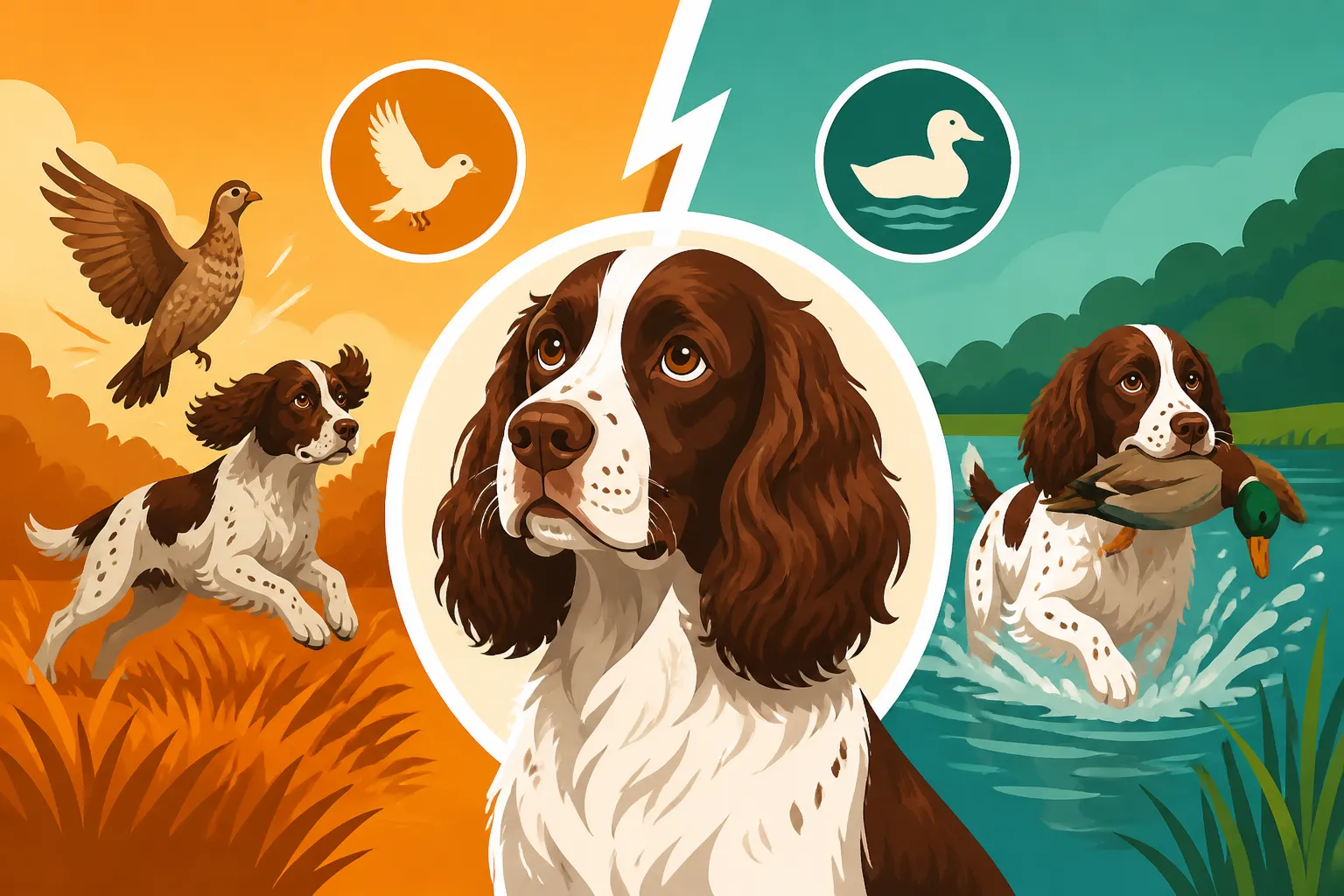
An English Springer Spaniel can flush a bird into flight and retrieve game after the shot, which makes it easy to wonder which job came first. The answer is that flushing is the breed’s defining traditional role, while retrieving became an important part of working alongside a gun. Here’s how the two jobs fit together, and what they mean for today’s dogs.
The Springer Spaniel’s Original Job Was to Flush Game
What flushing means in the field
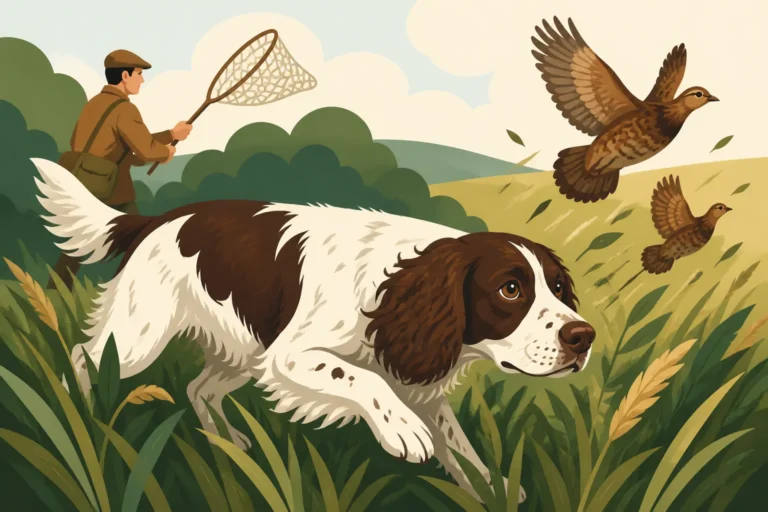
A flushing dog searches cover and pushes hidden game out into the open. In a traditional shoot, that might mean working through bracken, hedgerows or long grass to find birds that are sitting tight. The dog’s job is to make them take flight where a hunter can see and shoot safely. The name “springer” reflects this springing or flushing action: the dog causes game to rise rather than pointing and holding it in place.
That work depends on more than an enthusiastic dash through the undergrowth. A useful spaniel needs to search the ground, respond to its handler and work at a practical distance. If it races too far ahead, the bird may flush out of range. If it searches too narrowly or hesitates in thick cover, it may fail to find game that is close by. The handler and dog work as a team, with the dog’s nose locating birds and its movement encouraging them to fly.
This is the central distinction between a flushing spaniel and a pointing dog. A pointer typically indicates where game is before it is flushed; a Springer Spaniel traditionally works in to make the game move. If you’re curious about the action behind the breed’s name, Springing Game: What the Springer Spaniel Name Describes offers more background.
Why springing game suited the spaniel
Spaniels were valued for their willingness to work close in cover, where game might be difficult for a person to find on foot. Their size and agility helped them push through dense vegetation, and their keen noses helped them locate birds that were hidden from view. A spaniel could search patches of cover methodically while its handler followed and watched for a flush.
The exact work changed with hunting methods. Before firearms became central to the hunt, dogs helped drive game toward people using nets or toward falcons. Later, when guns became the main tool, flushing game into the air became especially useful. That change did not turn the dog into a gun dog with only one skill; it made its ability to find and spring game part of a different hunting partnership. For more on those earlier methods, see Whether Springer Spaniels Worked With Nets and Hawks.
Flushing also explains why the breed’s work is so interactive. The dog is not simply sent away to find game independently. Its handler needs to read the dog’s search, guide it across likely cover and be ready when a bird rises. A dog that works with energy but remains responsive can be more useful than one that covers ground quickly without regard for the handler’s position.
The difference between flushing and retrieving
Flushing and retrieving happen at different points in a hunt. Flushing is about finding and moving game; retrieving is about locating and carrying game after it has been shot. A dog may be excellent at one task and still need practice to become reliable at the other. The skills overlap in a working day, but they are not interchangeable.
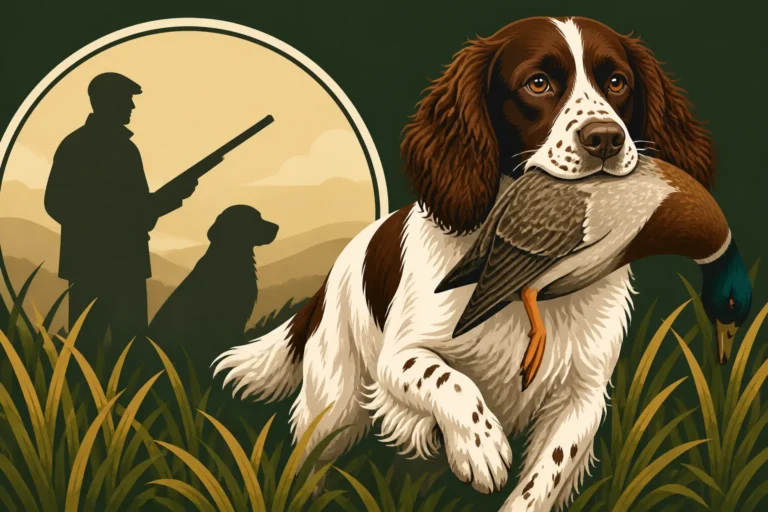
The Springer Spaniel is best known as a flushing spaniel, not as a specialist retriever bred primarily to collect game at a distance. Still, many Springers have a natural interest in carrying objects and a strong desire to work with people. With appropriate training, they can retrieve game on land or from water. What a particular dog enjoys and does well depends on its breeding, early experiences, temperament and training.
That distinction can help set realistic expectations. If you bring home a Springer Spaniel, you may see eager searching, carrying and chasing before you have taught a tidy retrieve. Those instincts are a starting point, not a guarantee that the dog will automatically return every object to hand. The practical range of objects and game a Springer might retrieve is discussed in What a Springer Spaniel Retrieves.
How Flushing and Retrieving Work Together
A working sequence from search to retrieve
In a typical shoot, the dog searches cover ahead of its handler. When it finds a bird, it moves in close enough to make the bird flush. The handler watches for the rise and takes the shot if appropriate. If game is brought down, the dog may then be sent to find and bring it back. The same dog can therefore play two connected roles during one outing.
The sequence sounds simple, but each part asks for different behavior. While hunting, a dog needs to use its nose, move through cover and remain responsive. After the flush, it may need to stop or steady itself rather than chase immediately. After the shot, it needs to shift from searching and flushing to locating a specific fallen bird and carrying it gently back. Training gives the dog cues for those transitions.
Imagine a dog working a hedgerow with its handler. It pushes a pheasant into flight, then pauses as the handler takes the shot. If the bird falls in nearby cover, the handler can direct the dog to search for that particular fall. A dog that bolts after every moving bird may be keen, but it has not yet learned the control that makes the whole sequence safe and useful.
Why the dog needs to stay within range
A flushing dog needs to work close enough that its handler can keep track of it and respond when game rises. “Close” does not mean walking at heel for the entire hunt. It means searching in a pattern that allows the dog to cover ground while staying connected to the person directing it. The right range varies with the landscape, visibility, the dog’s training and the conditions.
A dog that pushes too far ahead can flush birds before the handler is in a safe position, or disappear into cover where neither person can see what is happening. On the other hand, a dog that is constantly held close may not search effectively. Good handling balances freedom and communication, using voice, whistle, direction and the dog’s own awareness of the handler.
This balance is relevant even for dogs that never hunt. A Springer that races through a park, follows every scent or vanishes into woodland is showing some of the same enthusiasm that can make the breed a capable working dog. Recall and range training help channel that drive. For practical training considerations, see Teaching a Springer Spaniel to Stay in Range and Whether a Springer Spaniel’s Recall Can Be Trusted.
Why retrieving is a useful second skill
Retrieving lets the dog help recover game that has been shot rather than leaving it behind. It also reflects the cooperative nature of working with a handler: the dog goes out, finds an object and returns it. On a hunt, a retrieve may involve cover, uneven ground, water or a bird that is difficult to see from the handler’s position.
A retrieve is not just a game of fetch. The dog may need to wait until sent, search in a defined area, pick up an object carefully and bring it back without dropping it along the way. If a dog is allowed to chase every bird or retrieve every tossed toy without learning to wait and return, it may become more excited but not more dependable. Building the behavior in small, controlled steps gives the dog a clearer job.
The soft-mouth quality often associated with gundogs is another part of the picture. A dog carrying a bird should do so without chewing or damaging it. That behavior can be encouraged, but it should not be assumed simply because a dog belongs to a retrieving-capable breed. See Whether a Springer Spaniel Has a Soft Mouth for more on what a careful carry involves.
How the Work Changed With Hunting Methods
Before the gun became central
The history of spaniels includes work that predates the familiar image of a dog flushing birds for a gun. Dogs could help locate and drive game toward nets or assist in hunting with falcons. In those settings, springing game still mattered, but the human method of catching or pursuing the bird was different. The dog’s ability to search cover and make hidden game move was useful across more than one style of hunt.
It is worth being careful with modern labels when thinking about this history. Today, people may use “flushing dog” and “retriever” to describe distinct types of work or breed specialties. Earlier hunting practices did not always divide dogs’ jobs in exactly the same way. A dog might help locate and flush game, while people or other animals completed the capture.
As firearms became more widely used in hunting, the spaniel’s ability to bring birds into flight became a practical part of the shooting day. Retrieval also mattered, but the defining task remained searching for and flushing game. The historical transition is explored further in What a Springer Spaniel Did for a Gun Before Retrievers.
How the gun shaped the modern role
With a gun involved, the dog’s work had to fit around a hunter’s position and the moment a bird took flight. The dog could not simply chase every moving bird. It needed to work in a way that gave the handler the chance to see and shoot safely, then respond to the next instruction. In practical terms, this made control and steadiness valuable alongside hunting enthusiasm.
Retrieving became a natural partner to flushing because a bird that had been shot needed to be found. Some dogs were expected to locate fallen game, while people or other dogs might share the work in a larger shoot. The Springer’s ability to search and carry made it useful for both parts, but that does not mean every Springer was bred or trained to perform them equally.
There’s a helpful comparison here: a spaniel’s work is often centered on finding and flushing game, while a retriever’s traditional specialty is collecting game, including at greater distances or after a fall. Both may retrieve, but breed role and individual training shape the emphasis. The way a Springer covers ground compared with a retriever is covered in How a Springer Spaniel Works Cover Against a Labrador.
Why the breed’s role is not a rigid rule
“Bred to flush” describes the traditional purpose of the breed; it does not mean every individual dog will have the same strengths. Some Springers are keen hunters with strong working drive. Others are bred primarily for showing or companionship and may have less experience or less interest in formal gundog work. Even within a litter, puppies can differ in confidence, energy and natural inclination.
Nor does a dog need to hunt live game to enjoy work that draws on its instincts. Scent games, retrieving a dummy and training exercises can give a pet Springer satisfying ways to use its nose and cooperate with its owner. But a game of fetch in the garden does not automatically reproduce the complexity of searching cover, responding to a whistle and steadying after a flush.
The practical takeaway is not to assume that a Springer must hunt, or that every Springer will retrieve reliably without help. Instead, consider the individual dog, the type of work you want to do and the training you can provide. A breed’s history explains what it was developed to do; it does not dictate a single lifestyle for every dog.
What Springer Spaniels Do Today
Field-bred dogs and working expectations
Field-bred Springer Spaniels are often selected for working ability and may show strong drive to search, flush and retrieve. That can be a delight for someone who hunts or enjoys structured gundog training. It can also be demanding in a household that expects a dog to exercise only briefly and settle without much mental engagement. A working dog’s instincts do not switch off simply because it is living as a pet.
Training gives those instincts direction. A field-bred dog can learn to hunt within a handler’s range, respond to whistle cues and wait for permission to retrieve. Without consistent practice, it may instead rehearse its own version of the job: chasing birds, ranging ahead or locking onto scent. The breed’s inherited abilities are valuable, but they are not a substitute for teaching household manners and reliable responses.
For owners who are not hunting, structured activities can still help. Scent work, carefully managed retrieving games and field-style training exercises can provide mental challenge. Keep sessions age-appropriate and controlled, and avoid encouraging a young dog to leap repeatedly or exercise to exhaustion. A field-bred Springer may enjoy an activity because it resembles work, but excitement is not the same thing as safe conditioning.
Show-bred and companion dogs
Show-bred Springers may have a different overall appearance and breeding emphasis from field-bred dogs, but they remain English Springer Spaniels. A show-bred dog can still show an interest in scent, birds and retrieving. Whether it has the drive, training or physical conditioning for regular gundog work depends on the individual and its background, not simply on its type.
Some families are surprised when a show-bred Springer begins quartering the garden, carrying shoes or investigating every patch of long grass. These behaviors can reflect natural tendencies, even when the dog is not expected to hunt. Providing appropriate outlets and teaching calm behavior helps turn those instincts into manageable routines. If you’re comparing the two types, How the Field and Show Springer Spaniel Diverged explains why their roles and appearance can differ.
A companion Springer still benefits from learning basic field-style control: coming when called, waiting briefly and returning an object. Those lessons can make everyday life safer around birds, squirrels and open spaces. They can also help the dog understand that there are times for energetic play and times to settle beside the family.
A quick comparison of the two jobs
| Activity | Main purpose | Typical dog behavior | What training adds |
|---|---|---|---|
| Flushing | Find game and make it take flight | Searches cover and works ahead of the handler | Keeps the search controlled and within a useful range |
| Retrieving | Find and bring back game or an object | Locates, picks up and carries something | Builds waiting, a careful pickup and a reliable return |
| Steadiness | Prevent uncontrolled chasing | Pauses or remains with the handler when game moves | Helps the dog wait for a cue instead of rushing off |
| Scent work | Use the nose to locate a target | Follows scent and investigates | Teaches the dog to search methodically and finish with a clear response |
How to Encourage Flushing and Retrieving Safely
Build control before adding excitement
Start with everyday foundations before asking a dog to work around birds or in difficult cover. Practice recall in low-distraction places, teach a reliable wait and reward the dog for checking in with you. A long line can give a young or inexperienced dog room to explore while helping prevent an uncontrolled chase. Make the environment easier before making the exercise more tempting.
Keep training sessions short enough that the dog can succeed. If a puppy is tired, overstimulated or repeatedly ignoring cues, adding more excitement is unlikely to improve the lesson. Try a quieter location, reduce the distraction or return to a simpler behavior. The goal is not to suppress the dog’s energy; it is to show it how to direct that energy in ways you can manage together.
Use reward-based methods and clear cues. Some Springers are sensitive to harsh handling, and shouting can confuse or discourage a dog that is already trying to work out what is expected. Consistency matters more than volume. If you are planning formal gundog work, an experienced trainer can help you set up appropriate exercises and avoid teaching habits that are difficult to undo.
Introduce retrieving in small steps
For a basic retrieve, begin with an object the dog can comfortably carry. Encourage interest, allow the dog to pick it up and reward a return toward you. At first, that may mean working at a short distance in a quiet room or fenced area. Avoid repeatedly throwing the object farther if the dog is still running off with it or dropping it before reaching you.
As the dog understands the game, you can gradually add distance, a brief wait before sending and different settings. A training dummy is often more appropriate than using objects that could splinter, be swallowed or encourage rough chewing. If you’re choosing supplies, Chewy is one option people use to browse basic dog equipment such as dummies and long lines; match the item to your dog’s size and use, and check it for damage.
Retrieving from water requires extra care. Not every dog is a confident swimmer, and even dogs that enjoy water can tire or encounter cold, currents, steep banks or submerged hazards. Start in safe, shallow conditions and supervise closely. A dog should not be pushed into water to prove its ability. For more on the differences between land and water work, see Whether a Springer Spaniel Retrieves From Water.
Keep practice practical for a pet home
You do not need a shooting day to give a Springer Spaniel useful work. Hide a toy in a safe part of the home and let the dog search for it. Ask for a brief wait before tossing a dummy across a clear patch of ground. Practice a recall during a quiet walk, then reward the dog for returning rather than turning every outing into an intense game of chase.
Plan for the dog’s safety as carefully as its enjoyment. Check cover for hazards, watch for signs of fatigue and avoid throwing objects near roads, livestock or other dogs. A dog that becomes frantic around birds may need more distance and a calmer training setup, not more exposure at close range. Chewy may be a convenient place to find everyday items such as treat pouches or training leads, but the best equipment is the gear that fits securely and helps you manage the dog safely.
If your Springer is enthusiastic but struggles to settle, include calm activities alongside active ones. A short scent game, a chew after a walk or a few minutes practicing a settle cue can help create a rhythm of work and rest. The breed’s history is about doing a job with people; in modern life, the most useful job may simply be a safe, engaging routine that suits the dog and the household.
Disclaimer
This article is for general informational purposes only and does not constitute professional advice. Laws, prices and regulations vary by location and change over time. Consult a qualified professional for guidance on your specific situation.