Teaching a Springer Spaniel to Stay in Range
It's incredibly frustrating when you're out enjoying what should be a peaceful walk with your English Springer Spaniel, only for their nose to hit the ground and suddenly, they're gone – a speck in the distance or completely out of sight. This guide is all about equipping you with the understanding and practical steps to teach your beloved Springer to stay reliably within a comfortable range, ensuring their safety and your peace of mind, whether you're navigating urban parks or wide-open country.
Understanding Your Springer Spaniel's Instinct to Range
Let's be real, Springers aren't known for dawdling right by your side, are they? Their very nature, the essence of what makes them such fantastic dogs, is also what drives them to push boundaries. It’s not about being naughty; it's hardwired.
The Deep-Rooted Drive of a Flushing Spaniel
Your Springer Spaniel was bred, for centuries, to be a partner to a hunter, specifically designed to "spring" game from cover. Imagine dense hedgerows, thick brambles, or tall grasses – a Springer's job was to work diligently back and forth, sniffing out birds and rabbits, and then to flush them into the air for the waiting gun. This job requires an incredible amount of drive, stamina, and, yes, a tendency to cover ground. They are enthusiastic, tireless, and have an exceptional nose, making them absolute powerhouses in the field.
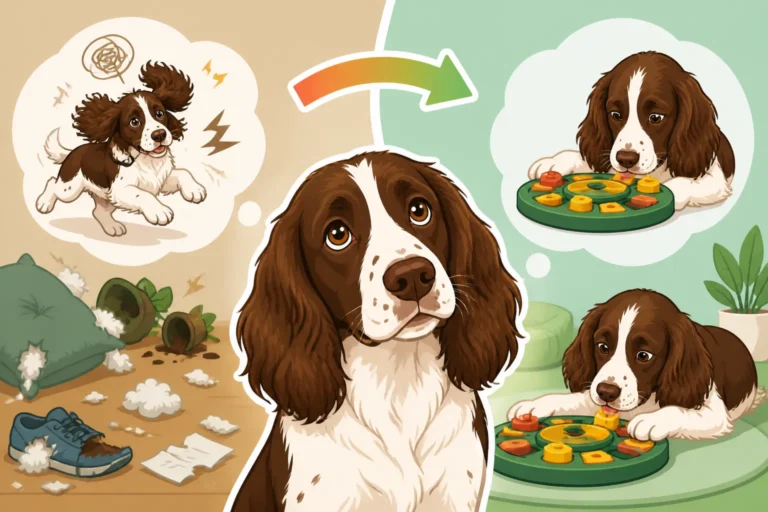
This ingrained instinct means that when your pet Springer hits a park or a trail, their brain immediately switches to "hunt mode." Every intriguing scent, every rustle in the bushes, calls to that ancient hunting spirit. It's why they seem to forget you exist when they get a whiff of something truly exciting. They're not being disobedient; they're simply following generations of genetic programming. Understanding this fundamental aspect of their character is the first step toward successful training. You can't fight their nature, but you can channel it effectively.
The Difference Between Field and Show Lines
It’s worth noting that not all Springer Spaniels are created equal when it comes to this hunting drive. The breed has, over many decades, diverged into two distinct types: the field-bred Springer and the show-bred Springer. While both are undeniably Springer Spaniels, their physical appearance and, crucially, their intrinsic drive, can be quite different. Field-bred Springers are typically leaner, with less coat, and are bred almost exclusively for their working ability. Their genetics are fine-tuned for covering ground with incredible speed and tenacity, often ranging much wider and faster. They live to hunt, and their drive to search can feel relentless.
On the other hand, show-bred Springers, while still possessing that wonderful spaniel exuberance and a good nose, generally have a somewhat softer, often wider-ranging instinct compared to their field cousins. They are bred to conform to a specific breed standard for appearance, and while many are still capable hunters, their primary purpose isn't always the field. This means a show-bred Springer might be easier to keep in range, as their impulse to "vanish" might not be quite as strong or as quick. However, don't let the "show" label fool you – even a beautifully feathered show Springer can still decide a squirrel track is far more interesting than your recall, so expect some degree of ranging from either type. If you're curious about how these two types came to be so distinct, you might find How Far Apart the Two Springer Spaniel Types Have Drifted an interesting read.
Why a Springer's Nose Overrides Its Ears
Ah, the classic Springer "selective deafness"! You call their name, you whistle, you might even shout, and they seem utterly oblivious, powering ahead with their nose glued to the ground. This isn't usually an act of defiance; it's a testament to the incredible power of their olfactory system. A Springer Spaniel's nose is an absolute marvel, packed with millions more scent receptors than ours. When they hit a strong scent – be it a rabbit, a pheasant, or even just another dog's trail – that scent takes over their entire world. It's an immersive experience for them.
Think of it like us trying to concentrate on a conversation while standing next to a blaring fire alarm. The scent acts as that alarm, demanding their full attention. The rest of the world, including your voice, becomes background noise, difficult to process. They're not intentionally ignoring you; their brain is simply prioritizing the overwhelming sensory input from their nose. This is why standard voice commands can often fall on deaf ears when a high-value scent is present. We'll talk about how to work with, rather than against, this powerful instinct. For a deeper dive into this phenomenon, check out Why a Springer Spaniel Puts Its Nose to the Ground and Vanishes.
Essential Foundations for Range Training
Before we even think about letting our Springers off-leash with the expectation of them staying close, we need to lay down some rock-solid foundations. These aren't just "nice-to-haves"; they are absolutely critical for success and safety.
Building a Rock-Solid Recall
Let's face it: if your Springer Spaniel doesn't have a reliable recall, then teaching them to stay in range is like building a house without a foundation. It just won't work. The ability to call your dog back to you, no matter the distraction, is the single most important command for any off-leash activity. For a Springer, with their incredible drive to explore, this is doubly true. A reliable recall isn't just about getting them to come back; it's about making coming back to you the most rewarding and exciting thing in their world.
Start small, in a low-distraction environment like your backyard. Use high-value treats (think cooked chicken, cheese, or even a favorite squeaky toy) and make a huge fuss when they come. Don't just give them a treat and send them away; make it a party! Gradually introduce more distractions and different environments, but always ensure success. If you call and they don't come, don't repeat the command; go get them. Every time they ignore you, the command weakens. Consistency and making it fun are key. If you're struggling with your Springer's reliability, you'll want to read Whether a Springer Spaniel's Recall Can Be Trusted for more tips.
The Importance of Whistle Work
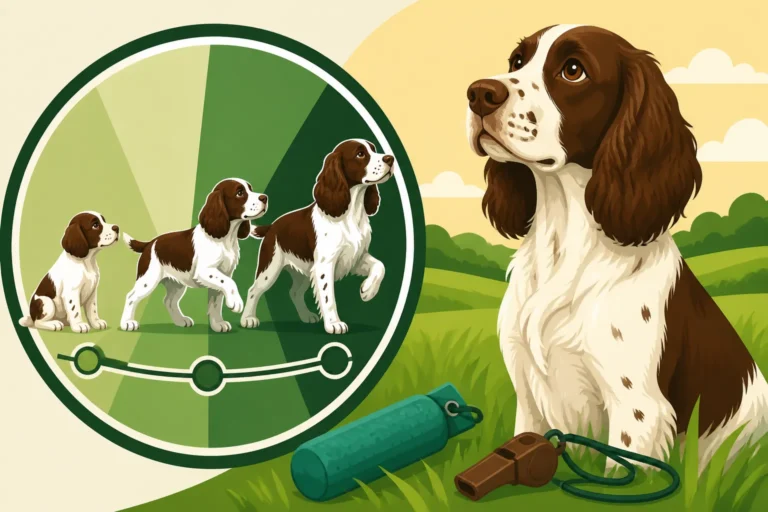
While your voice is perfectly fine for training in close quarters, it simply doesn't have the range, consistency, or emotional neutrality of a whistle. A whistle cut through wind, over long distances, and past background noise in a way your voice often cannot. More importantly, your voice carries emotion – frustration, impatience, exasperation – which your sensitive Springer will pick up on. A whistle, however, is always the same tone, always conveys the same message. This consistency builds trust and understanding.
For range work, a whistle is invaluable. You can use different pips or sequences to denote different commands: a single long blast for "come," a series of short pips for "turn," or a steady "pip-pip-pip" for general encouragement and direction. Introduce the whistle just like you would any other command: pair it with a known action and a reward. For instance, blow your "come" whistle, say "come," and when they arrive, lavish them with praise and treats. Soon, the whistle alone will trigger the response. Start in the house, then the yard, and gradually move to more distracting environments. The clear, unwavering sound of a whistle truly becomes the language a Springer learns when out and about. We have a great piece on this topic: Whistle Work: The Language a Springer Spaniel Learns.
Leash Manners and Boundary Setting
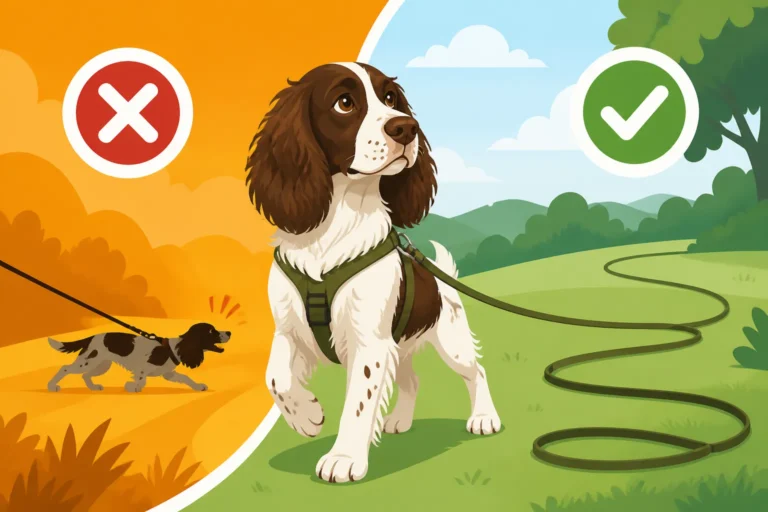
It might seem counterintuitive to talk about leash manners when discussing off-leash ranging, but hear me out. How your Springer behaves on a leash is often a direct indicator of how they'll behave off-leash. If your dog is dragging you down the street, straining against the leash, and constantly pulling towards every new scent, they're already practicing the behavior of ranging far and ignoring you. Good leash manners, like walking nicely at your side without pulling, teach them that staying close to you is the default, controlled state.
Start by teaching a loose-leash walk, using positive reinforcement to reward them for staying by your side. You can use a specific word like "heel" or "with me." This isn't just about control; it's about building a partnership where they understand that your pace and direction are important. Similarly, establish boundaries in your home or yard. If they're not allowed to bolt out an open door, they're learning impulse control. These small, consistent lessons in controlled proximity will build the foundation for extending that control to larger, off-leash environments. Think of it as teaching them the rules of the road before you hand them the keys to a sports car!
Practical Steps for Teaching "In-Range" Behavior
Now that we have the foundational commands in place, we can start actively shaping our Springer's ranging behavior. This involves a gradual process, using tools and techniques that allow them increasing freedom while maintaining your control.
Starting with a Long Line
One of the most effective tools for teaching a Springer to stay in range, without losing them completely, is a long line. We're talking 15, 20, even 30 feet of lightweight rope or webbing, not a retractable leash. The long line gives your Springer the illusion of freedom while giving you a crucial physical connection and a safety net. It allows them to explore scents and cover a bit of ground, which satisfies their natural instincts, but you still have the ability to gently guide them back or prevent them from bolting too far.
Here’s how you can use it: Take your Springer to a safe, open area with minimal distractions. Let them investigate, but keep the long line dragging on the ground. As they start to venture too far, or just before they get to the end of the line, give your "here" command (or recall whistle) and gently step on the line, or take it in your hand and reel them in with steady pressure. The instant they turn back towards you, release the pressure, praise them enthusiastically, and reward them with a high-value treat. Then, let them go explore again. The goal is for them to associate turning back to you with positive outcomes, not with being yanked or punished. Over time, they'll learn that staying within a certain distance means more freedom and more rewards. You can find excellent quality long lines on platforms like Amazon, perfectly suited for this type of training. For more on this, check out Whether a Long Line Suits a Springer Spaniel.
The "Patterning" Method – Quartering Basics
Springers, particularly field-bred ones, have a natural tendency to "quarter" the ground in front of them. This means they run in a zig-zag pattern, covering the ground from side to side, always moving forward but checking back with you for direction. This is exactly what you want them to do to stay in range! It satisfies their instinct to hunt and cover ground, but in a controlled, predictable manner.
You can teach your Springer to quarter by using your own body language. As you walk forward, take a few steps to the left, then change direction and take a few steps to the right. Your dog, if they are paying attention and have a desire to work with you (which most Springers do!), will often naturally follow this pattern. When they do, reward them. You can also use a series of short, sharp whistle pips to encourage a turn or change of direction. If they cast too wide to one side, blow the whistle and turn your own body sharply in the opposite direction. This often encourages them to swing back into your desired range. The key is to be consistent with your movements and rewards, so they understand that staying in front of you and working the ground means good things happen. This natural ability to quarter is a huge asset; for more information on how they instinctively do this, read Why a Springer Spaniel Quarters Your Yard Without Being Asked.
Reinforcing Proximity and Checking In
One of the most crucial aspects of encouraging your Springer to stay in range is to consistently and enthusiastically reward them for checking in with you. Springers are generally quite handler-focused, even when their nose is busy. They often glance back, pause, or even come a few steps closer just to see where you are or what you're doing. These are golden opportunities for reinforcement!
Every single time your Springer voluntarily looks at you, comes a little closer, or even just slows down to match your pace, mark that behavior with praise ("Good check-in!", "Yes!") and immediately reward them with a treat. This teaches them that choosing to be aware of your location and presence is highly rewarding. You're not asking them to stop what they're doing entirely; you're just rewarding the act of checking in. This builds an internal sense of your personal boundary, rather than just an external command. Over time, these brief check-ins will become more frequent and will help maintain their focus on you as they work the ground. They learn that being mindful of your location doesn't mean the fun stops; it means they get rewarded and then can continue exploring.
Addressing Common Challenges and Advanced Techniques
Even with a solid foundation, Springers, being Springers, will test the boundaries. It's their nature. Here are some strategies for when things get a bit more challenging, and some advanced tools to consider.
Dealing with "Deafness" to Scent
We've all been there: your Springer's nose hits a hot trail, their tail starts a furious wag, and they seem to enter a scent-induced trance, completely oblivious to your existence. This "deafness" to scent is perhaps the biggest challenge in range training for a Springer. The trick is to intervene before they become fully committed to the scent. You need to be proactive, not reactive. Watch your dog's body language – the sudden intense sniff, the low head, the tail moving faster. These are your early warning signs.
At this point, use your loudest, most distinct whistle command (your recall or turn whistle) paired with a sharp change in your direction. Don't chase them; move away from them. Make yourself interesting and move in a direction that pulls them away from the scent line. When they break their focus, even for a second, and look your way, immediately reward them. Consistency is paramount here. If a particular area is known for intense scents (like a rabbit warren), keep your dog on a long line or avoid it until their range training is stronger. Remember that a powerful scent can draw a Springer quite far from you, as explained in How Far a Springer Spaniel Will Go on a Scent.
Introducing a Stop Whistle
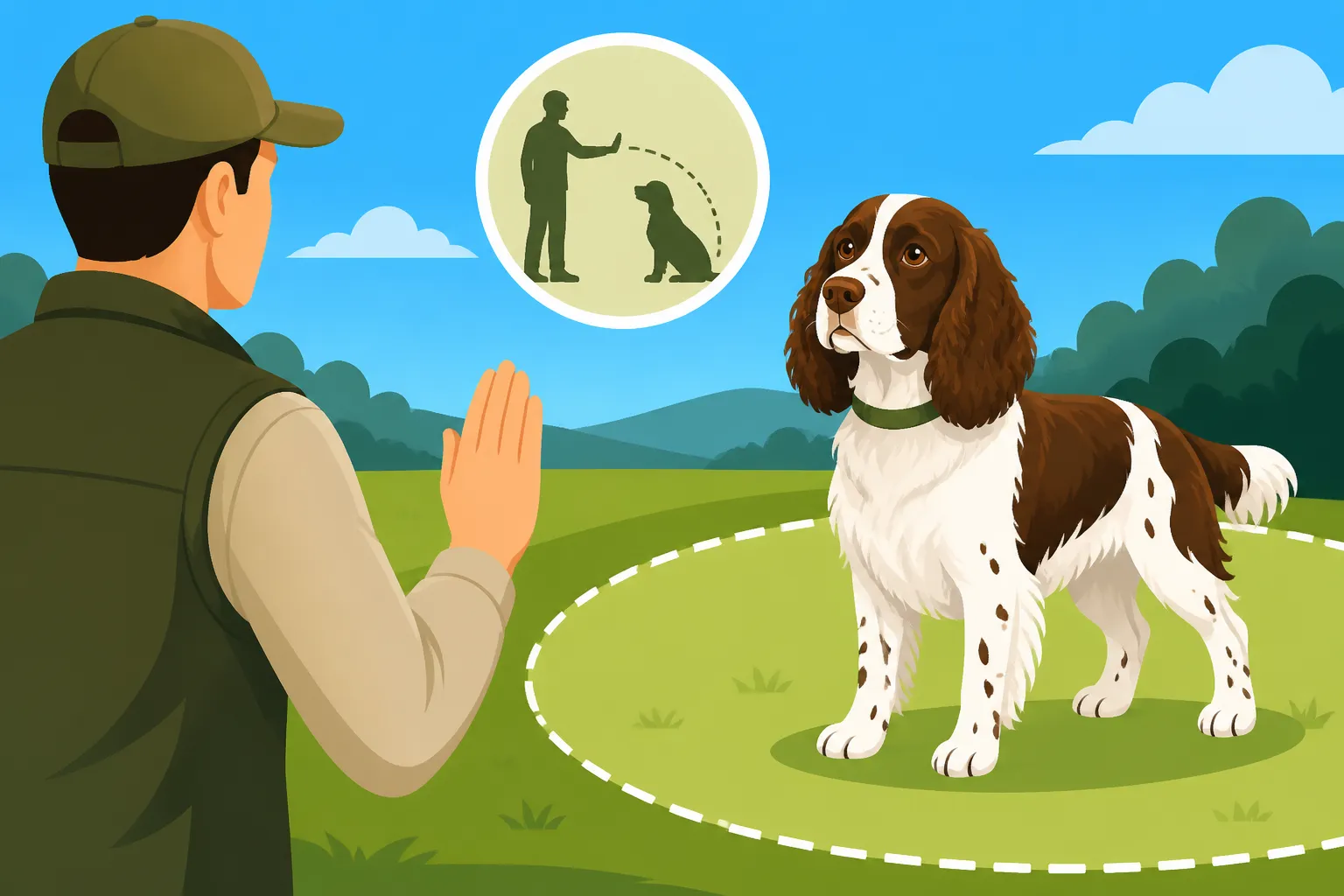
Beyond the recall whistle, a "stop" or "sit" whistle is an invaluable tool for range control, especially for a dog that loves to power ahead. This command means, "Freeze right where you are and sit." It's your emergency brake, giving you a chance to catch up, redirect, or prevent them from running into danger or disappearing entirely.
To teach the stop whistle, start in a low-distraction environment. With your dog walking a few steps in front of you (perhaps on a long line initially), blow your chosen stop whistle signal (a single, sharp pip is common), and simultaneously give your "sit" verbal command. As soon as their rear touches the ground, run to them and reward them heavily. Practice this frequently, gradually increasing the distance between you and the dog, and then slowly introducing mild distractions. The goal is for that whistle pip to immediately trigger a sit, no matter how far away they are. This requires a lot of repetition and highly motivating rewards. Imagine your Springer powering through a field, eyes on the horizon, when you blow that whistle and they drop instantly – that's the power you're aiming for.
When Electronic Collars E-Collars Might Be Considered
Let's talk about electronic collars, or e-collars, because they often come up in discussions about range control, especially with high-drive dogs like Springer Spaniels. It’s important to approach this topic with a balanced and responsible perspective. An e-collar is not a magic bullet, nor is it a substitute for foundational training. It's an advanced communication tool, and in the wrong hands, it can be misused. For many pet owners, a long line and consistent positive reinforcement will be more than sufficient.
However, for working Springers, or those pet Springers with incredibly strong ranging instincts that consistently put themselves in danger despite extensive positive training, an e-collar, used correctly, can provide a level of long-distance communication that nothing else can. The key is professional guidance. Never, ever attempt to use an e-collar without working alongside an experienced trainer who specializes in e-collar conditioning. They will teach you how to use low-level, consistent stimulation as a cue, similar to a tap on the shoulder, rather than a punishment. The goal is to pair the e-collar's gentle sensation with known commands, reinforcing the desired behavior from a distance. It's about clear communication, not fear. If this is a path you're considering, remember that establishing a strong positive training foundation, like those offered through programs such as BAXTER & Bella, should always come first. They teach essential obedience skills and build a positive relationship, which is vital before considering advanced tools. For a broader discussion on the pros and cons of these tools, consider reading Whether an Electronic Collar Belongs on a Springer Spaniel.
Consistency and Patience: The Keys to Success
Training a Springer Spaniel to stay reliably in range is not a quick fix; it's an ongoing journey that demands unwavering commitment from you. Their instincts are powerful, and overcoming them requires consistent effort and a boatload of patience.
Making Every Walk a Training Opportunity
One of the biggest mistakes owners make is compartmentalizing training. They think of "training time" as a distinct 20-minute session in the backyard. But for a Springer, every single walk, every time you step out the door, is a training opportunity. This means you need to be "on" constantly, observing your dog's behavior, anticipating their moves, and being ready to reinforce good choices.
Did they glance back at you while sniffing a bush? Reward! Did they turn slightly in your direction when you changed pace? Reward! Did they come within 10 feet of you without being asked? Reward! These small, continuous reinforcements throughout your walk teach them that staying connected to you is a constant source of positive outcomes. Don't wait for them to ignore you and then correct; actively seek out and reward the moments where they are making good decisions. This proactive approach builds good habits and strengthens their understanding of what "in range" means to you. This also means that everyone who walks the dog needs to be on the same page with commands and expectations.
The Long-Term Commitment
Let's be realistic: you're working with a breed specifically designed to explore and hunt, and that's a powerful genetic legacy. Training your Springer to stay in range is a long-term commitment. There will be days when they are brilliant, staying close, checking in, and responding to every whistle. And then there will be days when a particularly enticing scent or a sudden flush of birds turns them into a furry rocket, temporarily forgetting every lesson. Don't get discouraged!
Celebrate the small victories. Acknowledge that setbacks happen and use them as learning opportunities. Did they bolt? What was the trigger? How could you have prevented it? This isn't a race to a finish line where once trained, they stay trained forever. It's a continuous reinforcement process, like going to the gym to maintain fitness. Even once your Springer is reliably staying in range, occasional practice, varied environments, and continued rewards will be essential to keep those good habits strong. Your relationship with your Springer is built on these consistent interactions, and the payoff is a safe, enjoyable partnership for many years to come. Thinking about the long haul? The commitment is similar to what's outlined in The Full Cost of Thirteen Years With a Springer Spaniel, emphasizing the continuous investment of time and effort.
Seeking Professional Guidance
Sometimes, despite your best efforts, you might feel like you're hitting a wall. Your Springer's drive might be overwhelming, or you might be struggling with a particular behavior. This is absolutely nothing to be ashamed of. In fact, it's a sign of a responsible owner to know when to seek professional help. Experienced gundog trainers, or even certified professional dog behaviorists, have a wealth of knowledge and strategies tailored specifically to high-drive breeds like Springer Spaniels.
A good trainer can observe your dog's individual quirks, identify the specific triggers that cause them to range, and help you fine-tune your techniques. They can offer new perspectives, different whistle commands, or introduce advanced tools (like an e-collar, if appropriate and used ethically) with expert guidance. They can also help you understand how your own body language or timing might be inadvertently contributing to the problem. Don't hesitate to reach out to a local professional or an online training program like BAXTER & Bella, which provides structured guidance. Investing in professional help can be the difference between a frustrated owner and a joyful partnership. For more insights on finding the right trainer, check out Whether a Springer Spaniel Needs a Gundog Trainer.
Here's a comparison of some common tools and techniques for teaching your Springer to stay in range:
| Tool/Technique | Description | Pros | Cons |
|---|---|---|---|
| Recall Whistle | A specific whistle signal to call the dog back to you. | Consistent sound, cuts through noise, no emotional tone, works at distance. | Requires consistent training and high-value rewards to establish reliability. |
| Long Line | A long (15-30 ft) leash that drags on the ground. | Allows freedom with safety, physical control, prevents bolting, great for initial conditioning. | Can get tangled, requires open space, dog might chew through it if not supervised. |
| Quartering | Encouraging a zig-zag pattern of searching in front of the handler. | Channels natural instinct, keeps dog engaged and close, satisfies drive in a controlled way. | Requires handler to be active and consistent, initially needs guidance with body language. |
| Stop Whistle | A specific whistle signal that means "stop and sit." | Emergency brake, effective at distance, can prevent dangerous situations. | Requires significant training and reinforcement to be reliable in high-distraction scenarios. |
| E-Collar (low-level) | Advanced tool for remote communication (used as a cue, not punishment). | Provides long-distance communication, can reinforce commands when dog is distracted, enhances safety. | Requires professional training and ethical use, can be misused, not a first-step solution. |
| High-Value Rewards | Treats or toys that are extremely motivating for your dog. | Crucial for positive reinforcement, helps compete with distractions, builds strong associations. | Can add bulk to your pockets, requires finding what truly motivates your dog. |
Disclaimer
This article is for general informational purposes only and does not constitute professional advice. Laws, prices and regulations vary by location and change over time. Consult a qualified professional for guidance on your specific situation.