Whether a Welsh Springer Spaniel Is Always Red and White
A Welsh Springer Spaniel is expected to be red and white, but that does not mean every dog has the same balance of color or the same markings. The amount of red, the shape of the patches and small areas of ticking can vary. This guide explains what the breed’s coloring should look like, how it differs from an English Springer Spaniel, and what unusual markings may mean.
Is a Welsh Springer Spaniel always red and white
The breed’s characteristic coloring
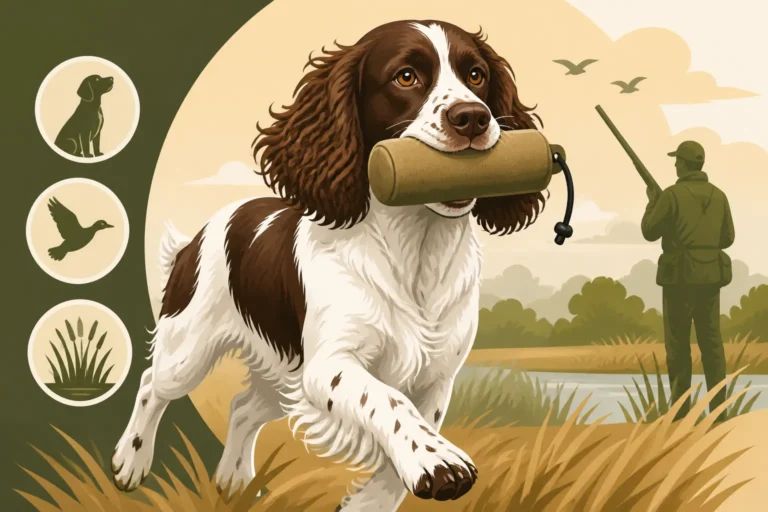
Yes, red and white is the defining coat color of the Welsh Springer Spaniel. A typical dog has a rich red shade on parts of the head and body, with white areas that can be large, small or unevenly distributed. The red may appear as broad patches rather than a uniform blanket over the coat, and the pattern can differ considerably from one dog to another.
“Red and white” describes the colors, not a precise layout. One Welshie may have a mostly red head with a white blaze and a mostly white body marked by red patches. Another may have more red over the back, with white on the chest, legs or face. Those differences in pattern do not, by themselves, make one dog more or less Welsh Springer Spaniel than another.
The red can also look different depending on lighting, coat length and age. A wet coat may appear darker, while sunlight can make red areas seem lighter or warmer. A young dog’s markings can look sharper or more vivid than those of an adult whose feathering has grown out. These ordinary differences can make photos look surprisingly inconsistent, even when the dogs share the breed’s traditional color.
What “always” does and does not mean
The breed standard describes the expected color for a Welsh Springer Spaniel, but real dogs are living individuals, not paint-by-number examples. Red-and-white markings can vary in size, placement and clarity. Small colored flecks within white areas may occur, and the white itself may not be a perfectly clean, solid block everywhere.
That is different from saying that other major color combinations are typical of the breed. Black-and-white or liver-and-white coloring, for example, is associated with English Springer Spaniels rather than the standard Welsh Springer Spaniel coat. If a dog advertised as a Welsh Springer has a very different color pattern, it is reasonable to ask the breeder or rescue for more information about the dog’s background.
Color alone, however, cannot establish a dog’s breed or pedigree. A photograph can be misleading, and coat color does not tell you whether a dog is purebred. If you are choosing a puppy, consider the breeder’s records, the parents’ information and the dog’s overall characteristics—not just whether its coat looks like the breed description.
How the red-and-white pattern can vary
Patch size and placement
Welsh Springer Spaniels can have very different-looking red patches while remaining within the familiar red-and-white appearance. The red may cover much of the ears and face, appear in a saddle-like area across the back, or form separate patches on the body. White may be prominent on the chest, legs, underside or face, but there is no single pattern that every dog must copy.
Facial markings are especially easy to overinterpret. A white blaze may run down the middle of the face, be narrow or broad, or be absent. The ears may be mostly red, while the muzzle and forehead have a mix of red and white. Those details can make two puppies from the same litter look quite distinct.
The distribution of color is worth separating from the color itself. A Welsh Springer Spaniel with a large amount of white is still red and white if red markings are present. Likewise, a dog with extensive red patches is not a different color variety simply because the white areas are less prominent.
Ticking and small flecks
Some coats show small colored flecks in areas that otherwise appear white. This can be called ticking. From a distance, light ticking may be barely noticeable; in a close-up photo, it can make a white area look speckled. It is not the same as a broad, solid patch of another color.
If you see flecks on a puppy, they may become easier to notice as the coat changes and grows. The reverse can happen in photographs: bright light, a wet coat or image compression can make small markings disappear. A single picture is rarely enough to judge the exact pattern.
When comparing a Welsh Springer Spaniel with other spaniels, it helps to look at the breed’s overall appearance as well as its coat. The guide to How a Welsh Springer Spaniel Differs From an English One explains other differences that can help you understand why color is only one part of identification.
Changes as a puppy grows
A puppy’s color pattern is visible early, but its coat does not stay exactly the same in texture or presentation. As the adult coat develops, feathering on the ears, legs, chest and underside can make patches look softer or less sharply edged. Grooming, shedding and seasonal coat changes can also alter how much of the skin and markings you see.
The basic red-and-white pattern does not ordinarily turn into a different major color as a dog matures. What changes is how the coat lies, how long it is and how clearly you can see the borders between markings. For more on those gradual shifts, see How a Springer Spaniel's Markings Change With Age.
A good way to assess a dog is to look at several recent photos in natural light and, if possible, see the coat in person. Ask whether the dog is wet, freshly groomed or photographed under strong indoor lighting. Those details can account for apparent color differences that seem dramatic online.
Welsh Springer Spaniel colors compared with English Springer Spaniel colors
Why the two breeds are often confused
Welsh and English Springer Spaniels share a name, a spaniel heritage and a broadly similar sporting-dog outline. That can lead people to assume their accepted coat colors are interchangeable. They are not. The Welsh Springer Spaniel is characteristically red and white, while English Springer Spaniels are commonly seen in combinations such as black and white or liver and white.
English Springer Spaniels may also have tan markings in some patterns. That can create a three-color appearance that is not the same as the Welsh Springer Spaniel’s traditional red-and-white coat. If you are trying to identify a dog, color can help narrow the possibilities, but it should be considered alongside body shape, head, coat and reliable breed records.
| Feature | Welsh Springer Spaniel | English Springer Spaniel |
|---|---|---|
| Characteristic color | Red and white | Commonly black and white or liver and white |
| Pattern variation | Red and white areas vary in size and placement | Color patches and markings vary by pattern |
| Tan points | Not part of the typical red-and-white description | May occur in some English Springer Spaniel patterns |
| Best way to identify | Consider coat alongside build, records and background | Consider coat alongside build, records and background |
For a closer look at the English breed’s accepted patterns, read Which Colors the Springer Spaniel Standard Allows and The Colors a Springer Spaniel Comes In. These references are useful for comparison, but they describe English Springer Spaniels, not Welsh Springer Spaniels.
Black, liver and tan markings
A black-and-white or liver-and-white dog may be a perfectly recognizable English Springer Spaniel, but those colors do not match the usual Welsh Springer Spaniel description. A dog with tan points also raises a different question: tan markings are associated with English Springer Spaniel color patterns, not the standard red-and-white Welsh appearance. The article Whether a Springer Spaniel Can Have Tan Points discusses that distinction.
This is one reason online listings can be confusing. A seller may use “Springer Spaniel” without specifying Welsh or English, or may describe a mixed-breed dog using the name of one parent breed. Look carefully at the full description and ask for documentation rather than relying on a short listing title.
It is also possible for a dog’s appearance to prompt questions without providing an answer. A mostly white dog, for instance, could still have red markings that are hard to see in a particular image. If the coat genuinely seems outside the expected pattern, ask about pedigree or ancestry rather than making a conclusion from color alone. The related guide Whether a Mostly White Springer Spaniel Is Purebred covers why appearance by itself is not enough to settle that question.
What to do if a Welsh Springer Spaniel has unusual markings
Ask for background before drawing conclusions
If you are considering a puppy and its coat seems unusual, begin with calm, specific questions. Ask the breeder to identify the parents, explain the puppy’s markings and share the relevant registration or pedigree information. A responsible breeder should be able to describe the litter clearly and help you understand how the puppy fits the breed.
If you are adopting an adult dog, the history may be incomplete. A rescue organization may have only the information provided at intake, and a dog’s coat can be difficult to judge when it is dirty, wet or matted. Focus on the details that are known, and treat any breed label as a useful starting point rather than proof of ancestry.
When exact breed identification matters, a veterinarian or a qualified breed professional can help you assess the dog. A DNA test may provide additional ancestry information, but it should not replace careful review of records when pedigree is important. Coat color can contribute clues; it cannot tell the whole story.
Keep coat care practical
Red-and-white coloring does not require a special color-maintenance routine. Regular brushing helps keep the feathering free of tangles, especially behind the ears, under the legs and along the chest. A soft brush or comb suited to the dog’s coat is usually more useful than trying to make white areas look brighter with frequent bathing.
If muddy walks leave the white parts of the coat looking dingy, rinse or wipe the affected areas and dry the dog thoroughly. Use only products made for dogs, and avoid trying human whitening shampoos or home remedies without veterinary guidance. Skin irritation is a much bigger problem than a temporary mud stain.
For everyday supplies such as a suitable brush, comb or dog shampoo, a pet retailer such as Chewy may be one place to browse options; choose products based on coat type and your dog’s needs rather than claims about changing its natural color. If you are unsure whether a product is appropriate, ask your groomer or veterinarian. Chewy can also be a convenient place to look for basic grooming tools, but a dog’s skin sensitivity and coat condition should guide the choice. For grooming questions more broadly, How a Show Springer Spaniel's Coat Differs offers useful context about coat texture and maintenance in the English breed.
When an unusual coat needs attention
A coat that looks different is not usually a medical emergency. But changes in the skin or hair deserve attention if they come with itching, redness, bald patches, sores, a strong odor or persistent flaking. Those signs are about skin health, not whether the dog’s red-and-white pattern is correct.
Similarly, a new dark spot should not automatically be treated as a coat-color issue. If a mark appears suddenly, changes shape or seems to be on the skin rather than in the hair, ask a veterinarian to examine it. Photos taken over time can help you describe when you first noticed it.
The practical answer is straightforward: red and white is the expected Welsh Springer Spaniel color, but individual dogs can show a wide range of red-and-white patterns. If a dog appears to have a distinctly different major color, check its background and records instead of relying on a label or a single photograph.
Disclaimer
This article is for general informational purposes only and does not constitute professional advice. Laws, prices and regulations vary by location and change over time. Consult a qualified professional for guidance on your specific situation.