The Year the AKC Recognized the Springer Spaniel
Many people bring home an English Springer Spaniel puppy, utterly charmed by their boundless energy and sweet disposition, without fully realizing the rich history behind this incredible breed. It's easy to just see the dog in front of you, but understanding their journey, especially how they came to be formally recognized in a place like America, offers a fascinating glimpse into their heritage and what makes them tick today. This guide will walk you through the pivotal moments of the Springer Spaniel's journey to formal recognition by the American Kennel Club, exploring the historical context and the lasting impact this had on the breed we know and love.
The Journey Across the Atlantic: Springer Spaniels Arrive in America
Long before any formal recognition, English Springer Spaniels, or their early ancestors, began making their way to the shores of North America. These weren't typically grand, pedigree imports at first; rather, they were often working dogs accompanying settlers, hunters, and farmers looking for reliable companions in the vast new world. The concept of a "purebred" dog as we understand it today was still developing, and utility was paramount.
Early Introductions and Unofficial Presence
In the colonial days and the early years of the United States, dogs were primarily valued for their working capabilities. A good hunting dog was a necessity, not a luxury. Spaniel-type dogs, known for their ability to "spring" game from cover, were highly prized. They arrived with immigrants from Great Britain, carrying on their traditions of hunting fowl and small game. These early dogs might not have looked exactly like the sleek, well-defined English Springer Spaniels we see today, but their purpose and inherent traits were undeniably similar.
Imagine a settler carving out a life on the frontier, with dense forests and abundant game. A dog that could work tirelessly, flushing birds and retrieving fallen game, was an invaluable asset to put food on the table. These dogs were selected for their drive, their nose, and their willingness to please, traits that are still hallmarks of the breed. They were working partners, indispensable members of the family unit, helping to ensure survival in challenging environments.
Growing Popularity Among American Hunters
As America expanded and hunting transitioned from a pure necessity to a sport for many, the demand for specialized gundogs grew. British gundogs, with their long histories of selective breeding for specific tasks, naturally became highly sought after. The English Springer Spaniel, already a well-established and celebrated gundog in its homeland, began to gain a stronger foothold. Hunters appreciated their versatility, their medium size making them adept at navigating various terrains, from dense undergrowth to open fields.
This period saw more intentional importation of what were considered "true" English Springer Spaniels. Breeders and enthusiasts in America started to recognize the distinct advantages of these dogs over more generic spaniel types. They observed their efficient quartering patterns, their keen scenting abilities, and their natural retrieve. As these dogs proved their worth in the American field, their reputation spread, leading to a desire for more organized breeding and, eventually, formal recognition. It was a natural progression from practical utility to a recognized and esteemed sporting companion.
The Emergence of Formal Recognition: Setting the Stage for the AKC
The late 19th and early 20th centuries were a time of great change for dog breeds, both in Britain and America. As societies became more industrialized and leisure time increased for some, the concept of dog shows and pedigree breeding began to flourish. This shift created a need for standardization and official recognition, moving away from purely functional breeding to a focus on consistent type and documented lineage.
Kennel Clubs and the Need for Breed Standards
Before kennel clubs, dogs were often bred simply for their immediate usefulness or appearance within a local area. There was no overarching agreement on what a "true" breed should look like or how it should perform. This meant significant variation, even among dogs given the same breed name. The formation of kennel clubs, like the Kennel Club in the UK and later the American Kennel Club (AKC), fundamentally changed this. Their purpose was to establish clear, written standards for each breed, defining everything from ideal height and weight to coat color, ear set, and temperament.
These standards served several crucial purposes. Firstly, they provided a blueprint for breeders, guiding them in their efforts to produce dogs that consistently conformed to the breed's ideal. This helped to preserve distinct breeds and prevent their dilution through indiscriminate crossbreeding. Secondly, they offered a framework for competitive events, such as dog shows, where dogs could be judged against a common ideal. This spurred interest in purebred dogs and encouraged responsible breeding practices aimed at improving the overall quality of a breed. For a breed like the English Springer Spaniel, which had a long but informal history, this formalization was a huge step.
The British Influence and Initial Registrations
The English Springer Spaniel's roots are, as its name suggests, firmly in England. The breed, or at least its direct ancestors, had been a recognizable type of gundog for centuries. However, the formal separation of the Springer Spaniel from its smaller cousin, the Cocker Spaniel, only occurred relatively recently. Before 1902, spaniel puppies in the same litter might be classified as either a "cocker" or a "springer" based purely on their adult size, not their genetic background. The larger dogs "sprung" game, while the smaller ones worked "cock" (woodcock). The 1902 Split That Separated Springer From Cocker was a significant moment, leading to distinct breed definitions.
The Kennel Club (KC) in the UK officially recognized the English Springer Spaniel as a distinct breed in 1902. This gave the breed its own standard and registry, cementing its status. This British recognition naturally paved the way for American acceptance. American enthusiasts looked to the British standards as the gold standard, and initial imports to the U.S. were often dogs already registered with the KC. This lineage and documented ancestry were crucial for American breeders who wanted to establish a similar level of quality and authenticity in their own breeding programs. Having a foundation of registered dogs made the process of seeking AKC recognition much smoother.
The Landmark Year: When the AKC Officially Welcomed the Springer Spaniel
The American Kennel Club's recognition is a momentous occasion for any breed. It signifies that a breed has a stable population, a documented history, a consistent type, and a dedicated group of fanciers committed to its preservation and promotion in the United States. For the English Springer Spaniel, this milestone arrived in the early 20th century.
The Significance of 1910 for the English Springer Spaniel
The year 1910 marks the official recognition of the English Springer Spaniel by the American Kennel Club. This was a pivotal moment. It wasn't just about a name being added to a list; it was about the acknowledgment of the breed's distinct characteristics, its long history as a working companion, and its growing presence in American homes and fields. Before this, while Springer Spaniels certainly existed in America and were appreciated by hunters, their status was somewhat informal.
With AKC recognition, the breed gained a formal identity and a place within the organized world of purebred dogs. This allowed for the consistent tracking of pedigrees, the establishment of official competitions like dog shows and field trials, and the promotion of ethical breeding practices. It provided a clear definition of the breed for everyone, from seasoned hunters to potential pet owners picking up supplies from a store like Chewy, ensuring they knew exactly what an English Springer Spaniel was meant to be. This act of recognition validated years of effort by dedicated breeders and enthusiasts who saw the value and potential of these dogs.
What AKC Recognition Meant for Breeders and Owners
For breeders, AKC recognition brought structure and prestige. It meant they could register their dogs, track their lineages, and participate in a nationwide system that upheld breed standards. This was essential for improving the breed through selective breeding, ensuring that desirable traits were passed down and genetic health issues were addressed responsibly. Breeders could now confidently market their puppies as purebred English Springer Spaniels, backed by the integrity of the AKC. This also encouraged a higher standard of breeding, as breeders strove to produce dogs that not only excelled in the field but also conformed to the physical ideal.
For owners, recognition provided a sense of community and access to a wealth of resources. They could participate in AKC events, join local breed clubs, and connect with other Springer Spaniel enthusiasts. Owning an AKC-registered dog also offered a degree of assurance about the dog's background and potential. It wasn't just about showing off a pretty dog; it was about owning a piece of living history, a dog bred to a specific standard for temperament, health, and working ability. This formal structure helped elevate the breed from simply a working utility dog to a beloved and celebrated companion animal in American households.
The Establishment of the English Springer Spaniel Club of America
Hand-in-hand with AKC recognition, the formation of a national breed club is crucial for the breed's long-term success. The English Springer Spaniel Club of America (ESSCA) was founded in 1924, further solidifying the breed's presence and advocacy in the United States. While the AKC provided the overarching framework, the ESSCA became the dedicated custodian of the breed, focusing specifically on its welfare, promotion, and preservation.
The ESSCA plays a vital role in upholding the breed standard, educating the public, and encouraging responsible ownership and breeding. They organize specialty shows, field trials, and obedience competitions, providing platforms for Springer Spaniels to demonstrate their skills and beauty. This club also acts as a hub for information, support, and mentorship for both new and experienced owners. Their efforts have been instrumental in guiding the breed's development in America, ensuring that the working heritage is not lost while also nurturing the qualities that make Springers wonderful family companions. Their collective passion truly champions the breed.
Beyond Recognition: Shaping the American Springer Spaniel
AKC recognition was merely the beginning of the English Springer Spaniel's distinct journey in America. Once officially acknowledged, the breed began to evolve, influenced by American sporting traditions and breeding preferences. This led to a fascinating divergence within the breed itself, creating two distinct types that share a common ancestry but now look and perform quite differently.
How American Field Trials Shaped the Springer Spaniel
American field trials for flushing spaniels developed somewhat differently from those in the UK. The emphasis on specific hunting styles and the types of game pursued in America subtly, but significantly, influenced breeding choices. How American Field Trials Shaped the Springer Spaniel is a topic that truly highlights this divergence. American field trial champions were bred for explosive drive, intense quartering patterns, and a tireless work ethic in cover. The focus was on performance above all else.
This intensive selection for specific working traits meant that field-bred Springer Spaniels in America became increasingly specialized. They often developed a finer bone structure, a shorter, harsher coat, and an even more relentless desire to hunt. These dogs are powerhouses in the field, designed to cover ground quickly and efficiently, locate birds, and retrieve them enthusiastically. While still recognizable as Springers, their form clearly followed their function, demonstrating the profound impact of competitive sport on breed development.
The Divergence of Field and Show Types in the US
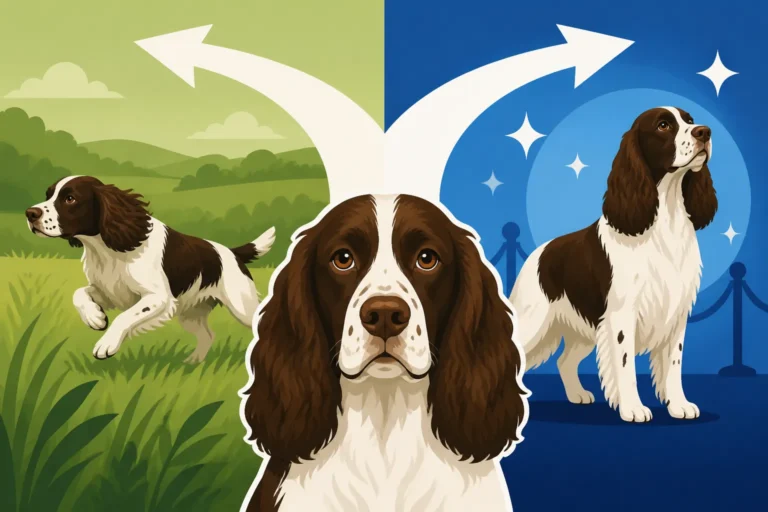
The emphasis on different qualities for show ring success versus field performance ultimately led to a distinct split within the breed. On one side, you have the field-bred Springer Spaniel, often referred to as a "working" or "field trial" Springer, honed for its gundog abilities. On the other, the "show-bred" Springer Spaniel emerged, with an emphasis on conformation to the written breed standard, which often prioritizes specific physical aesthetics, bone structure, and coat. How the Field and Show Springer Spaniel Diverged is a classic example of how a single breed can effectively become two.
These two types, while genetically the same breed, now possess noticeable differences in appearance, temperament, and exercise needs. Show Springers tend to have a heavier bone structure, longer and more profuse feathering, and a generally calmer demeanor, making them excellent family pets and show ring competitors. Field Springers are lighter, leaner, with less coat, and possess an almost insatiable drive to work, making them ideal for avid hunters or those seeking a high-octane canine partner. Understanding this divide is crucial for anyone considering a Springer Spaniel, as the type they choose will dramatically impact their daily life.
| Characteristic | Field-Bred English Springer Spaniel | Show-Bred English Springer Spaniel |
|---|---|---|
| Primary Purpose | Hunting, field trials, gundog work | Conformation shows, family companion |
| Appearance | Lighter build, less feathering, often shorter coat, athletic appearance | Heavier bone, more profuse feathering, longer coat, elegant appearance |
| Energy Level | Very high, requires extensive mental and physical stimulation | High, but generally calmer than field lines, adapts well to family life |
| Coat Care | Less grooming needed, often kept shorter for practicality in the field | Extensive grooming needed, regular brushing and trimming |
| Drive | Intense prey drive, strong hunting instinct, eager to work | Good prey drive, but often more subdued, enjoys training and activities |
| Temperament | Highly focused, sometimes more intense, quick to learn | Often more laid-back, affectionate, can be sensitive |
The Enduring Legacy of AKC Recognition
The American Kennel Club's recognition of the English Springer Spaniel in 1910 was not just a historical footnote; it laid the foundation for the breed's continued success and evolution in the United States. It set a precedent for organized breeding, competitions, and the ongoing commitment to the breed's health and integrity.
Impact on Breeding Practices and Health Testing
With official recognition came the imperative for responsible breeding. AKC registration allowed for meticulous record-keeping of pedigrees, which is invaluable for breeders striving to make informed decisions. Knowing the lineage of a dog helps prevent inbreeding and allows breeders to trace potential genetic health issues. This formal structure directly supports the development and implementation of health testing protocols. For a breed that can be prone to certain hereditary conditions, like some eye diseases, hip dysplasia, or even some more obscure metabolic disorders, health testing is paramount.
Today, reputable breeders diligently screen their breeding stock for conditions like The Four Eye Diseases a Springer Spaniel Breeder Screens For, hip and elbow dysplasia, and genetic diseases such as Fucosidosis and PFK Deficiency. The DNA Test That Should Precede Every Springer Spaniel Purchase is a testament to how far breed clubs and the AKC have pushed for healthier dogs. This commitment to health is a direct result of the structured environment fostered by AKC recognition and the dedicated efforts of breed clubs like the ESSCA. When you choose a puppy from a responsible breeder, you're benefiting from generations of careful planning and health screening. Many owners even purchase specialized supplements from places like Chewy to support their Springer's health journey.
The Springer Spaniel's Place in the Sporting Group
Following its recognition, the English Springer Spaniel was naturally placed within the AKC's Sporting Group. This group is dedicated to dogs developed to assist hunters in the field by finding, flushing, and retrieving game. The Sporting Group is a prestigious category, filled with breeds known for their athleticism, intelligence, and biddability. The Springer Spaniel's inclusion solidified its identity as a premier gundog in America.
Being part of the Sporting Group means the Springer Spaniel regularly participates in events tailored to its abilities, such as hunt tests, field trials, and obedience competitions, alongside conformation shows. This keeps the breed active, challenged, and true to its working heritage. It continually reinforces the qualities that make a Springer Spaniel such a dynamic and beloved companion – whether they are flushing pheasants in a crisp autumn field or curled up on the couch after a long walk. The journey from unofficial working dog to AKC-recognized Sporting Group member is a testament to the enduring appeal and versatile talents of the English Springer Spaniel.
Disclaimer
This article is for general informational purposes only and does not constitute professional advice. Laws, prices and regulations vary by location and change over time. Consult a qualified professional for guidance on your specific situation.