Steadying a Springer Spaniel to Flush
One of the most exhilarating—and sometimes frustrating—moments for any Springer Spaniel owner, particularly those interested in gundog work, is the sudden, explosive flush of game. That burst of energy, the dog launching itself forward, is ingrained deep in their DNA. But while it's thrilling to witness, an uncontrolled dash after flushed birds can be downright dangerous and completely counterproductive in the field. This guide is all about tackling that exact challenge: teaching your high-drive Springer to be "steady to flush," ensuring they hold their position calmly, awaiting your command, even as game explodes skyward.
Understanding the Springer Spaniel's Drive to Flush
Let's be real, your Springer Spaniel isn't trying to be disobedient when a pheasant bursts out from under their nose. Their entire being is hardwired for this moment. It's why we love them, right? That boundless energy, that intense focus when they're on a scent – it's all leading up to that glorious "springing" of game. But this very drive is what makes training for steadiness such a crucial, albeit challenging, endeavor.
The Instinctive "Spring"
The name "Springer Spaniel" isn't just a cute moniker; it describes their historical job. These dogs were bred, for centuries, to spring game from heavy cover so that a hunter, often with a net or a hawk in older times, or later a gun, could harvest it. This isn't just a learned behavior; it's an intrinsic part of their genetic makeup, a powerful instinct that tells them, "Game up! Chase!" When your dog smells that pheasant or sees that rabbit bolt, their primal instincts kick in, overriding almost everything else. Imagine a deep-seated command telling them, "Go, go, go!" It’s a powerful force to reckon with, and simply yelling at them won't reprogram centuries of selective breeding. We need to work with that drive, not against it.
The Energy and Enthusiasm
Beyond pure instinct, Springers are just incredibly enthusiastic dogs. They're always ready for action, always keen to please, and always operating at about a hundred miles an hour when there's a task at hand. This high-octane personality is part of their charm, but it also means their arousal levels can spike incredibly quickly. A sudden flush pushes them past a certain threshold where their brain switches from "thinking and listening" to "pure, unadulterated instinct and drive." Their enthusiasm, when unmanaged, can become a significant hurdle to steadiness. They want to do it right, but their sheer excitement often gets the better of them. It's a testament to their spirit, but it requires us to be patient, consistent, and exceptionally clear in our training.
What "Steady to Flush" Truly Means
So, if your Springer's natural inclination is to launch itself after every bird, what exactly are we asking them to do when we say "steady to flush"? It's more than just a trick; it's a fundamental principle of safe and effective gundog work, and a testament to the strong bond and communication between handler and dog.
The Hunter's Perspective
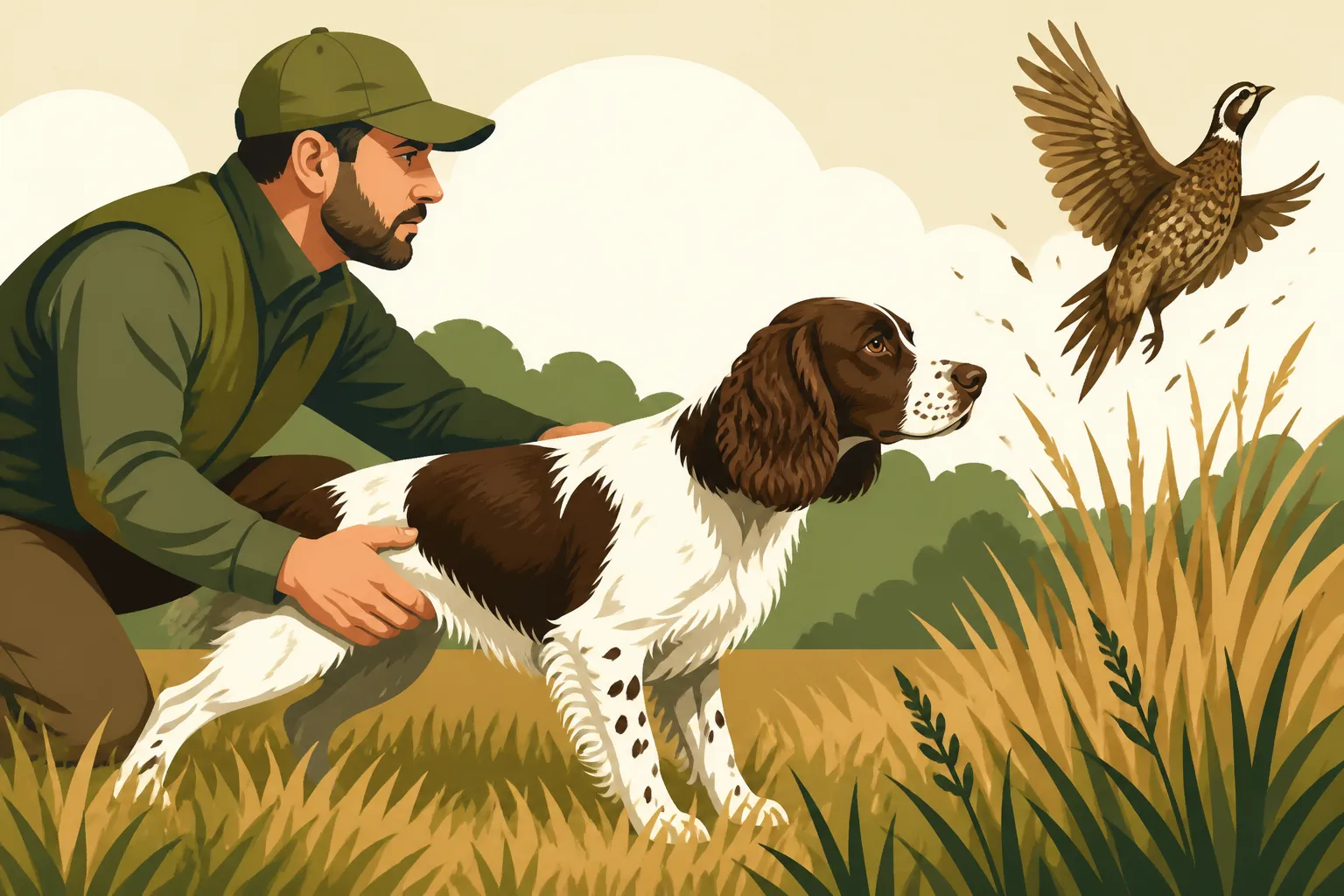
From a hunter's standpoint, "steady to flush" is non-negotiable. It means that when game, be it a pheasant, quail, or rabbit, explodes from cover, your Springer Spaniel remains absolutely still, watching the flight or run of the game, until given a specific command. They do not chase, they do not bark, they do not even inch forward. Their eyes might be locked on the game, their body might quiver with anticipation, but their feet stay planted. This allows the hunter to safely take the shot without worrying about hitting the dog or having the dog interfere with the shot itself. Only after the shot is taken, and often after the bird has fallen, will the dog receive a command to retrieve, such as "fetch" or "retrieve." This control ensures a disciplined and effective hunt, preventing lost game and maintaining safety. Without steadiness, a gundog becomes a liability rather than an asset in the field.
Safety for Dog and Hunter
The importance of steadiness extends far beyond just retrieving efficiency; it's a critical safety measure. Imagine a scenario where a bird flushes low, and your dog instantly breaks cover in pursuit. If a hunter takes a shot, the risk of accidental injury to the dog is extremely high. Furthermore, an un-steady dog can quickly run out of gun range, chasing a bird that ultimately flies away, meaning both the dog is out of control and the game is lost. In thick cover, losing sight of an un-steady dog can also lead to them getting lost or injured by other hazards. For the hunter, steadiness means they can focus on the target, confident that their dog is in a safe position. It builds trust and a clear line of communication, which is paramount when working with firearms in dynamic environments. It protects not just the dog and the handler, but also any other members of the hunting party.
Building the Foundation: Early Training Steps
You can't just throw a bird in front of a puppy and expect them to be steady. Like any complex behavior, steadiness is built upon a strong foundation of basic obedience and control. Think of it as a pyramid: the widest, most stable part is consistent, positive reinforcement training at home, long before you ever step foot in the field with live game.
The Importance of a Solid "Whoa" or "Sit-Stay"
Before you even dream of flushing birds, your Springer Spaniel needs an iron-clad "whoa" or "sit-stay" command. This is your primary control mechanism. Your dog needs to understand that when you give this command, all forward motion stops, and they remain in that position until released. This isn't just about making them pause; it's about teaching them self-control and the ability to ignore distractions while holding a position.
Start in a quiet environment, perhaps your living room or a fenced yard with minimal distractions. Use high-value treats or toys to reward success. Practice short "stays" first, then gradually increase distance and duration. When they fail, don't scold. Simply reset them to the correct position and try again, making it easier. This command needs to be ingrained so deeply that it's almost automatic. If you can't get a reliable "whoa" in your backyard, you definitely won't get it when a pheasant is in the air. For many working dog enthusiasts, programs like BAXTER & Bella offer structured online courses that can guide you through these fundamental obedience steps, helping you build that solid groundwork at your own pace, right from your living room. You'll find that The Soft Springer Spaniel That Shuts Down If You Shout is very real, so keep your tone positive and encouraging.
Introducing Distractions Gradually
Once your "whoa" or "sit-stay" is solid in calm environments, it's time to add distractions – but gradually. This is where many owners rush the process, leading to frustration for both dog and handler. Start with mild distractions, like another person walking by, or a ball rolling slowly a short distance away. If your dog holds, lavish praise and reward. If they break, calmly reset and reduce the level of distraction.
The key here is incremental exposure. Move from static distractions to moving ones, from quiet noises to louder ones. You might introduce toy birds being tossed, then dead birds on a string. The idea is to teach your dog that even with exciting things happening, the "whoa" command means stop and hold. This is also where Whistle Work: The Language a Springer Spaniel Learns comes into play. A consistent whistle command for "stop" or "sit" can become incredibly powerful in the field, cutting through distractions when your voice might not. Practice your whistle commands during these distraction training sessions, ensuring your dog associates the sound with immediate cessation of movement. Remember, success breeds confidence, so set your Springer up to win more often than not.
Introducing the Flush: Step-by-Step Training
This is where the rubber meets the road. After building that rock-solid foundation, you're ready to start mimicking the actual flush. This phase requires control, patience, and often, specialized equipment to ensure safety and consistent learning.
Using Controlled Environments and Live Birds
Starting with live birds, especially in a controlled environment, is absolutely critical. Releasing pigeons or chukars from a remote launcher allows you to control the timing and location of the flush. This isn't about letting your dog chase; it's about conditioning them to stay steady when the bird flushes.
Begin with your dog on a long check cord in an open field, with plenty of room. Have a bird launcher positioned some distance away. Give your "whoa" command, ensure your dog is steady, then activate the launcher. The moment the bird flies, if your dog tries to break, gently but firmly apply pressure with the check cord to prevent them from moving. The instant they cease trying to move forward, release the pressure and praise them. Do not allow them to chase. Repeat this many, many times. The goal is for the dog to learn that the flush is not a release signal, but a signal to hold. It's a slow, methodical process, but vital for ingraining the desired behavior. You might find resources on platforms like Amazon useful for acquiring reliable remote bird launchers and check cords.
The Role of the Check Cord and E-Collar
The check cord is your safety net in the early stages. It allows you to physically enforce the "whoa" command when instinct kicks in. As your dog progresses, you might transition to a lighter, longer lead, and eventually, off-leash work in the training area.
For more advanced training, especially when transitioning to actual hunting scenarios, a properly fitted and correctly used electronic collar (e-collar) can be an invaluable tool. It's crucial to understand that an e-collar is not a punishment device; it's a communication tool. Whether an Electronic Collar Belongs on a Springer Spaniel is a common debate, but when introduced correctly at low, barely perceptible levels, it can reinforce commands at a distance when verbal or leash corrections are no longer feasible.
Introduce the e-collar after your dog fully understands the "whoa" command on a leash. Pair the e-collar's stimulation (start at the lowest working level) with the "whoa" command and a simultaneous check cord correction. The dog learns that the sensation from the collar means the same thing as the physical tug or your verbal command. Only use it to reinforce a known command, never to teach a new one or to punish. When a bird flushes and your dog hesitates, a light, consistent stimulation can remind them to hold their position until released. This allows you to extend your control over greater distances. Many reputable gundog trainers can guide you on the safe and ethical use of an e-collar.
Progressing to Real-World Scenarios
Once your Springer Spaniel is consistently steady to flush in controlled settings, it's time to gradually introduce more realistic hunting scenarios. Start by training in fields with natural cover, similar to where you might actually hunt. Increase the complexity: have multiple birds flush, introduce gunshots (only after the dog is steady to flush and has been properly conditioned to gunfire – see How to Introduce a Springer Spaniel to Gunfire), and work with other dogs or people.
The ultimate goal is for your dog to be steady in a dynamic hunting environment, with all the sights, sounds, and smells that come with it. This progression is not linear; you'll likely have to take steps back sometimes. If your dog breaks, go back to a more controlled environment and reinforce the basics. Consistency is king here. Think of it as a journey, not a destination. Your dog is learning to override a powerful instinct, and that takes time, repetition, and a lot of patience. This is also where their natural ability to learn quickly can be a huge advantage. As discussed in How Fast a Springer Spaniel Learns, Springers are intelligent and eager, making them excellent students when given clear direction.
Common Challenges and Troubleshooting
Even with the best intentions and diligent training, you're bound to hit some bumps in the road. Springers are notoriously enthusiastic, and their drive can make steadiness a long-term project. Recognizing common pitfalls and having strategies to address them is key to success.
The Dog That Breaks Early
This is perhaps the most common frustration: your Springer Spaniel just can't resist that initial surge. The moment the bird leaves the ground, they're off, ignoring all commands. This often happens because the foundation wasn't quite strong enough, or distractions were introduced too quickly.
Troubleshooting:
- Go Back to Basics: If your dog consistently breaks, you must return to the controlled environment. Re-establish a rock-solid "whoa" or "sit-stay" with no distractions. Make it 100% reliable before adding anything else.
- Increase Control: Use a longer, heavier check cord. Sometimes, a thicker rope simply provides better physical control and communicates the "stop" more effectively.
- Decoy/Assistant: Have an assistant help. They can hold the dog on the check cord while you flush the bird. This allows you to focus solely on the flush and give the "whoa" command, while the assistant physically prevents the break.
- Varying Flush Distances: Sometimes dogs break because the bird flushes too close, making the temptation overwhelming. Try flushing birds further away initially, making it easier for the dog to stay. As they get more reliable, gradually decrease the distance.
- E-Collar Reinforcement (If Used): If you're using an e-collar, ensure the dog understands the connection between the low-level stimulation and the "whoa" command. When a bird flushes and the dog thinks about breaking, a timely, consistent low-level stimulation paired with "whoa" can serve as a valuable reminder. Remember, it's about communication, not correction.
Dealing with Over-Excitement and "Creeping"
Some Springers don't bolt entirely but rather "creep" forward, slowly inching their way towards the flushed bird or the fall. This is a subtle form of breaking and needs to be addressed just as firmly as a full break. Creeping often stems from over-excitement and a lack of precise control.
Troubleshooting:
- Praise for Immovable Steadiness: Be very specific with your praise. Don't just praise them for not chasing; praise them for being absolutely rock-solid. Make it clear that no movement is the goal.
- Verbal Corrections: A firm, sharp "No!" or "Stay!" delivered the instant you see them creep can be effective. Follow it immediately with praise if they stop.
- Physical Reset: If they creep, calmly walk up to them, return them to their exact starting spot (even picking them up and moving them back if necessary), and make them "whoa" again. Then restart the scenario. This teaches them that creeping leads to more work and no reward.
- Change Scenery: Sometimes, dogs learn to be steady in one specific spot. Take them to different fields, different types of cover, and even different times of day to generalize the steadiness command. This helps prevent them from associating steadiness with just one location.
- "Whoa" for Longer: Practice extending the duration of the "whoa" command even after the bird has flushed and landed. Make them wait for a longer period before giving the retrieve command. This reinforces patience.
It's a marathon, not a sprint. Celebrate the small victories, remain consistent, and don't get discouraged by setbacks. Every time you reset and reinforce, you're building a stronger, more reliable gundog. Understanding What a Springer Spaniel Will Work For – usually praise, a specific retrieve, or a valued toy – will help you maintain motivation and keep training sessions positive.
| Challenge | Description | Training Solution |
|---|---|---|
| Breaking Early | Dog immediately chases the flushing bird. | Revisit "whoa" in low-distraction environments; use check cord; controlled bird launches; e-collar reinforcement. |
| Creeping Forward | Dog slowly inches towards the bird instead of holding. | Precise praise for absolute stillness; verbal corrections; physically reset dog to original spot; extend "whoa" duration. |
| Over-Excitement | Dog is too hyped to listen, panting, whining, distracted. | Practice calming exercises before training; shorter, more frequent sessions; ensure strong basic obedience. |
| Anticipation | Dog tries to anticipate the flush or retrieve command. | Vary flush timing; delay retrieve command; sometimes walk away before sending for retrieve. |
Maintaining Steadiness Throughout a Springer Spaniel's Life
Steadiness isn't a one-and-done lesson; it's a lifelong commitment. Your Springer Spaniel's powerful instincts will always be there, just beneath the surface. Consistent reinforcement and thoughtful management are essential to ensure they remain a reliable and safe partner in the field for years to come.
Consistent Reinforcement
Just like any skill, if you don't use it, you lose it. Regular practice is paramount. This doesn't mean you need to be flushing live birds every week, but it does mean reinforcing the principles of steadiness.
- Everyday Obedience: Integrate "whoa" or "sit-stay" into your daily life. Make your dog hold a "sit-stay" before eating, before going out the door, or while you're talking to a neighbor. Every time they hold, you're reinforcing the core concept of waiting for a release.
- Dummy Flushes: Even without live birds, you can practice with training dummies. Have a friend throw a dummy from cover, commanding your dog to "whoa" as it flies. Your dog learns that even exciting objects require them to hold.
- Occasional Live Bird Drills: When possible, conduct occasional drills with live birds in a controlled environment. This keeps the skill sharp and reminds your dog of the real-world application. Remember, The Age a Springer Spaniel Can Start Gundog Training sets the stage, but consistent work builds mastery.
- Varying Environments: Don't just practice in one field. Take your Springer to different types of cover, different scents, and different levels of ambient distraction. The more varied the environment, the more generalized and reliable their steadiness will become. A dog that is steady in a manicured park might still break in dense cattails with the scent of wild pheasants.
- Always End on a Positive: Make sure your training sessions are enjoyable and end on a successful note. This keeps your Springer engaged and eager for the next session.
Ethical Considerations in Training
When training a gundog, especially with powerful instincts like a Springer Spaniel's, ethical considerations are always important. This means using humane methods, understanding your dog's temperament, and always prioritizing their well-being.
- Positive Reinforcement First: Always start with positive reinforcement, rewarding desired behaviors. Build a strong relationship based on trust and clear communication. Your Springer should want to work with you.
- Avoid Aversives as Primary Teaching Tools: Aversive tools, such as e-collars, should never be the first method for teaching a new concept. They are primarily for reinforcing known commands at a distance, after the dog fully understands what is expected. If you choose to use an e-collar, seek guidance from a qualified, experienced gundog trainer to ensure humane and effective use. Improper use can create fear, anxiety, and break down your relationship with your dog. Whether a Springer Spaniel Needs a Gundog Trainer is often yes, especially for advanced field work.
- Respect Your Dog's Temperament: As mentioned in The Soft Springer Spaniel That Shuts Down If You Shout, Springers can be sensitive. Harsh corrections or an overly critical approach can quickly undermine their confidence and enthusiasm. Keep training fair, consistent, and mostly positive.
- Prioritize Safety: Always ensure the training environment is safe for both you and your dog. Be mindful of terrain, other animals, and any potential hazards.
- Know When to Take a Break: If you or your dog are getting frustrated, take a break. Pushing through frustration rarely leads to good results. Come back to it later with a fresh perspective.
Remember, the goal is not just a steady dog, but a happy, confident, and willing partner in the field. Training steadiness is a journey that strengthens your bond and allows you to experience the full potential of your incredible Springer Spaniel.
Disclaimer
This article is for general informational purposes only and does not constitute professional advice. Laws, prices and regulations vary by location and change over time. Consult a qualified professional for guidance on your specific situation.