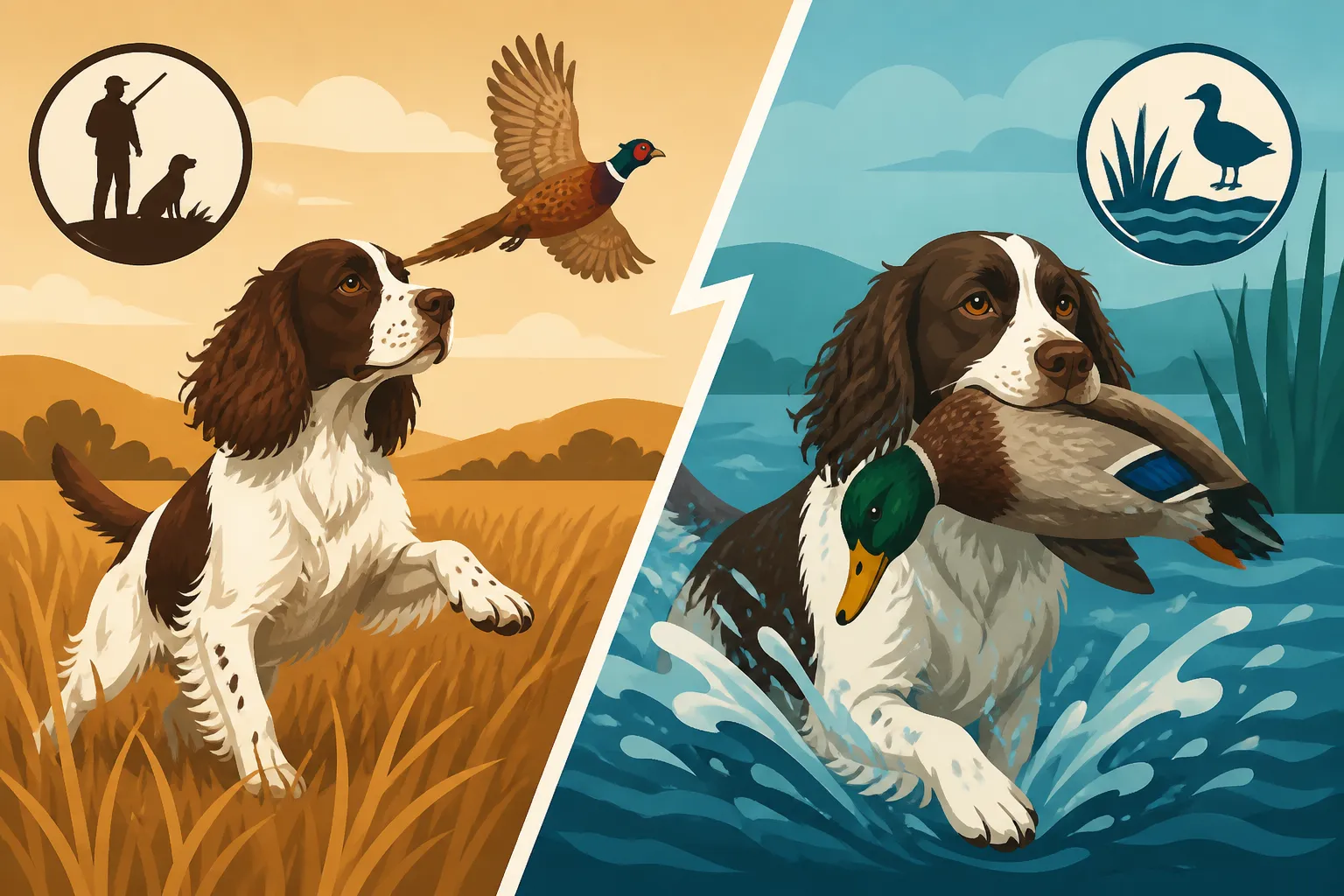
How Springer Spaniel Field Trials Differ From Retriever Trials
A Springer Spaniel field trial and a retriever trial may both involve dogs, birds, handlers, and a judge, but they test very different kinds of work. It’s easy to assume one is simply a smaller version of the other. This guide explains what each competition asks of a dog, how the events are run, and what to expect if you’re choosing which one to watch or try.
The central difference is what the dog is being asked to do
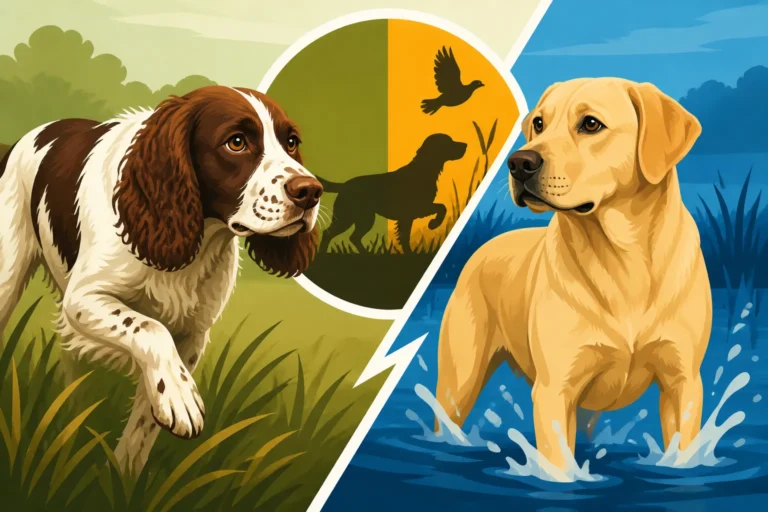
Spaniel trials focus on finding and flushing game
A Springer Spaniel is bred to hunt close in front of its handler, working through cover to locate game and flush it within shooting range. In a field trial, judges assess how effectively the dog searches, how it responds to its handler, and what it does when it encounters game. The work is active and continuous: the dog quarters the ground, adjusts its search as the cover changes, and tries to keep the handler involved rather than disappearing out of range.
That close-working pattern is a defining feature of the test. A dog that races far ahead, hunts without regard for the handler, or ignores directions may be impressive to watch but is not necessarily doing the job well. Judges are looking for purposeful work and cooperation, not just speed or enthusiasm. For a closer look at the searching pattern, see What Quartering Means in a Springer Spaniel and Teaching a Springer Spaniel to Hunt Within Gun Range.
When a Springer locates game, the flush is a key moment. Depending on the event and its rules, the dog may be expected to respond to the flush and shot by stopping or otherwise showing steadiness, then retrieve a bird when sent. The exact requirements vary, so it’s worth checking the rules for the particular organization and country. Still, the broad emphasis remains: the dog is being judged first and foremost as a close-working flushing spaniel. Steadying a Springer Spaniel to Flush explains why that pause and control matter.
Retriever trials focus on marking and retrieving
Retriever trials generally center on a different sequence of work. A dog may need to watch one or more birds fall, remember where they landed, and retrieve them when directed. In some tests, the dog is also asked to find a bird it did not see fall, following the handler’s cues to a specific area. These tasks test memory, marking ability, control, confidence, and the dog’s willingness to work at a distance.
Retrieving in a spaniel trial is usually part of a broader flushing performance; in a retriever trial, retrieving is the central job. The retriever may be sent away from the handler to retrieve a marked fall, sometimes across challenging ground or water. The handler’s control matters, but the dog also needs to make decisions while out of reach. A spaniel’s close, searching pattern and a retriever’s longer-distance retrieve are therefore not interchangeable skills.
| Feature | Springer Spaniel field trial | Retriever trial |
|---|---|---|
| Main job being assessed | Hunting cover and flushing game in cooperation with the handler | Marking, finding, and retrieving game |
| Typical working pattern | Close, systematic searching in front of the handler | Longer-distance work toward falls or search areas |
| Key skills | Hunting, responsiveness, flush behavior, steadiness, and sometimes retrieving | Memory, marking, delivery, control, and sometimes blind retrieves |
| What the handler may be doing | Moving with the dog and guiding its search | Directing the dog from a more stationary position |
| Event format | Often dogs work in pairs or braces, depending on the rules | Often includes individual retrieves and may include multiple dogs or tests |
| Important caveat | Rules differ among countries and trial organizations | Rules and test difficulty differ among organizations and levels |
The table describes the general contrast, not every event. A spaniel may be asked to retrieve, and a retriever may search for game, but the emphasis and judging priorities differ.
How the courses and competition formats differ
Spaniel trials often put two dogs into the same ground
In many Springer Spaniel field trials, dogs work in braces, meaning two dogs are assessed while working at the same time. That gives judges a chance to see how each dog hunts, responds to its handler, and behaves around another dog. The dogs are expected to work their own ground without interfering with one another. A dog that crowds its competitor, becomes distracted, or loses focus can struggle even if it has plenty of hunting drive.
A brace also makes the event feel more like a working day than a series of isolated retrieves. The handlers move through the ground with their dogs, and judges watch the quality of the search as well as the moments when game is found. A dog needs energy, but it also needs enough steadiness and awareness to work safely and cooperatively around its partner.
The precise format depends on the trial rules. Some competitions may use different arrangements, and what counts as a qualifying performance can vary. For anyone following a specific event, reading the organizer’s rules is more reliable than assuming every spaniel trial uses the same setup. For another useful perspective on the sequence of work, see How a Springer Spaniel Trial Is Run in Braces.
Retriever trials build around falls, retrieves, and directed work
Retriever trial grounds are often set up to present a series of retrieves. A dog may be asked to watch a bird fall, remember its location, and retrieve it after being sent. The handler may need to direct the dog toward the fall, especially when it cannot see the bird or has not marked its location. Water, distance, cover, and other obstacles can make the retrieve more demanding.
This setup changes the handler’s role. In spaniel work, the handler is often moving through the ground as the dog searches nearby. In a retriever test, the handler may stay at a starting point and use voice, whistle, or hand signals to guide a dog working farther away. A successful dog needs to respond at a distance while still making sensible choices when the handler’s directions do not give every detail.
Not every retriever event includes the same kinds of retrieves, and not every spaniel trial follows one universal course design. The useful distinction is that retriever competitions typically make the retrieve itself the main event, while spaniel trials make hunting and flushing the central performance. A spaniel can retrieve well without having the specialized distance-control skills that a retriever trial may require. What a Springer Spaniel Retrieves and Whether a Springer Spaniel Does Blind Retrieves explore two parts of that distinction.
What judges look for and what can go wrong
In a spaniel trial, a busy dog is not automatically a good dog
A Springer’s enthusiasm is part of its appeal, but judges need to see that energy shaped into effective work. The dog should search the available cover with purpose, remain responsive, and work in a way that gives the handler a practical chance to follow. A dog that charges ahead without hunting the ground thoroughly may cover distance without showing the quality of search the trial is designed to assess.
The flush can reveal training gaps quickly. A dog might find game reliably but rush in too close, fail to stop when expected, or become so excited that it is difficult to handle afterward. Another dog may be steady but hesitant about entering thick cover. Those are different problems, and the right preparation depends on which part of the work is weak. Watching the whole performance—not just the dramatic flush—helps explain why a judge may favor a dog that appears less flashy but works more consistently.
Handlers also need to manage the dog without overhandling it. Too much noise or constant direction can interrupt the dog’s search, while too little guidance may allow it to drift beyond the useful working area. This balance takes practice. If you’re preparing a Springer for hunting-style work, Whistle Work: The Language a Springer Spaniel Learns offers helpful context on communication at a distance.
In a retriever trial, control must hold up at a distance
Retriever work can expose small weaknesses in memory, marking, delivery, and response to direction. A dog may take the wrong line toward a fall, lose track of where a bird landed, or need repeated guidance to reach the right area. It may find the bird but return inefficiently or fail to deliver it in the manner expected by the rules. A reliable retrieve is not just “the dog brought something back”; the route, control, and completion can all matter.
Distance makes the handler’s timing important. A cue given too early or too late can confuse the dog, and a dog that is used to close-range work may not yet understand how to respond to signals while far away. That doesn’t mean a Springer cannot learn retrieving skills. It means that succeeding in a retriever-style test may call for focused training that goes beyond the basic retrieve often seen within spaniel work.
It’s also useful to distinguish formal field trials from other types of working-dog events. A hunt test, for example, may assess whether a dog demonstrates certain abilities against a standard, while a field trial is generally a competition in which dogs are compared. The names and formats differ among organizations, so check the specific event’s regulations before drawing conclusions about what a title or result represents.
Choosing an event and preparing a dog
Match the competition to your dog’s strengths and training
If your Springer naturally searches cover close to you, enjoys finding game, and is learning to respond reliably around a flush, a spaniel-focused trial may fit its instincts and current training better. That does not mean every Springer is ready to compete. Comfort around other dogs, steady behavior, recall, and the ability to work with a handler all matter. A dog can be keen in the field yet still need more time before the pressure and distractions of a trial are a good fit.
A retriever trial may suit a dog that enjoys retrieving and has developed reliable marking, delivery, and distance control. If your Springer enjoys bringing back toys or training dummies, that’s a useful starting point, but it does not tell you everything about trial readiness. The dog may need gradual practice with longer retrieves, directional cues, varied terrain, and water if those are part of the event.
For either type of competition, start by observing an event and speaking with experienced local handlers or trainers. Ask which rules apply, what training foundations are expected, and whether beginners can attend without entering a dog. Watching in person helps make the differences concrete: you can see where handlers stand, how dogs are released, and what the judges appear to value.
Build skills gradually and keep the setup safe
For spaniel work, focus on a controlled search, responsiveness to the handler, and calm behavior around exciting distractions. Short sessions in appropriate, permitted training areas are often more useful than repeatedly pushing a young or inexperienced dog through difficult cover. If a dog becomes frantic, loses contact, or stops responding, simplify the exercise rather than adding pressure.
For retrieving, build the pieces separately before combining them. A dog may need to learn to wait calmly, watch a fall, return directly, and deliver reliably before attempting more complicated marked or directed retrieves. Use safe, legal training equipment and follow guidance from a qualified trainer familiar with the rules of the event you want to enter. Training bumpers, a whistle, and a long line may be useful in some early exercises; retailers such as Chewy carry general dog-training supplies, but the equipment should suit the dog, exercise, and trainer’s advice. You can also check Chewy when making a basic gear list, then compare products for fit and suitability rather than choosing by appearance alone.
The point is not to turn every Springer into a retriever or every retriever into a spaniel. The two trial styles reward different working patterns. If you’re trying both with one dog, keep sessions clear and avoid mixing cues in a way that leaves the dog unsure. A trainer can help decide whether the dog is ready to combine skills or whether it’s better to establish one foundation at a time. Chewy may be one convenient place to browse everyday training items, but the training plan and the dog’s welfare should guide what you buy.
Disclaimer
This article is for general informational purposes only and does not constitute professional advice. Laws, prices and regulations vary by location and change over time. Consult a qualified professional for guidance on your specific situation.