Whether a Springer Spaniel Can Be Steadied to Shot
For anyone who’s ever spent time with a Springer Spaniel, you know their drive and enthusiasm are truly boundless. But that incredible energy, while a hallmark of the breed, can also be a real challenge when it comes to advanced gundog work, especially when you're trying to teach them the ultimate discipline: steadiness to shot. Many owners worry if their spirited companion can ever truly master this, fearing their dog's natural instinct to chase will always win out. This guide will walk you through the process, showing you that with patience and the right methods, your Springer can indeed become a calm, reliable partner in the field.
Understanding "Steadied to Shot" for a Springer Spaniel
The phrase "steadied to shot" might sound intimidating, conjuring images of stoic dogs sitting perfectly still amidst chaos. And while that's the ideal, it's also a journey, not an overnight trick. For a Springer Spaniel, a breed practically born with a nose to the ground and a desire to find and flush game, achieving this level of control is a testament to both their intelligence and your dedication. It’s about building a deep, unwavering trust and respect between you and your dog.
What Steadiness Truly Means for a Gundog
Steadiness in a gundog isn't just about not running off when a bird flushes or a gun goes off. It’s a multi-layered concept that encompasses a dog’s ability to remain calm and under control through every stage of the hunting sequence. This means:
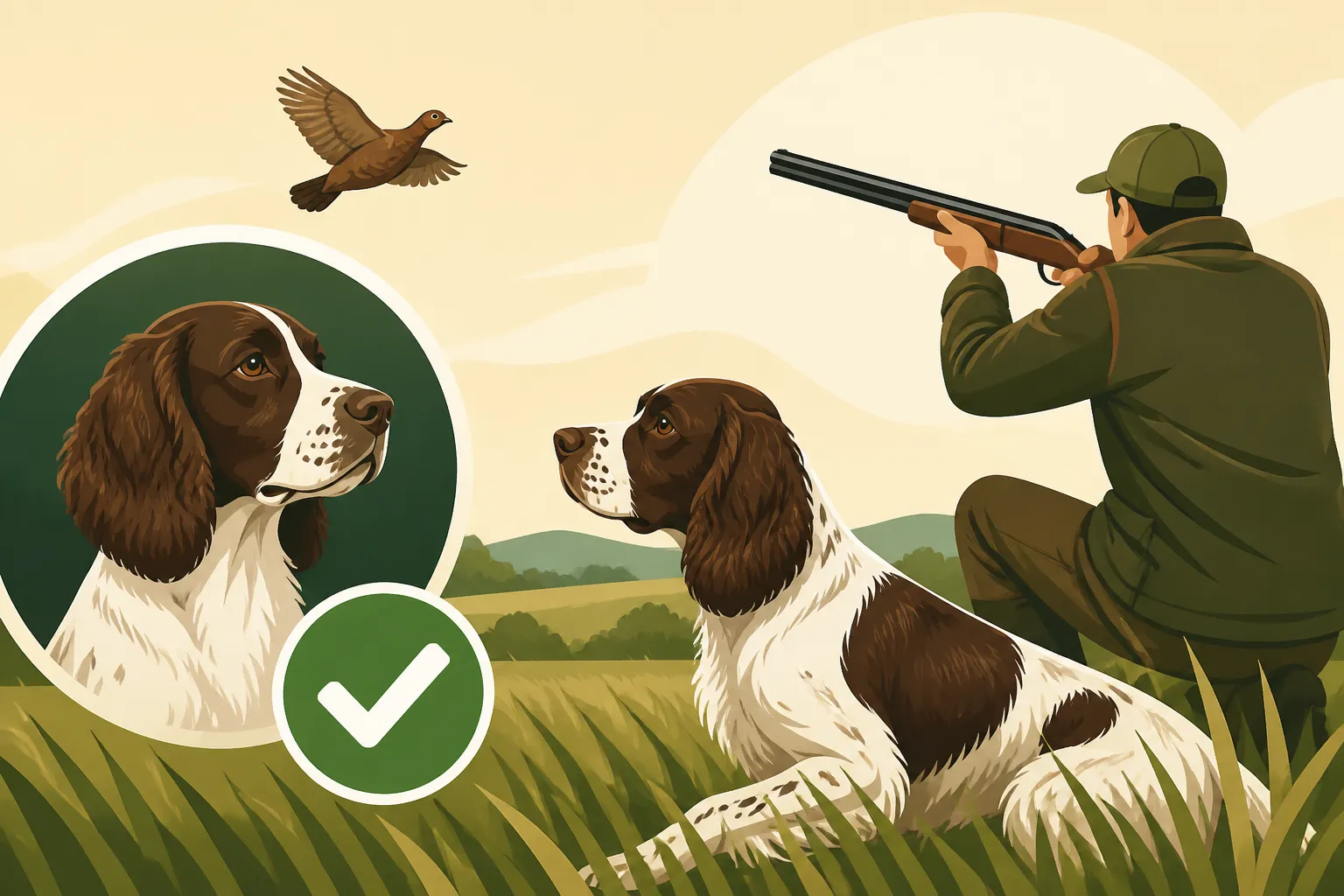
- Steady to Flush: Your Springer should hold its position, typically sitting, when a bird is flushed from cover, rather than instinctively giving chase. This is vital because the dog's job is to find the bird, and the hunter's job is to shoot it. If the dog is chasing, it risks running into the line of fire.
- Steady to Shot: When the gun fires, your dog should remain steady, not flinching, jumping, or breaking its position. This shows they are accustomed to the sound and understand it's part of the process, not a cue to run.
- Steady to Fall: After the shot, if a bird falls, the dog must still remain steady until given a command to retrieve. This prevents multiple dogs from rushing in, ensures the hunter can mark the fall accurately, and gives clear direction for a successful retrieve.
- Steady to Mark and Retrieve: Once given the command, the dog should proceed directly to the fallen bird, retrieve it gently, and return it promptly to hand. This entire sequence relies on the foundation of steadiness.
Think of it as a series of green lights and red lights in their brain. Their natural instinct gives them a constant green light to go, go, go! Your training needs to install those red lights, giving you control over when the light turns green. It requires a lot of repetition and making the right choices consistently rewarding.
Why Steadiness is Crucial for Springer Spaniels
For a breed like the English Springer Spaniel, which was literally developed to "spring" game, steadiness isn't just a nicety; it's a non-negotiable safety and efficiency requirement. Without it, you run into several significant problems:
- Safety First: An unsteady dog is a dangerous dog in the field. If your Springer breaks at the flush or shot, they could run into the line of fire, putting themselves and others at extreme risk. No bird is worth risking your dog's life or the safety of hunting companions. This is the paramount reason why this training is so critical.
- Effective Hunting: A Springer Spaniel's job is to work within gun range, find game, and flush it. If they are constantly ranging too far, chasing after every flush, or ignoring commands, the hunt becomes disorganized and often fruitless. Teaching a Springer Spaniel to Stay in Range is a foundational step before you even think about introducing gunfire. A steady dog allows the hunter to make a clean shot and then directs the dog to the retrieve.
- Ethical Hunting: Wounded game that is not retrieved quickly and efficiently is unethical. A steady Springer, who waits patiently and then executes a precise retrieve, ensures that every bird found is accounted for.
- Respect and Control: Beyond the field, a steady gundog is a well-mannered companion. The discipline required for steadiness translates into a dog that respects your commands in all aspects of life, making them a joy to live with. It demonstrates a profound level of control that speaks volumes about your relationship with your dog.
The Challenges of Steadiness with a High-Drive Springer
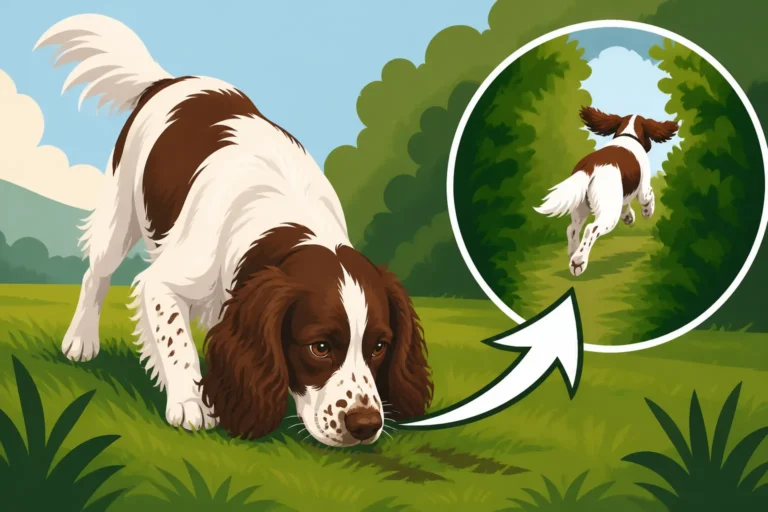
Let's be real: training a Springer Spaniel to be steady can feel like trying to hold back a coiled spring. Their genetics scream "go!" and asking them to pause when every instinct tells them to chase is a monumental task. This isn't a reflection of their intelligence, but rather the sheer power of their prey drive.
Instinct vs. Training: The Internal Tug-of-War
Springer Spaniels were bred for centuries to locate game, flush it, and retrieve it. This isn't just a learned behavior; it's hardwired into their DNA. How a Field Bred Springer Spaniel Differs in Drive is often evident in these situations. When a bird bursts from cover, or a training bumper flies, their brain releases a surge of adrenaline and dopamine, creating an almost irresistible urge to chase. This natural impulse is incredibly strong, and training requires redirecting that raw energy, not eliminating it entirely.
Many owners face the frustration of a dog that performs beautifully in the backyard but seems to forget every command the moment a feather flutters. It's not defiance; it's often the primal instinct taking over, making it incredibly difficult for the dog to process commands amidst such high excitement. Imagine trying to solve a complex math problem while someone is loudly playing your favorite, most exciting song right next to you – it's distracting, to say the least! We're asking our Springers to do something that goes against millennia of selective breeding, and that takes immense dedication.
Common Pitfalls in Early Training
The road to steadiness is paved with good intentions, but also with common missteps that can inadvertently reinforce the wrong behaviors:
- Rushing the Process: This is probably the biggest mistake. You simply cannot rush steadiness training. Each step needs to be mastered in a low-distraction environment before moving on to higher-distraction scenarios. Introducing birds or gunfire too early, before the dog has a solid understanding of basic obedience and impulse control, is a recipe for disaster.
- Inconsistent Commands: One day you let them break, the next you punish them for it. This inconsistency is incredibly confusing for your Springer. They need crystal-clear boundaries and expectations every single time. Every "break" allowed is a step backward.
- Over-Correcting or Being Too Harsh: Springer Spaniels are known for being "soft" dogs. The Soft Springer Spaniel That Shuts Down If You Shout is a real phenomenon. Harsh corrections, yelling, or physical punishment can make them shut down, become fearful of the training process, or even develop a negative association with the gun or birds, potentially leading to issues like gun shyness. The goal is confident control, not fear-based obedience.
- Lack of Proofing: Training in a quiet yard is one thing; training in a field with other dogs, birds, and changing scents is another. Failing to gradually introduce real-world distractions (proofing) means the dog hasn't truly learned the command, only that it applies in specific, familiar circumstances.
- Not Addressing Basic Obedience First: You can't put a fancy roof on a house without a strong foundation. Without a rock-solid "sit," "stay," and "recall," attempting steadiness to shot is pointless. Whether a Springer Spaniel's Recall Can Be Trusted is directly tied to their steadiness when distractions are high.
A Step-by-Step Approach to Steadiness Training
Achieving steadiness isn't a quick fix; it's a systematic build-up of skills, starting with the absolute basics and slowly adding layers of distraction and excitement. Think of it as constructing a building, brick by carefully placed brick.
Foundation: Obedience and Impulse Control
Before any birds fly or shots are fired, your Springer needs to master fundamental obedience and impulse control. This means:
- Reliable Sit and Stay: Your dog should be able to sit and stay for extended periods, even with you out of sight, and with minor distractions. Practice this daily in various locations, gradually increasing duration and distraction. If your dog can't "stay" for 5 minutes in your living room, they certainly won't stay when a pheasant flushes.
- Solid Recall: Your recall needs to be absolute, a "come" that means come now, no matter what. This is your ultimate safety net in the field. Practice with increasingly tempting distractions, rewarding heavily when they return. Why a Springer Spaniel Puts Its Nose to the Ground and Vanishes is a common problem that a reliable recall helps mitigate.
- "Whoa" or "Hup" Command: This command means "stop immediately, no matter what, and freeze." It's incredibly valuable for checking your dog's momentum in the field. Start by teaching it simply as a stand-stay or a sit-stay, then build up to stopping them while they are moving.
- Boredom and Patience: Teach your dog to be calm and patient. Not every moment is for high-energy play. A dog that can settle down easily is much more likely to remain steady when asked.
- Leveraging Resources: Many excellent online training programs, like those offered by BAXTER & Bella, can provide structured guidance for building these foundational obedience skills from puppyhood. They break down complex behaviors into manageable steps, which is perfect for laying the groundwork for steadiness. Consistency is key, whether you're using an online program or working with a local trainer.
Introducing the Noise: From Cap Guns to Shotguns
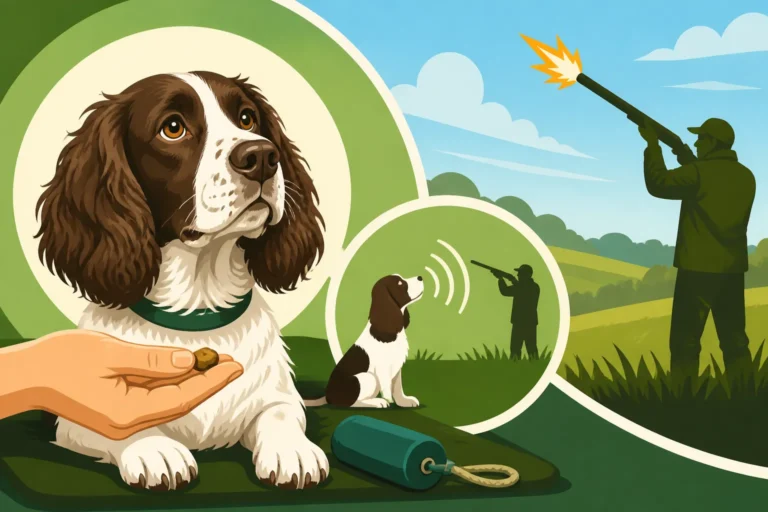
Desensitizing your Springer to gun sounds must be done gradually and positively. The goal is for the sound to be a non-event, or even a pleasant signal that a retrieve is coming, not a terrifying bang.
- Start Small, Stay Distant: Begin with very low-level noise, like a cap gun or even clapping hands. The key is distance. Have someone fire the cap gun far away while you're engaging your dog in something fun, like playing fetch with a training dummy. Don't make a big deal out of the sound yourself.
- Associate with Positive Things: The sound should always precede something positive. For example, the cap gun fires, and then you immediately throw a favorite toy or a piece of kibble. The dog learns that the sound means good things happen, not that it's a signal to run wild.
- Gradual Increase: Slowly, over many sessions and days, decrease the distance or increase the volume (moving from a cap gun to a starter pistol, then a .22 rifle, and finally a shotgun). Watch your dog's reaction closely. If they show any signs of fear – flinching, cowering, trying to run – you've moved too fast. Go back to a lower level and slower pace. How to Introduce a Springer Spaniel to Gunfire specifically details this process to prevent Whether a Springer Spaniel Is Gun Shy.
- No Pressure: Never force the issue. If your dog is having an off day, or seems sensitive, stop and try again another time. This isn't a race.
Integrating Birds and Retrieves (Controlled Scenarios)
This is where things get exciting, but also where steadiness can easily break down. The introduction of birds needs to be as controlled as the sound introduction.
- Steady to Thrown Dummies: Start by throwing training dummies. Your dog must sit and stay while you throw the dummy, and only retrieve it on command. Make sure they retrieve What a Springer Spaniel Retrieves gently. Practice this until it's absolutely solid, even with exciting throws.
- Live Birds (Wing-Tipped or Launcher): Begin with wing-tipped pigeons or pheasants that can only fly a short distance, or use a remote bird launcher. Place your dog on a lead, have them sit, and then release a bird or launch a dummy. As the bird flushes, gently correct any attempt to break. The goal is for them to remain perfectly still.
- Adding the Shot: Once your dog is steady to the flush of a bird (or dummy) without gunfire, introduce the shot. Have a helper fire a gun (starting distant and low volume) after the bird flushes, but before you send your dog to retrieve. Your dog must remain steady through the flush and the shot, waiting for your release command.
- Send for Retrieve: Only send them for the retrieve after they have been steady to the flush and shot. This creates a strong chain of events: steady -> shot -> retrieve. The retrieve is the reward for their patience.
Here's a simplified progression table:
| Phase | Distraction/Cue Introduced | Dog's Action | Trainer's Focus |
|---|---|---|---|
| Foundation | Verbal commands, hand signals | Sit, Stay, Come, Whoa/Hup | Reliability in low distraction |
| Sound Desensitization | Cap gun, starter pistol | Remain calm, focus on trainer, positive association | Gradual sound increase, distance control |
| Dummy Steadiness | Thrown dummies, rollers | Sit/Stay through throw, retrieve on command | Impulse control, waiting for permission |
| Bird/Flush Steadiness | Live birds (clipped), bird launcher | Sit/Stay through flush, ignore bird in air | Ignoring prey drive, holding position |
| Shot Integration | Gunshot after flush | Sit/Stay through flush and shot | Combining elements, solidifying steadiness |
| Field Proofing | Hunting scenarios, multiple birds | Consistent steadiness, marking fall, retrieve | Generalizing skills to real-world chaos |
Practicing in the Field: Real-World Scenarios
Once your Springer is performing well in controlled environments, it's time to generalize those skills to actual hunting conditions. This is where patience truly becomes a virtue.
- Gradual Exposure: Start in fields with fewer distractions. Work with one bird at a time. Slowly introduce more complex cover, varying terrain, and eventually, other hunters or dogs.
- Simulated Hunts: Set up simulated hunting scenarios. Walk your dog, let them quarter, and when a bird (planted or wild) flushes, demand steadiness. If they break, immediately go back to basics in a more controlled setting.
- Group Training: Training with experienced gundog groups can be invaluable. Your dog will learn to be steady around other working dogs, and you'll get insights from seasoned trainers.
- Short, Successful Sessions: Always aim for success. Keep training sessions short and end on a positive note. It's better to have several short, perfect sessions than one long, frustrating one. How Many Repetitions a Springer Spaniel Needs will be far more than you think, so pace yourselves!
Essential Tools and Mindset for Success
Successfully training a Springer Spaniel for steadiness to shot requires more than just knowing the steps; it demands the right equipment, the right attitude, and sometimes, the right help.
Training Aids That Make a Difference
While training is primarily about the bond and consistency, certain tools can make the journey smoother:
- Training Dummies: These are indispensable for retrieve training. From plastic to canvas, various types simulate birds. You can find a huge variety of quality training dummies on Amazon, allowing you to choose what works best for your dog.
- Bird Launchers: Manual or remote-controlled launchers are excellent for simulating flushes in a controlled manner, allowing you to gradually introduce birds.
- Check Cords/Long Lines: Essential for enforcing commands at a distance. A 30-foot or 50-foot check cord allows you to give your dog freedom to range while still having the ability to correct a break instantly. A Long Line Suits a Springer Spaniel for practicing recall and steadiness at greater distances before going completely off-leash.
- Electronic Collars (E-Collars): These are a controversial topic, but when used correctly and humanely by an experienced trainer, they can be an invaluable tool for reinforcing commands at a distance, especially for a high-drive breed like the Springer Spaniel. They are not for punishment, but for communication and gentle correction. Whether an Electronic Collar Belongs on a Springer Spaniel is a serious discussion, and careful consideration and professional guidance are crucial before using one. Never introduce an e-collar without first understanding its proper application.
- Whistles: Whistle commands are clearer than voice commands in the field, especially over distances or in noisy environments. Teaching a Springer Spaniel Whistle Commands is a core part of gundog training that significantly aids steadiness and control.
Patience, Consistency, and Professional Guidance
This is not a sprint; it's a marathon. Expect setbacks, celebrate small victories, and remember that every dog learns at their own pace.
- Patience is Paramount: You will have days where your Springer seems to have forgotten everything. Take a deep breath, go back a step, and remind yourself of the long-term goal. Getting frustrated or angry will only hinder progress.
- Consistency is Key: Every interaction, every training session, every walk—it all contributes to your dog's understanding of boundaries and expectations. If you let them get away with breaking one day, you've undone days of training.
- Know When to Ask for Help: If you're struggling, or feel like you've hit a wall, don't hesitate to seek out a professional gundog trainer. They have the experience and techniques to troubleshoot problems and guide both you and your dog. Whether a Springer Spaniel Needs a Gundog Trainer is often yes, especially for advanced field work. They can identify subtle cues you might be missing and provide invaluable hands-on guidance. Sometimes, just having an extra set of experienced eyes can make all the difference.
Steadiness to shot is the pinnacle of gundog training for a Springer Spaniel. It demands time, effort, and a deep understanding of your dog's instincts, but the reward is an incredibly well-trained, safe, and effective hunting partner who will enrich your life in countless ways.
Disclaimer
This article is for general informational purposes only and does not constitute professional advice. Laws, prices and regulations vary by location and change over time. Consult a qualified professional for guidance on your specific situation.