Teaching a Springer Spaniel Whistle Commands
It's a familiar scenario for many Springer Spaniel owners: you're out for a walk, enjoying the fresh air, and suddenly your beloved dog is a speck on the horizon, nose to the ground, utterly oblivious to your increasingly frantic calls. Their boundless energy and incredible scent drive, while wonderful in their own right, can also be a source of immense frustration and even danger. This guide is all about giving you a powerful tool to bridge that communication gap and ensure your Springer is always responsive, no matter how exciting the distractions around them: whistle commands.
Why Whistle Commands Are a Game Changer for Your Springer
You might be thinking, "Why a whistle? My voice works just fine… sometimes." And you're right, your voice is essential! But for a dog like a Springer Spaniel, bred for generations to work at a distance from its handler, a whistle offers a level of clarity and consistency that human vocal commands simply can't match. It’s not about replacing your voice entirely, but enhancing your communication toolkit.
Cutting Through the Noise and Excitement
Imagine you're in a busy park, a field with rustling leaves, or near a road with traffic. Your voice, no matter how loud, can get lost in the ambient noise. It can also sound different depending on your emotional state—are you happy, frustrated, or panicking? Your Springer picks up on all those nuances. A whistle, however, delivers a sound that is consistent in tone and pitch every single time, making it incredibly easy for your dog to distinguish from other sounds.
Consider a sunny afternoon walk in a local nature preserve. Your Springer suddenly catches the scent of a rabbit and is off like a shot, weaving through the undergrowth. Your voice might crack with urgency, but to your dog, it might just sound like another exciting noise in the distance. A shrill, consistent whistle, on the other hand, cuts through that sensory overload. It’s a signal they've learned to associate with a specific action, overriding the distraction of that irresistible scent. This consistent, unwavering sound is invaluable for a breed that can get incredibly focused on a task.
Consistency in Communication
One of the biggest hurdles in dog training is human inconsistency. We use different tones, different words, or even different durations for the same command. For a dog that thrives on predictability, this can be confusing. "Come," "Come here," "Rover, come!"—these all mean the same thing to us, but to your Springer, they can be three separate commands requiring different responses. This is where the whistle shines.
With a whistle, a single, distinct pattern of pips or blasts always means the exact same thing. A short, sharp blast for "sit" will always be a short, sharp blast, regardless of whether you're having a great day or feeling stressed. This uniformity removes ambiguity and accelerates your dog's learning. It builds a clear, undeniable language between you and your dog, making them more confident in their understanding of what you're asking. This reliability is especially important for a breed that needs clear guidance to channel its immense drive effectively.
The Range Advantage
Springer Spaniels were bred to work a field, often ranging out to flush game from cover before returning. This means they naturally want to work at a distance from you. Your voice carries only so far, and its effectiveness diminishes rapidly with distance, wind, or thick cover. A whistle's sound travels much further and more clearly.
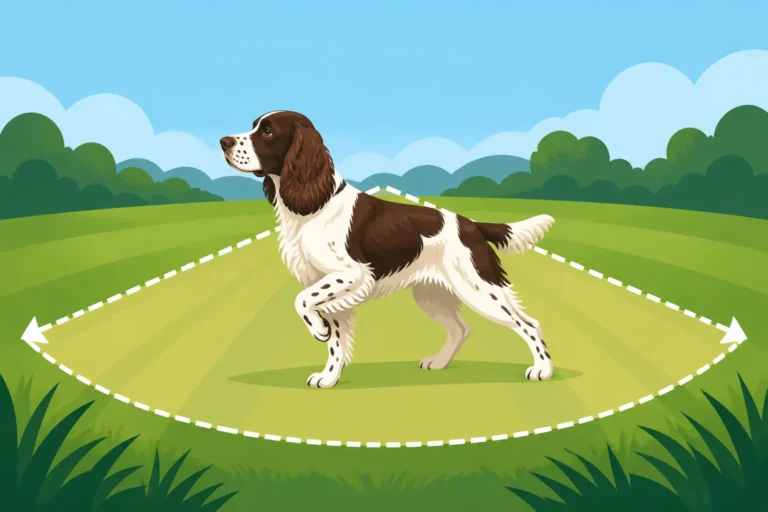
Think about a sprawling open field where your Springer is happily Teaching a Springer Spaniel to Stay in Range, quartering back and forth, sniffing out every interesting detail. If they drift a bit too far, a vocal command might be lost in the wind. A whistle command, however, can easily reach them, conveying your instructions even when they are a good distance away. This extended range means you can maintain control and safety without having to constantly chase after them or raise your voice to an unhealthy pitch. For a breed that naturally covers a lot of ground, this range advantage is not just convenient; it's absolutely crucial for effective training and managing their natural instincts. It also means you can enjoy watching them work without constantly worrying about their whereabouts.
Choosing the Right Whistle and Introducing It
Selecting the right tool is the first step in successful whistle training. Just like picking the right collar or leash, your whistle needs to suit both you and your dog. Once you have it, the introduction process is all about building positive associations.
Different Types of Whistles and Their Uses
There's a surprising variety of dog whistles out there, and each has its own characteristics. The two most common types you'll encounter are pea whistles and pealess whistles.
- Pea Whistles: These are the traditional kind, often made of plastic or metal, with a small pea inside that vibrates to create a trilling sound. They tend to have a distinct, somewhat louder sound that can carry well. They are generally affordable and easy to find on platforms like Amazon. The varied sound can be useful for certain commands, but some find the trill less consistent than a pealess whistle, especially if the pea gets wet or stuck.
- Pealess Whistles: These whistles produce a consistent, often higher-pitched tone because there's no pea to interfere. They are particularly popular with gundog trainers because of their reliability and clear, piercing sound that cuts through distractions. They are less prone to issues with moisture or temperature changes, which is a huge benefit if you're out training in all sorts of weather. Brands like Acme Thunderer are highly regarded in this category. They come in various frequencies, some audible to humans, some largely silent. For most general training, an audible whistle is perfectly fine, but some prefer silent whistles for discretion or to avoid bothering others.
Beyond these, there are also combination whistles that might have two different pitches or functions, though for starting out, a single-purpose whistle is best. The most important thing is to choose a whistle that you find comfortable to use and that produces a sound you can easily replicate consistently. The consistency of the sound is far more important than the specific type of whistle.
Making the Whistle a Positive Experience
Before you even think about teaching commands, you need your Springer Spaniel to associate the whistle with good things. This foundational step is critical for building a dog that eagerly responds to the whistle rather than being startled or indifferent. Start in a quiet environment, free from distractions, like your living room or a calm backyard.
The process is simple: whistle, then treat. Blow a single, clear whistle command, and immediately follow it with a high-value treat or a favorite toy. Don't ask for any specific behavior yet. You're simply teaching them, "When you hear that sound, awesome things happen!" Repeat this 5-10 times in a session, a few times a day. Keep sessions short and fun. You'll notice quickly that your Springer's ears will prick up, and they'll look at you expectantly as soon as they hear the whistle. This positive association forms the bedrock of all your future whistle training. Never use the whistle to scold or express frustration; it must remain a positive cue. You can also incorporate praise like "Good dog!" immediately after the treat, linking your verbal approval with the whistle as well.
The "Recall Pip" Your Foundation Command
Once your Springer has a rock-solid positive association with the whistle, it's time to teach the most crucial command: the recall. For most gundog trainers, this is often a series of rapid pips or blasts. Let's call it the "Recall Pip." This pattern needs to be distinct from any other whistle commands you'll teach later. A common recall whistle is three short, sharp pips in quick succession: pip-pip-pip.
Start again in a low-distraction environment. With your dog a short distance away (maybe across the room or a few feet in the yard), blow your "Recall Pip" sequence. The moment they turn their head or start moving towards you, offer enthusiastic praise and a super-tasty treat when they reach you. Don't wait for them to sit or offer any other behavior; just getting to you is the goal. Gradually increase the distance, always ensuring success. If your dog isn't responding, you're either too far away or there are too many distractions. Dial it back. For an energetic breed, using a long line (available on Amazon) during this stage is incredibly helpful. This allows you to gently guide them towards you if they get distracted, ensuring they always complete the "come to whistle, get reward" sequence. Companies like BAXTER & Bella often emphasize positive, consistent recall training in their puppy programs, highlighting how vital this early foundation is.
| Command | Whistle Pattern | Primary Action | Secondary Benefits |
|---|---|---|---|
| Recall | Three short, rapid pips (pip-pip-pip) | Come immediately to the handler | Safety, control, strengthens bond, overrides distractions |
| Sit/Stop | One long, continuous blast (wheeeeeet) | Stop, sit, and face the handler | Steadiness, waiting at a distance, control at crossings/hazards |
| Turn/Cast | Two short pips (pip-pip) | Change direction, sweep an area | Directing hunting patterns, finding retrieves, working cover |
| Hunt On | Series of rapid, alternating pips | Continue searching, extend range | Encouraging thorough coverage, maintaining motivation |
| Directional | Single pip, followed by hand signal | Move left/right to a specific area | Advanced retrieve direction, sending to specific cover |
Core Whistle Commands Every Springer Should Know
Once your Springer is reliably recalling to the whistle, you can start building out their repertoire of commands. These core commands are invaluable for managing your dog's natural instincts and ensuring they are a well-behaved companion both at home and in the field.
The "Sit/Stop" Whistle
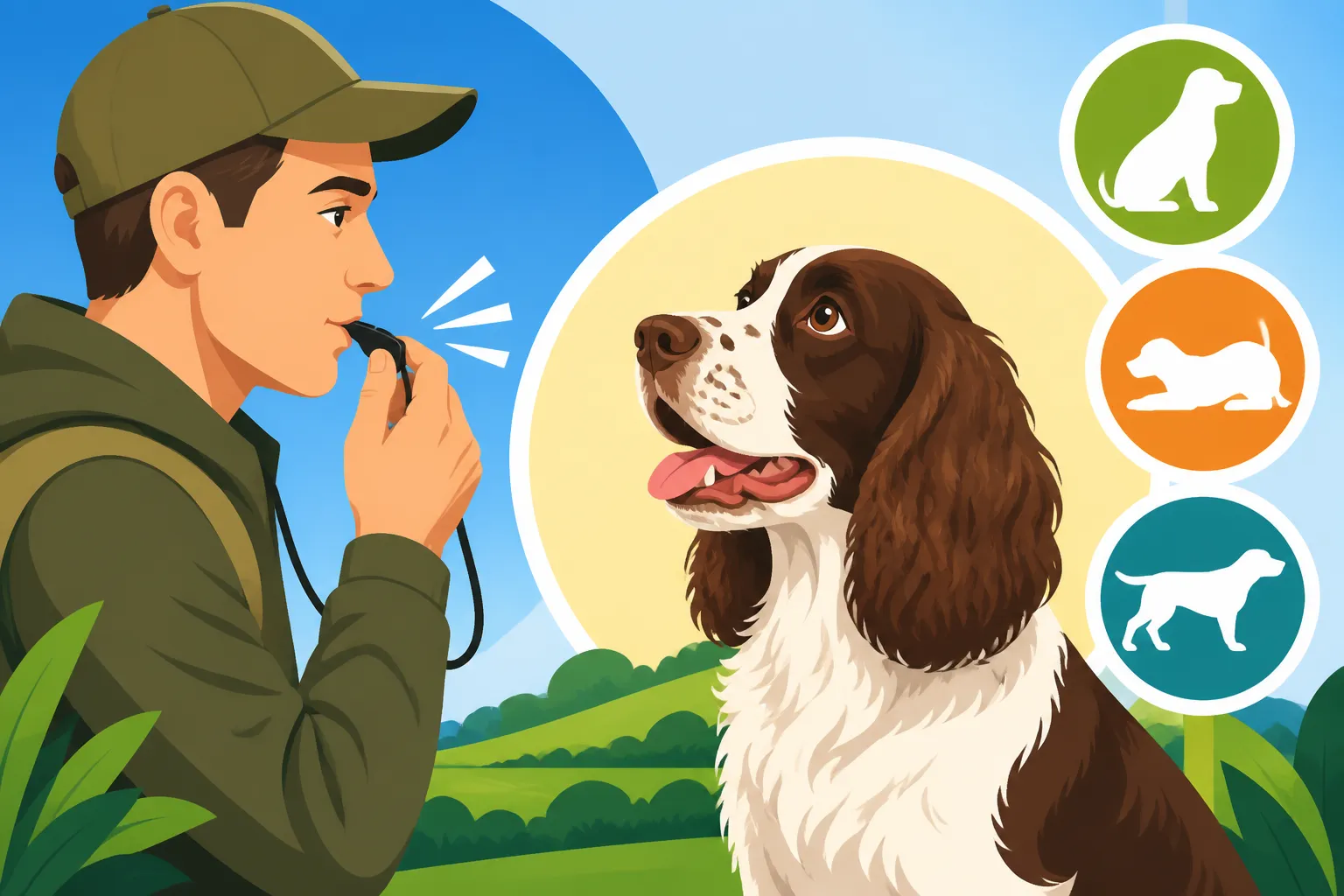
This is arguably the second most important whistle command, especially for a gundog. The ability to stop and sit instantly, even at a distance, is a cornerstone of control and safety. It's often taught with a single, long, continuous blast of the whistle: wheeeeeet.
To teach this, start with your dog on a leash, close to you. Give your verbal "sit" command, and as they begin to sit, blow the long whistle blast. Immediately reward them when their rear touches the ground. Repeat this many times. The goal is to pair the whistle with the physical action of sitting. Once they are consistently sitting with the verbal cue and whistle together, gradually fade out the verbal cue. Just blow the whistle. As they become reliable nearby, start asking for the sit from a few steps away, then a bit further. Again, a long line is your friend here. If they don't sit, you can gently guide them with the line, then reward. This command is fantastic for getting your dog to hold still at a road crossing, wait while you talk to someone, or hold steady while you flush game. It teaches them patience and reinforces your leadership in a calm, clear manner. Whether a Springer Spaniel's Recall Can Be Trusted is often dependent on this stop whistle too. If they can stop, they can then be recalled.
The "Change Direction/Cast" Whistle
For a dog like a Springer, bred to sweep an area and find game, the ability to direct their hunting pattern is incredibly useful. This command, often a couple of quick pips (pip-pip), tells your dog to change the direction they are working or to cast out to an area you indicate with a hand signal.
Begin by working in an open area, like a field or large backyard. Walk with your dog, encouraging them to move back and forth in a natural quartering pattern. As they are moving in one direction, blow your "change direction" whistle, simultaneously giving a clear hand signal (e.g., sweeping your arm to the left or right). When they respond by changing direction, immediately reward them. This takes practice and patience, as it’s a more nuanced command than a simple sit. You're asking them to observe their environment, interpret your signal, and adjust their natural hunting rhythm. Over time, this whistle will allow you to guide your dog through challenging cover, ensuring they cover the ground efficiently and thoroughly without missing any potential finds. This command is integral to teaching a Springer Spaniel to quarter naturally with whistle cues and truly harnessing their working instincts.
The "Come In" or "Hunt On" Whistle
While the recall whistle brings your dog directly to you, a "come in" whistle might simply mean to shorten their working range or to come closer without necessarily sitting at your feet. Conversely, a "hunt on" whistle encourages them to extend their range and continue searching diligently. These commands allow for more fluid communication in the field.
- "Come In" (e.g., a single, drawn-out pip followed by a quick one): This tells your dog, "You're a bit too far out, shorten your arc, but keep working." It's perfect when your Springer is covering ground too enthusiastically and you want them to tighten their quartering pattern without interrupting their flow entirely. Practice this by letting them range a bit further than you'd like, then giving the whistle and walking backwards slightly, rewarding them when they naturally shorten their search closer to you.
- "Hunt On" (e.g., a series of excited, rapid alternating pips): This whistle is used to encourage your dog to keep going, to search more thoroughly, or to extend their range when they're perhaps being a bit too sticky. It injects energy and renewed purpose into their hunt. This is great for those moments when you've just crossed a fence line into new cover and want them to understand it's time to get back to business. Blow the whistle with enthusiasm and sweep your arm forward, encouraging them to move out. Reward them for their increased effort and range. Mastering these nuanced commands means you can have a flowing conversation with your Springer as they work, allowing them to perform their job effectively and with minimal vocal interruption.
Integrating Whistle Commands into Daily Training and Fieldwork
The true value of whistle commands comes from how well they integrate into your daily life and, for many, into field activities. It's a progression from controlled environments to real-world scenarios.
Practicing in Low-Distraction Environments
Just like with the initial conditioning, consistency and starting simple are key. Always begin teaching new whistle commands, or reinforcing existing ones, in a calm, controlled setting. Your home, a quiet backyard, or an empty park early in the morning are ideal. This allows your Springer Spaniel to focus solely on the whistle and the associated action without being pulled away by compelling scents, other dogs, or people.
During these low-distraction sessions, aim for short, frequent bursts of training. Five to ten minutes, several times a day, is far more effective than one long, tedious session. Keep it positive, playful, and end on a high note. Always use high-value rewards – something your Springer really loves, whether it's a specific treat or a favorite retrieve toy. Repetition in these controlled settings builds muscle memory and a strong understanding of what each whistle pattern means. If your dog isn't responding, don't blame the dog; evaluate the environment or your method. Are you blowing the whistle clearly? Is the reward high enough? Are you asking for too much too soon? How Many Whistle Cues a Springer Spaniel Learns is less about their capacity and more about your consistent, patient teaching method.
Gradually Increasing Distractions and Distance
Once your Springer is reliably responding to whistle commands in a quiet setting, it's time to gradually introduce more challenge. This is where many owners get impatient, but slow and steady wins the race.
- Introduce mild distractions first: Practice in your backyard when a neighbor is mowing the lawn, or at a park when there are only a few people around.
- Increase distance: Start with recall pips when your dog is just a few feet away, then gradually increase to ten, twenty, thirty feet, and beyond. Always use a long line during this phase, especially for recall, to ensure success and prevent your dog from "failing" by running off. A high-quality long line can be found easily on Amazon and is an indispensable tool for this stage.
- Vary the environment: Move from open fields to areas with more cover, or near water if your Springer enjoys swimming. Each new environment presents new scents and sights that can be distracting, so treat each as a step up in difficulty.
The key is to set your dog up for success. If they fail to respond, the distraction was too high, or the distance too great. Don't scold. Simply reduce the challenge and try again. Each successful response, even with minor distractions, builds confidence and reinforces the value of listening to the whistle over everything else. This structured progression helps your dog understand that the whistle commands apply everywhere, not just in quiet training zones. Why a Springer Spaniel Ignores You on a Scent is a common challenge, and gradual distraction training with whistles is the answer.
Troubleshooting Common Whistle Command Challenges
Even with the best intentions, you might run into some bumps in the road. Here are a few common issues and how to address them:
- My dog ignores the whistle completely:
- Go back to basics: Re-establish the positive association in a quiet environment. Whistle = high-value treat, immediately. No expectations, just pairing.
- Check your whistle technique: Are you blowing it consistently? Is it loud enough to be heard?
- Evaluate your rewards: Are they truly high-value? Sometimes, a change in treat can re-engage a dog.
- My dog only responds when there are no distractions:
- Slow down: You've likely progressed too quickly through the distraction levels. Go back to a slightly less distracting environment where they are successful.
- Use a long line: For recall especially, a long line ensures you can physically reinforce the command, making it impossible for them to fail.
- Increase value: In distracting environments, make your reward even more exciting. A piece of cooked chicken might be worth more than a regular kibble.
- My dog is slow to respond or takes multiple whistles:
- "One and Done": Aim for a single whistle cue. If they don't respond, don't repeat the whistle. Instead, move towards them, get their attention, and then give the whistle again when you know they will succeed. Repeating the whistle teaches them they don't have to respond immediately.
- Anticipation: Are you giving a verbal cue before the whistle? Ensure the whistle is the primary cue.
- My dog understands the command but doesn't always perform it:
- This often comes down to motivation or environmental difficulty. Ensure your rewards are exciting enough for the level of distraction. Never punish a lack of response; instead, ensure success through management (e.g., long line, less distraction). Remember, your Springer Spaniel is sensitive; The Soft Springer Spaniel That Shuts Down If You Shout can lose confidence with harsh corrections, making them less likely to try.
Beyond the Basics: Advanced Whistle Work
Once your Springer Spaniel has a solid foundation in core whistle commands, you can begin to explore more advanced applications, particularly if you have an interest in gundog work or other dog sports. These advanced techniques truly leverage the Springer's natural abilities and whistle-based communication.
Teaching a Springer Spaniel to Quarter Naturally with Whistle Cues
Quartering is a natural hunting pattern for a Springer Spaniel, where they systematically sweep an area in a zig-zag pattern, covering the ground efficiently to locate game. While they have an innate tendency to do this, whistle cues can refine and control their pattern, ensuring thorough coverage within gun range.
The "change direction" whistle (often two pips, pip-pip) is central here. Start in an open field with light cover. Encourage your dog to move out. As they approach the boundary of your desired working area (or if they start to drift too wide), blow your "change direction" whistle and give a sweeping hand signal to turn them back towards you, encouraging them to cover the ground they just missed. The goal is to create a rhythm: dog moves, you whistle and signal, dog turns, dog moves, you whistle and signal, dog turns. Reward them for making these turns promptly and for maintaining a consistent pattern. Over time, your Springer will learn to anticipate the whistle and adjust their quartering pattern more smoothly. This methodical approach to What Quartering Means in a Springer Spaniel not only makes them a more effective hunting dog but also provides a fantastic mental and physical workout for any Springer. You’re essentially communicating a complex search pattern through simple, consistent sounds and gestures.
Whistle Work for Blind Retrieves and Advanced Field Skills
Blind retrieves are a hallmark of advanced gundog training, where your dog is sent to retrieve an item they haven't seen fall. This requires precise directional control, often achieved through a combination of whistle commands and hand signals. This is where your "stop" whistle and directional cues become incredibly powerful.
Imagine you're walking along a field edge, and you know there's a training dummy hidden in a patch of tall grass far to your left, out of your dog's sight.
- "Stop" (long whistle blast): Send your dog forward a short distance, then blow your "stop" whistle to get them to sit and look back at you. This anchors them and focuses their attention on you for further instruction.
- "Back" or "Over" (verbal cue + hand signal): While they are stopped, give a verbal cue like "back" or "over," paired with a clear hand signal (e.g., pointing directly in the direction of the dummy).
- "Go" or "Hunt On" (whistle/verbal cue): Release them with a "go" command or your "hunt on" whistle.
- Directional Correction (stop + new hand signal): If they veer off course, blow your "stop" whistle again. Once they are sitting and looking at you, give a new directional hand signal to correct their path, then release them again.
This sequence allows you to precisely guide your dog to the hidden retrieve. It’s a sophisticated dance between handler and dog, built entirely on trust and clear communication through whistle and body language. For these more complex tasks, some handlers also combine whistle commands with Whether a Springer Spaniel Learns Hand Signals to create an even richer language for their dog. Patience is paramount here, and celebrating every small step of success will keep your Springer motivated and eager to learn. This kind of nuanced training truly showcases the incredible intelligence and biddability of the English Springer Spaniel.
Teaching your Springer Spaniel whistle commands is more than just a training exercise; it's an investment in a stronger bond, clearer communication, and a safer, more enjoyable life together. It unlocks their potential as a working companion and gives you unparalleled control and confidence in any environment. Take your time, be consistent, and enjoy the journey of discovering just how much your amazing Springer can understand.
Disclaimer
This article is for general informational purposes only and does not constitute professional advice. Laws, prices and regulations vary by location and change over time. Consult a qualified professional for guidance on your specific situation.