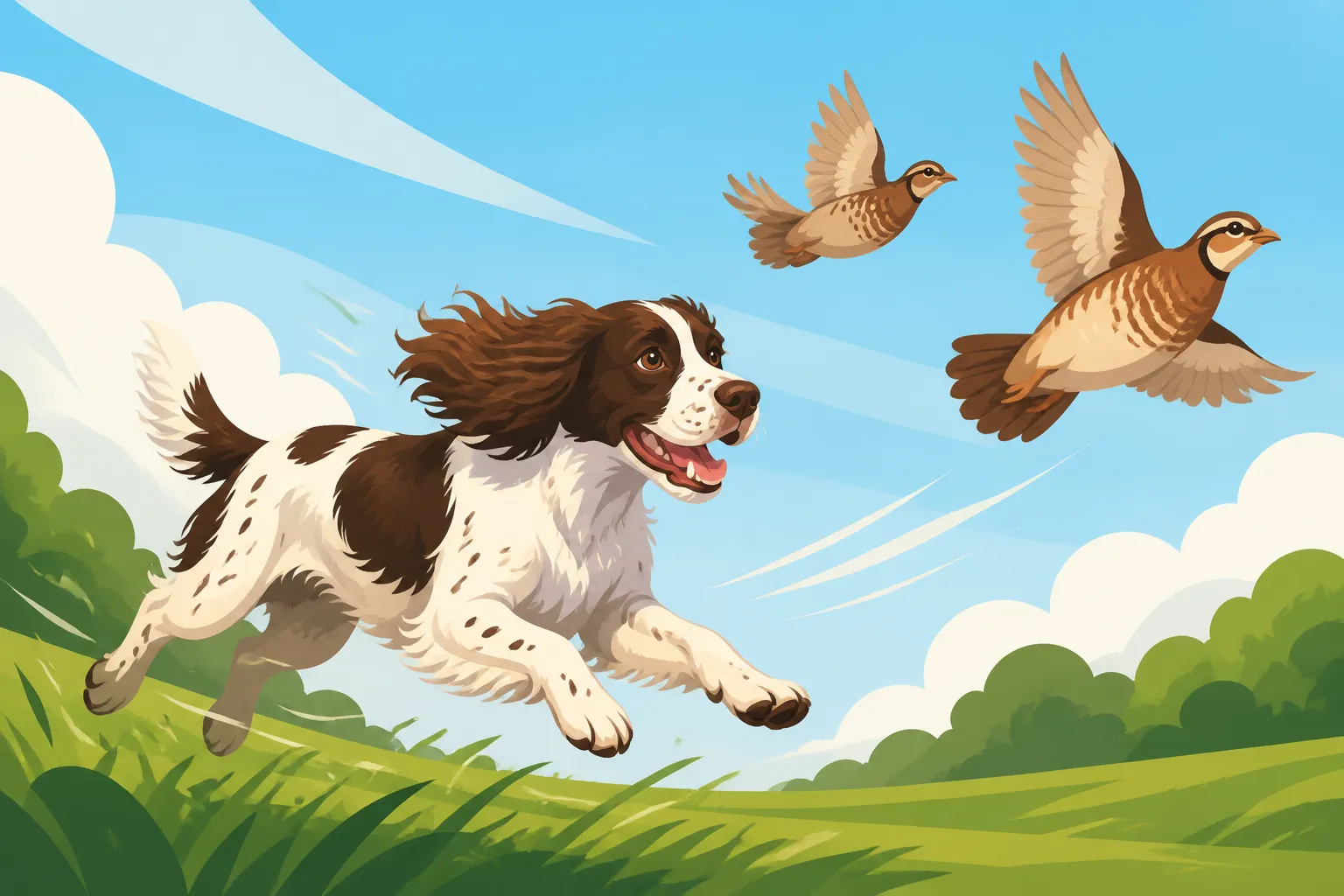
Whether a Springer Spaniel Chases Birds Off Leash
One of the most common frustrations for English Springer Spaniel owners is the seemingly irresistible urge these wonderful dogs have to chase after birds, especially when off-leash. It can be incredibly disheartening, not to mention a safety concern, when your beloved companion suddenly locks onto a flock of pigeons or a pheasant flushing from the brush and takes off with a singular, determined focus. This guide will delve into why Springer Spaniels are so prone to this behavior and, more importantly, equip you with practical strategies and training techniques to manage and mitigate this powerful instinct, helping you achieve a more reliable off-leash experience.
Understanding the Springer Spaniel's Innate Bird Drive
To effectively manage a Springer Spaniel's tendency to chase birds, it's crucial to first understand why they do it. This isn't just a mischievous whim; it's a deeply ingrained genetic predisposition, honed over centuries of selective breeding. These dogs were quite literally bred for the job, and their instincts are a testament to their historical purpose.
A Legacy of Flushing Game
The English Springer Spaniel's name itself offers a huge clue to their core function: "springing" game. Their ancestors were developed in Britain to work alongside hunters, specifically to find birds and small game hidden in dense cover, then "spring" or flush them out into the open for the hunter to shoot. This demanding role required a dog with an exceptional nose, boundless energy, and an intense drive to pursue. They needed to be bold, quick, and persistent. Every aspect of their physical and mental makeup, from their powerful legs to their keen senses and inherent desire to push through thick brush, was selected for this very purpose. When you see your Springer disappear into a thicket after a bird, you're witnessing generations of genetic programming at work, a living echo of their storied past. It’s not disobedience; it’s instinct.
Their entire being is geared towards this task. They live for the thrill of the chase, the rush of scent, and the satisfaction of finding something. Unlike retrievers who are often bred to sit patiently and wait for the retrieve command, Springer Spaniels were traditionally active participants in the flush itself. They are, in essence, canine bird dogs, and their enthusiasm for this "job" is what makes them so captivating to watch, but also challenging to control without proper guidance. Ignoring this deeply rooted history means misunderstanding your dog's fundamental motivations.
The Power of Scent and Sight
For a Springer Spaniel, the world is a rich tapestry of smells, and birds, with their distinct odors, are particularly captivating. Their incredible olfactory senses mean they can pick up the faint scent trail of a bird long before a human ever spots it. This scent can act like an invisible leash pulling them forward, drawing them into the chase. Once they get a whiff, especially a fresh one, their brains light up with purpose. It's an internal command, often overriding any training you might have in place, if that training hasn't been specifically designed to compete with such powerful natural urges. Why a Springer Spaniel Puts Its Nose to the Ground and Vanishes speaks to this exact phenomenon, highlighting how easily their noses can lead them astray.
Beyond scent, their excellent eyesight plays a huge role. The sudden movement of a bird taking flight—a quick flutter of wings, a flash of color—is an irresistible trigger. It's an immediate, visual stimulus that ignites their prey drive instantly. Imagine a bright, flashing light, but one that promises a thrilling game. This combination of powerful scenting ability and sharp visual acuity means that a Springer Spaniel can go from calmly walking beside you to a full-speed dash in a split second, sometimes without any apparent warning to us mere humans. It’s a primal response that they often struggle to suppress without careful, consistent intervention.
Why "Off-Leash" Can Be a Challenge with Birds
Allowing your Springer Spaniel off-leash is a wonderful freedom, but it also opens the door to their natural instincts, particularly when birds are around. The very traits that make them exceptional gundogs can become significant challenges in an everyday setting.
The Instinct to Pursue
When a bird flushes, your Springer Spaniel isn't thinking about dinner, or your angry shouts, or the delicious treat you have in your pocket. In that moment, they are simply a pure, unadulterated instinct machine. The instinct to pursue, to chase, to "spring" the game, is overwhelmingly powerful. It's a hardwired program that tells them, "Go! This is what you were made for!" This drive is often more potent than their desire to please you, especially in the heat of the moment. It's not a personal affront; it’s deeply biological. This is why a simple "come" command, which might work perfectly in a distraction-free yard, can utterly fail when a flock of geese lifts off from a nearby pond.
This strong desire to pursue isn't just about catching the bird, though that might be the ultimate goal for some. For many Springer Spaniels, the act of the chase itself is intensely rewarding. The thrill of the sprint, the focused intent, the utilization of their senses—it's all highly satisfying. This internal reward system makes it incredibly difficult to interrupt once it's been activated. It's similar to a human being deeply engrossed in a favorite hobby; interrupting them takes a lot of effort. For a Springer, the chase is their favorite hobby, perhaps their defining one.
Overcoming Distractions in Nature
Nature is, by design, full of distractions that can easily derail even the best-trained Springer. A rustle in the bushes, the distant caw of a crow, the movement of a squirrel, or, of course, the scent or sight of a bird, can instantly grab their attention and override their focus on you. Unlike a controlled training environment, the real world is unpredictable and teeming with stimuli that speak directly to their prey drive. Trying to get your Springer's attention when they're locked onto a scent or a visual stimulus feels like shouting into a hurricane. How Far a Springer Spaniel Will Go on a Scent illustrates just how far their noses can lead them, making recall an immense challenge.
Consider a walk in a local park. A flock of pigeons pecking at crumbs is a mundane sight for us. For a Springer, it's a dynamic puzzle. The scent of their droppings, the flutter of wings, the potential for a chase—it's all incredibly exciting. Now imagine a more rural setting, a field bordered by woods. The potential for pheasants, grouse, or even deer (Whether a Springer Spaniel Chases Deer) makes the environment even more stimulating. Every new scent, every rustle, every bird call is an invitation to engage their instincts. It’s not just one distraction; it’s a constant barrage, making consistent off-leash reliability a monumental training undertaking.
Essential Training Foundations for Reliable Recall
Given the powerful instincts at play, a truly reliable off-leash recall, especially around birds, requires a strong foundation of training. This isn't just about teaching a command; it's about building a relationship where your dog chooses to listen to you, even when their instincts are screaming otherwise.
Building a Rock-Solid "Come" Command
A strong "come" command (or "here," or whatever your chosen cue is) is the absolute bedrock of off-leash safety. This isn't a command you teach once and assume your dog knows. It needs constant reinforcement and practice, elevating its importance in your dog's mind. Start in a quiet, distraction-free environment, like your living room or a fenced yard. Use high-value treats—think cooked chicken, cheese, or hot dogs—and enthusiastic praise. Make coming to you the most rewarding thing in their world. Always pair the command with the reward. Don't just say "come" and grab them; ensure they reach you, then reward them immediately.
Gradually introduce distractions. Practice in your backyard with a few toys scattered around. Then move to a quiet park on a long line. The key is to set your dog up for success. If you call them when they are too engrossed in a scent trail or chasing something, and they ignore you, you've just taught them that they don't have to come. Whether a Springer Spaniel's Recall Can Be Trusted delves deeper into the nuances of building this vital trust. One excellent online resource for foundational training, including recall, is BAXTER & Bella. Their systematic approach can guide you through the steps to build a dog who genuinely wants to come back to you, even when facing alluring distractions like birds.
The Role of a Long Line and Whistle
For Springer Spaniels, a long line is an indispensable training tool for safely practicing off-leash recall around distractions. A 30-foot or 50-foot lead, easily found on Amazon, allows your dog the illusion of freedom while you maintain control. When your dog is on a long line and starts to fixate on a bird or ignore a recall, you can gently but firmly apply pressure to the line, guiding them back to you, and then immediately reward them when they comply. This teaches them that ignoring your call means encountering resistance, while responding means praise and treats. It’s a vital bridge between on-leash and truly off-leash freedom.
The whistle is another powerful tool, especially for gundog breeds like the Springer Spaniel. Unlike your voice, a whistle carries farther, cuts through wind and other environmental noise, and always sounds the same, no matter your mood or frustration level. Whistle Work: The Language a Springer Spaniel Learns emphasizes the importance of consistent whistle commands. A single pip for "stop," a series of pips for "come"—these consistent sounds become crystal clear cues for your dog. Introduce the whistle during meal times, blowing it right before you put down their food, associating it with something highly positive. Then, integrate it into your recall training on the long line, always pairing the whistle with coming to you and a high-value reward. This ensures that the whistle command becomes a distinct, reliable signal that means "return to me immediately for something amazing."
Practicing in Diverse Environments
Once your recall is solid in a controlled environment, it's time to generalize the training. This means practicing in increasingly distracting locations. Start with areas where bird encounters are minimal, then gradually move to places where birds are present but not overwhelmingly so. A park with open fields might be a good next step, where a few pigeons might be visible but not right under your dog's nose. Always use your long line initially. Observe your dog's threshold for distraction. If they start to ignore you at a certain level of bird activity, you know you've pushed too far, and you need to dial back to a less distracting environment.
The key is to build success upon success. Don't expect your Springer to ignore a flushing pheasant if they haven't reliably ignored a few walking pigeons first. Vary the types of birds, too. The sight of a soaring hawk might be less tempting than a low-flying duck. Always have those high-value treats ready, and be more exciting than the birds! Run away from your dog and call them, making yourself the most engaging thing in their environment. This continuous, progressive exposure, combined with consistent positive reinforcement, is how you build a recall that can compete with their powerful prey drive. Teaching a Springer Spaniel to Stay in Range also connects directly to this, as keeping them close means they are less likely to encounter a bird undetected.
Tools and Techniques for Managing Bird Chasing Instincts
Even with a strong foundational recall, managing a Springer Spaniel's intense bird-chasing instincts often requires a multi-faceted approach, incorporating specialized tools and advanced techniques. These aren't shortcuts but rather aids to help reinforce desired behaviors and ensure safety.
The Strategic Use of Electronic Collars
For many gundog breeds, including Springer Spaniels, an electronic collar (e-collar) can be a highly effective training tool when used correctly and humanely. It's not about punishment, but rather about communication and interruption, providing a consistent, undeniable signal to your dog even at a distance. The goal is to condition your dog to respond to a very low-level stimulation as a cue, similar to a tap on the shoulder, meaning "pay attention" or "come." Start by finding your dog's "working level"—the lowest setting they can feel and acknowledge without showing discomfort. Pair the stimulation with your recall command and a high-value reward.
The e-collar is particularly useful for interrupting an undesirable behavior as it starts rather than after your dog is already at full sprint. If your Springer begins to stiffen, lock onto a bird, and takes a few steps towards it, a well-timed, low-level stimulation can break their focus and allow you to re-engage them with your recall. This needs to be introduced carefully, ideally under the guidance of a professional trainer experienced with e-collars and gundog breeds. Never use it out of frustration or as a primary method of discipline. Whether an Electronic Collar Belongs on a Springer Spaniel provides more context on this debated tool. When used responsibly, an e-collar, such as those available on Amazon, can be a game-changer for off-leash reliability and safety, allowing your Springer more freedom than they might otherwise have.
Counter-Conditioning and Desensitization
Another powerful technique is counter-conditioning, which involves changing your dog's emotional response to birds from excitement and chase-drive to neutrality or even a positive association with you in the presence of birds. This is achieved by systematically exposing your dog to birds at a distance where they notice them but aren't yet intensely reactive. As soon as they notice a bird, mark the moment (e.g., with a clicker or a verbal "yes!") and immediately reward them with a super high-value treat. The goal is for them to eventually think: "Bird! Oh, a bird means I look at my human for chicken!"
Desensitization works hand-in-hand with this. Gradually decrease the distance to the birds or increase the level of bird activity, always staying below your dog's threshold for reacting. If they start to fixate, you've moved too close too fast. Back up, get them calm, and try again. This process takes immense patience and consistency. It's about slowly reprogramming their automatic response. For a pet Springer, the goal isn't necessarily for them to ignore birds entirely, but to be able to focus on you despite the birds, and to choose to check in with you rather than chasing. This method requires a strong understanding of your dog's body language and a commitment to rewarding calm, attentive behavior.
Employing a GPS Collar for Safety
Let's be realistic: even with the best training, a Springer Spaniel's instincts can sometimes override everything, especially if they are highly motivated or catch a bird completely by surprise. For peace of mind and ultimate safety, particularly if you enjoy exploring large, unfenced natural areas, a GPS collar is an invaluable tool. These devices, many available through Amazon, attach to your dog's regular collar and allow you to track their location in real-time via an app on your smartphone.
If your Springer does manage to slip past your control and takes off after a bird, a GPS collar means you won't be left frantically searching for them. You'll know their exact whereabouts, which can dramatically reduce stress and search time. It's not a substitute for training, but it's an essential layer of insurance for a breed known for its wandering nose and tenacious pursuit. Whether a Springer Spaniel Should Wear a GPS Collar outlines the benefits of this technology further. While a well-trained dog is always the goal, acknowledging the limits of even the most dedicated training in the face of millennia of instinct is simply being a responsible owner.
Here's a quick comparison of these valuable tools:
| Tool | Primary Purpose | Best For | Key Benefit | Considerations |
|---|---|---|---|---|
| Long Line | Safe recall practice, controlled freedom | Building reliable recall in distracting environments | Teaches consequences of ignoring commands | Can get tangled; still requires handler attention |
| Whistle | Consistent, far-reaching recall cue | Off-leash recall, cutting through noise | Unaffected by emotion, travels far | Requires careful conditioning; specific cues needed |
| Electronic Collar | Remote communication, interruption of undesirable behavior | Advanced recall, stopping chase in progress | Precise timing, consistent signal at distance | Requires professional guidance; controversial; not for punishment |
| GPS Collar | Real-time location tracking | Safety net for off-leash adventures | Peace of mind, quick recovery if dog gets lost | Not a training tool; battery life; subscription fees |
Realistic Expectations and Ongoing Management
Living with a Springer Spaniel means embracing their exuberant, bird-driven nature. While training can achieve incredible results, it's also important to have realistic expectations and commit to ongoing management throughout your dog's life.
Acknowledging the Breed's Nature
You chose a Springer Spaniel, a dog explicitly bred to find and flush birds. It’s important to remember that asking them to completely ignore a bird is like asking a fish to ignore water—it goes against their very nature. While we can train them to have impeccable manners and a stellar recall, the underlying instinct will always be there, simmering just below the surface. Acknowledging this means understanding that occasional lapses might occur, particularly in highly stimulating environments or if you let your guard down. It's not a failure on your part or your dog's; it's simply a reflection of who they are. The Household a Springer Spaniel Was Built For really dives into the breed's intrinsic characteristics.
Instead of fighting against their nature, learn to work with it. Provide appropriate outlets for their energy and their nose. Scent work, retrieving games, and structured training sessions that tap into their innate drives can be incredibly satisfying for them and reinforce your bond. A bored Springer Spaniel, or one whose natural instincts are constantly suppressed without an outlet, can become frustrated and more likely to give into impulse. Providing a "job" that channels their intelligence and drive can actually make them more responsive to you in other situations. Whether a Springer Spaniel Needs a Job is a testament to this fact.
Consistency Is Key for a Lifetime
Training is not a one-time event; it's an ongoing process, especially with a breed as intelligent and driven as the Springer Spaniel. You can't expect to train them for a few months and then assume they're "fixed" for life, particularly when it comes to such a strong instinct as bird chasing. Consistency in your commands, your rewards, and your expectations is paramount. Every interaction is a training opportunity. Reinforce good behavior, redirect undesirable behavior, and always be fair and predictable.
This means that every walk, every outing, every interaction where birds might be present is a chance to reinforce your dog's recall and impulse control. If you sometimes let them chase, and sometimes demand they come back, you're creating confusion. Your rules need to be clear and unwavering. For a sensitive breed like the Springer Spaniel, positive reinforcement, as often emphasized by training programs like BAXTER & Bella, works wonders. Shouting or harsh corrections, as explored in The Soft Springer Spaniel That Shuts Down If You Shout, can actually be counterproductive, eroding trust and making them less likely to respond. Keep it positive, keep it consistent, and you'll build a strong, lasting partnership.
When to Seek Professional Help
If you're struggling to make progress with your Springer Spaniel's bird chasing, or if the behavior is escalating to a dangerous level, don't hesitate to seek professional help. A qualified dog trainer or behaviorist, especially one with experience in gundog breeds and prey drive, can offer invaluable insights and personalized strategies. They can observe your dog's specific behaviors, identify triggers, and help you implement a tailored training plan. They can also provide hands-on guidance for using tools like electronic collars safely and effectively.
Sometimes, an outside perspective is all it takes. A professional might spot subtle cues you've missed or suggest a training approach you hadn't considered. They can also help you set realistic goals and manage your own expectations, preventing burnout and frustration. Investing in professional guidance is not a sign of failure; it's a sign of a responsible and loving owner committed to their dog's safety and well-being. Ultimately, your goal is to have a happy, well-adjusted Springer Spaniel who can safely enjoy off-leash freedom within appropriate boundaries, even in a world full of tempting birds.
Disclaimer
This article is for general informational purposes only and does not constitute professional advice. Laws, prices and regulations vary by location and change over time. Consult a qualified professional for guidance on your specific situation.