How Different the Two Springer Spaniel Types Look
It can be incredibly confusing when you’re out and about, you see an English Springer Spaniel, and then you see another one that looks completely different! You might even think they’re entirely separate breeds. Owners often wonder why their neighbor's Springer looks like a sleek, compact athlete while theirs is a fluffy, substantial bundle of joy. This guide will walk you through the distinct visual characteristics that separate the field-bred (or working) English Springer Spaniel from its show-bred counterpart, helping you understand what makes each type unique to the eye.
The Tale of Two Looks: A Brief History of the Divide
It’s easy to assume all dogs of the same breed should look alike, but with English Springer Spaniels, that’s just not the reality. The divergence in appearance didn’t happen overnight; it was a gradual process driven by human selection and purpose. Understanding this history helps us appreciate why they look so different today.
When the Paths Diverged Visually
The roots of the English Springer Spaniel as a distinct type date back centuries, but the significant visual split we see today really solidified in the early to mid-20th century. Before that, breeders often focused on a dog's ability to "spring" game, with less emphasis on a rigid appearance standard. However, once breed clubs formed and formal dog shows gained popularity, a "breed standard" was written. This document detailed the ideal physical characteristics for a Springer Spaniel intended for the show ring.
At the same time, hunters and field enthusiasts continued to breed primarily for working ability. They needed dogs that could tirelessly cover ground, navigate dense cover, and flush game effectively. The qualities that made a dog excel in the field—like a lighter build, a practical coat, and boundless energy—weren't always aligned with the evolving aesthetic demands of the show ring. Over generations, these differing breeding goals led to two distinct visual types, even though they were (and still are) registered as the same breed. It’s a classic example of form following function, where one group prioritized beauty standards and the other, raw working talent. The result is a divergence that created what is, in essence, two different "breeds" under one name. It’s truly fascinating to consider The Seventy Year Gene Pool Divide Inside One Springer Spaniel Breed.
Why Appearance Became So Important to Each Type
For the field-bred Springer, every aspect of its physical appearance is geared towards performance. A lean, athletic build isn't about looking good on a podium; it's about endurance and agility in demanding terrain. A shorter, coarser coat isn't a stylistic choice; it's a practical necessity to protect against brambles and weather while being easy to clean. The dogs were bred to do a job, and their bodies adapted to be the best tools for that job. There was no prize for the prettiest face; the prize was a successful hunt.
Conversely, for the show-bred Springer, appearance is the job. The breed standard, meticulously detailing everything from head shape to tail set, became the blueprint for success in the show ring. Breeders aiming for show champions selected for specific traits like heavy bone, a particular head shape, and an abundant coat, all designed to embody the "ideal" look. The visual characteristics became paramount because judges evaluate dogs based on how closely they conform to this written standard. While temperament and soundness are also crucial, the overall aesthetic presentation is key to winning ribbons and titles. It’s a world where every hair and curve is scrutinized, which naturally led to a very different looking dog from its working cousin.
Head and Expression: The Face of Each Spaniel
The head and its expression are often the first things you notice about a dog, and here, the two types of Springers offer a stark contrast. It's not just about aesthetics; these differences reflect centuries of selective breeding for specific tasks or ideals.
The Field Springer's Leaner, More Athletic Head
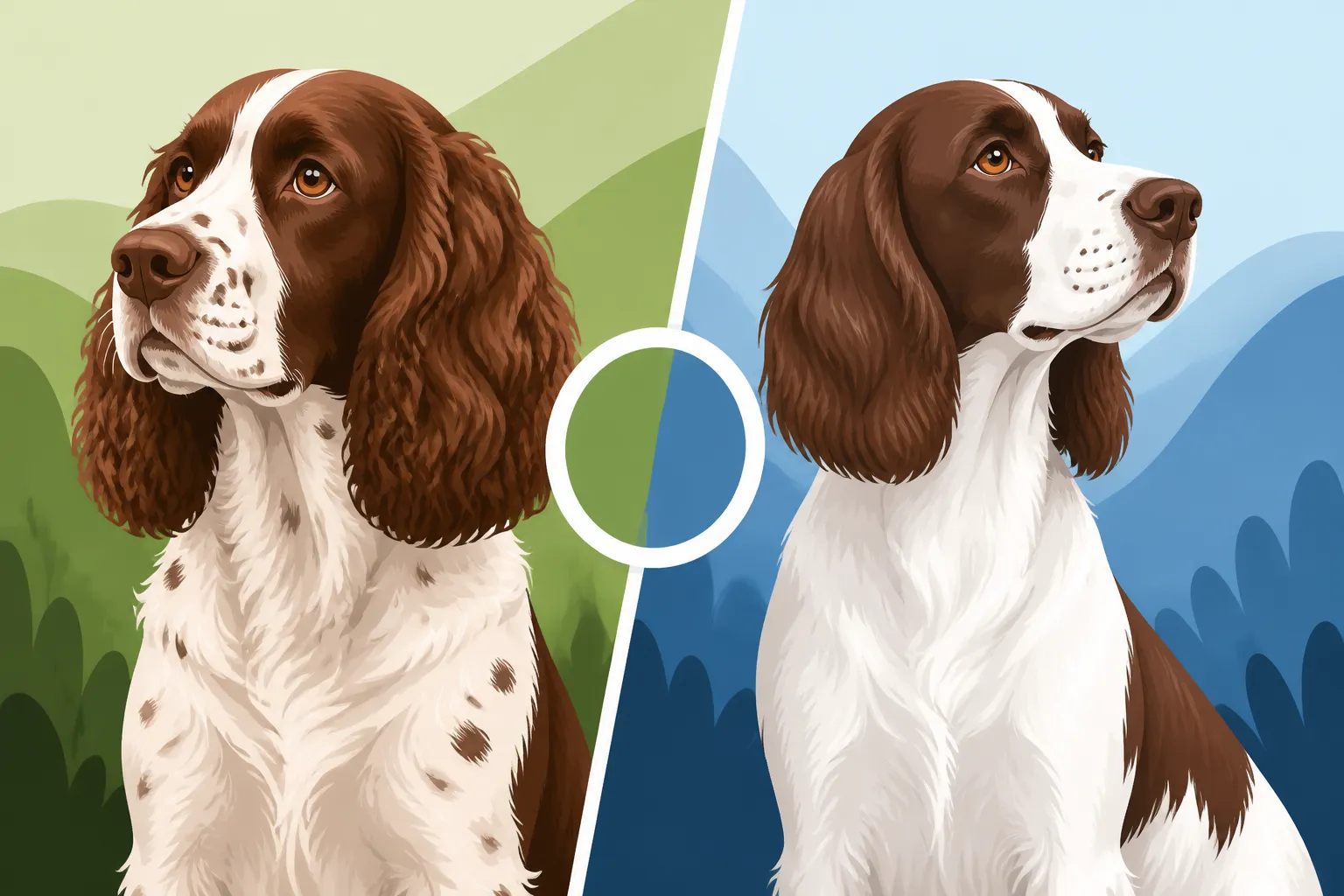
When you look at a field-bred Springer Spaniel, you’ll typically see a head that is more refined, often described as lighter or more athletic. The stop – the indentation where the muzzle meets the skull – is usually less pronounced than in a show dog. The muzzle itself tends to be longer and narrower, giving the entire head a less bulky, more streamlined appearance. Think of it as a finely chiseled tool designed for efficiency.
This leaner head isn’t accidental; it’s advantageous for a dog working in dense cover. There’s less fur to get snagged on thorns and branches, and the overall structure provides excellent airflow for a dog that’s constantly on the move, breathing heavily. Their eyes often have a keen, intelligent, and focused expression, always ready to spot game or take a command. The look is one of intense capability and unwavering attention, reflecting their primary role as a tireless hunting companion. This focused gaze is very different from the softer expression often found in show lines, hinting at the different demands placed upon them.
The Show Springer's Deeper Stop and Softer Look
Switching to a show-bred Springer, you'll immediately notice a broader skull and a more pronounced, often deeper stop. The muzzle tends to be shorter and wider, giving the head a more substantial, almost "blocky" appearance compared to its field cousin. This combination of a wider skull and a more defined stop often contributes to a characteristic "melting" or "gentle" expression, which is highly prized in the show ring. Their eyes, while still intelligent, might appear larger and set to give that soft, appealing gaze.
The ears, too, play a significant role in the overall head profile. Show Springers typically have ears that are set lower and are more heavily feathered, framing the face beautifully and contributing to that softer, more luxurious look. While these ears are beautiful, they do require more care and attention to prevent matting and manage potential ear infections, a trade-off for their aesthetic appeal. You might find yourself searching for specific ear care products on Chewy to keep those gorgeous show ears in top condition. This difference in ear set and feathering is a key visual marker, and you can learn more about How Show Springer Spaniel Ears Differ.
Body and Build: From Compact to Powerful
Just as their heads differ, so too do their overall body structures. These physical variations are directly linked to the purposes for which each type of Springer Spaniel was bred, showcasing how form and function intertwine.
The Field Springer's Athletic and Agile Frame
Imagine a marathon runner: lean, powerful, built for endurance. That's essentially the blueprint for a field-bred English Springer Spaniel. They possess a lighter, more athletic frame, with less bone substance than their show-bred counterparts. Their legs tend to be slightly longer in proportion to their body, giving them the leverage and stride needed for covering vast amounts of ground quickly and efficiently.
This athletic build allows them to navigate dense cover with ease, spring vigorously to flush game, and retrieve tirelessly throughout a long day. Their topline is strong and level, providing a solid foundation for explosive movement. Every muscle seems to be precisely where it needs to be for speed and agility. They often appear less bulky, more "trim," a physical testament to their working heritage. It’s a body built for action, not for standing still. This contributes to why you might observe How Much Smaller a Field Springer Spaniel Runs compared to a show-bred dog, though both are undoubtedly Springers.
The Show Springer's Sturdier, More Substantial Build
In contrast, the show-bred Springer Spaniel typically presents a more substantial, robust, and compact body. They are bred to conform to a specific breed standard that often calls for heavier bone and a more "cobby" or stocky frame. Their legs might appear shorter relative to their body length, contributing to a lower, more grounded silhouette. This is the classic "bench dog" look, designed for presence and symmetry in the show ring.
The show Springer’s body emphasizes a powerful, well-sprung rib cage and a deep chest, giving them a stately appearance. While they are still capable and active dogs, their conformation is optimized for a visually pleasing outline rather than intense, prolonged physical exertion in demanding environments. This difference in build is one of the most immediate visual cues when comparing the two types, especially when you see them side-by-side. Their overall impression is one of solid, well-proportioned elegance, built to catch the judge's eye.
Coat and Feathering: Grooming's Great Divide
Perhaps one of the most obvious visual distinctions between field and show Springers lies in their coats and the amount of feathering they carry. This isn't just a matter of aesthetics; it dictates their maintenance needs and how they fare in various environments.
The Field Springer's Practical, Low-Maintenance Coat
A field-bred Springer Spaniel boasts a coat that is all about practicality. It's generally shorter, coarser, and has significantly less feathering on the legs, belly, and ears compared to a show Springer. This type of coat is a working dog's best friend. Its texture allows it to shed water and dirt relatively easily, preventing it from becoming a matted mess when the dog is plunging through mud, water, or dense undergrowth.
The reduced feathering means fewer burrs, thorns, and seeds get tangled, which drastically cuts down on grooming time after a day in the field. Imagine trying to untangle a show coat after a romp through thorny bushes – it would be a nightmare! The field coat is designed for minimal interference with movement and maximum protection from the elements. While still beautiful in its own right, its beauty is rugged and functional, built for durability rather than decorative flair. For a field Springer, brushing after a hunt is often quick, focusing on checking for ticks and grass awns rather than extensive dematting. This is why you'll often hear discussions about Whether a Field Springer Spaniel Has Less Feathering and the benefits it offers.
The Show Springer's Luxurious, Flowing Mane
Now, step into the world of the show-bred Springer Spaniel, and you'll find a dramatically different coat. These dogs are renowned for their abundant, silky, and often longer coats, complete with profuse feathering. You'll see luxurious fringes of hair on their legs, chest, belly, and especially their ears, creating an elegant, flowing silhouette. This coat is designed to be aesthetically pleasing and to conform to the breed standard's description of a graceful, well-furnished dog.
This beautiful, flowing coat, while stunning to look at, requires considerable grooming to maintain its pristine condition. It's prone to matting, picking up debris, and can easily get dirty. Regular brushing, combing, and professional trimming are essential to keep a show Springer looking its best. Owners might spend hours meticulously brushing out tangles, especially from the longer "skirt" on their belly and the "pants" on their hind legs. Tools like thinning shears are indispensable for shaping and tidying, and you'll often find owners stocking up on grooming supplies from places like Chewy. The dedication to maintaining this coat is a testament to its integral role in the show ring, and understanding Trimming a Springer Spaniel's Feathering becomes a crucial skill. Without regular care, that beautiful feathering can quickly become The Feathering a Show Springer Spaniel Drags Through Everything!
Tail and Movement: Form Dictates Function
Beyond the static appearance of head, body, and coat, the way these dogs carry themselves and the look of their tail also provide telling clues about their type. Movement, in particular, is a dynamic reflection of their breeding purpose.
The Field Springer's Active, Purposeful Tail
For a field-bred Springer Spaniel, the tail is a crucial communication tool and a flag of excitement and intention. While tradition often dictates docking for practical reasons to prevent injury in dense cover – a practice that varies by region – a field Springer's tail, whether docked or natural, is typically carried with gusto. It’s a lively appendage, constantly wagging, circling, and signaling the dog's focus on a scent or the presence of game. It often acts as a rudder for balance as they navigate challenging terrain.
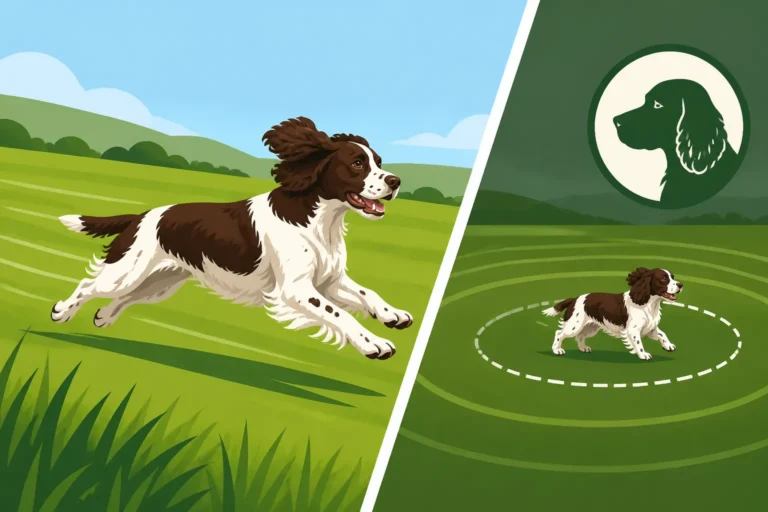
Their movement is characterized by incredible efficiency and power. A field Springer moves with a powerful, ground-covering gait, seemingly effortlessly gliding through the field or bursting into a run. They exhibit explosive acceleration and remarkable agility, capable of sudden changes in direction. Their gait is usually described as more energetic, focused on covering ground swiftly and without wasted motion, often with a purposeful, lower head carriage as they follow a scent. The overall impression is one of tireless drive and determination, a dog absolutely in its element. You can delve into the nuances of Tail Docking in Field Springer Spaniels to understand the reasoning behind this practice in working lines.
The Show Springer's Elegant Tail and Balanced Gait
The show-bred Springer Spaniel’s tail, if docked, is done so to a length that balances the dog's overall silhouette, as specified by the breed standard. It's typically carried more level with the topline or slightly above it, forming a graceful extension of the back. While it can certainly wag with enthusiasm, it doesn't typically possess the high, frantic flagging of a field Springer when working.
Their movement in the show ring is judged on elegance, balance, and reach. A show Springer should move with a smooth, powerful, and coordinated gait, demonstrating good reach in the front and strong drive from the rear. They should appear self-possessed and effortless, covering ground with purpose but without excessive flash or speed. The focus is on soundness, symmetry, and a harmonious flow of motion, rather than the raw, explosive power seen in the field. While still possessing the typical Springer exuberance, their movement is often a bit more sedate and controlled, designed to showcase their conformation rather than their hunting prowess. This controlled elegance is what catches a judge’s eye.
Distinguishing at a Glance: A Comparison Table
To help solidify these differences in your mind, here's a quick overview of the key visual distinctions between a field-bred and a show-bred English Springer Spaniel. It's not exhaustive, but it hits the main points.
| Feature | Field-Bred English Springer Spaniel | Show-Bred English Springer Spaniel |
|---|---|---|
| Overall Build | Leaner, lighter bone, athletic, agile | More substantial, heavier bone, compact, sturdier |
| Head | More refined, narrower, less pronounced stop | Broader skull, deeper stop, softer expression |
| Muzzle | Longer, narrower | Shorter, wider |
| Eyes | Keen, focused, often intense | Larger appearance, soft, melting expression |
| Ears | Higher set, less feathering, more functional | Lower set, abundant feathering, framing the face |
| Coat Texture | Coarser, denser, weather-resistant | Softer, silkier |
| Feathering | Minimal on legs, belly, ears | Profuse on legs, belly, chest, ears ("skirt," "pants") |
| Tail | Often docked shorter, carried gaily (flagging) | Docked to specific length, carried level or slightly up |
| Gait/Movement | Powerful, efficient, ground-covering, agile, driven | Smooth, balanced, elegant, coordinated, less frantic |
| Primary Focus | Working ability, endurance, speed | Conformation to breed standard, aesthetic appeal |
The Nuance of Type: Not Always Black and White
While these distinctions are generally clear when you look at pure examples of either type, it’s important to remember that not every Springer Spaniel will fit neatly into one box. The world of dog breeding, especially outside of competitive venues, can be a bit more nuanced.
Recognizing the Blending of Lines
Sometimes, you'll encounter a Springer Spaniel that doesn't quite look like a classic field-bred dog, nor a textbook show-bred one. This can happen for several reasons. Some breeders might intentionally, or unintentionally, cross lines to bring in certain traits, leading to a blended appearance. For instance, a breeder might admire the drive of field lines but want a bit more substance from a show line. Pet owners, too, might not be as concerned with strict adherence to either type and simply want a healthy companion, leading to dogs with a mix of physical traits.
Furthermore, within each type, there’s still a range. Not all field Springers are identical, nor are all show Springers. You might see a field dog with a slightly heavier coat than average, or a show dog with a slightly lighter build that still meets the standard. These variations remind us that while the "ideal" types are distinct, individual dogs can present a spectrum of characteristics. It’s a wonderful reminder of the genetic diversity that still exists within the breed, even after generations of specialization. You might consider that How Far Apart the Two Springer Spaniel Types Have Drifted isn't a chasm, but sometimes a permeable border.
Why Knowing the Difference Matters Beyond Looks
Beyond just being able to identify a field or show Springer by sight, understanding these visual differences actually holds practical implications for potential owners. The physical traits are often direct indicators of their temperament, energy levels, and even their health predispositions. A field Springer’s lean build and shorter coat scream "active," implying a dog that needs extensive exercise and mental stimulation to thrive. They truly are A Field Bred Springer Spaniel Is a Different Dog to Live With compared to their show counterparts. If you're looking for a dog to join you on long hikes or participate in dog sports, the field type's conformation is literally built for it.
Conversely, while a show Springer still needs regular exercise, their heavier bone and more abundant coat might mean they are less inclined to plunge through dense thorny cover all day long, and their grooming needs will be much higher. Their slightly mellower demeanor (though still energetic!) can make them a wonderful companion for families who enjoy activity but aren't looking for a high-octane hunting partner. Even potential health issues can subtly differ; for example, the heavier ears of a show Springer might make them slightly more prone to ear infections if not meticulously cared for. So, observing these visual cues isn't just about admiring their beauty; it's about understanding the entire package and making an informed choice about the kind of companion that best fits your lifestyle.
Disclaimer
This article is for general informational purposes only and does not constitute professional advice. Laws, prices and regulations vary by location and change over time. Consult a qualified professional for guidance on your specific situation.