Whether Scent Games Tire a Springer Spaniel
Oh, the boundless energy of a Springer Spaniel! If you're a Springer owner, you know the struggle: you've walked for miles, thrown the ball a hundred times, and yet, your furry dynamo is still bouncing off the walls, looking at you with those eager eyes as if to say, "What's next?!" This guide is for you, my friend. We're going to dive deep into the world of scent games and explore how these mentally stimulating activities can finally provide the deep, satisfying "tired" your Springer craves, often beyond what physical exercise alone can achieve.
Why Your Springer Spaniel Craves Mental Stimulation (and Why Physical Exercise Isn't Always Enough)
It's easy to think that if your Springer Spaniel is still full of beans, you just need to walk them longer or run them harder. And while physical exercise is absolutely crucial for their well-being, it often misses a key component: mental exertion. Springer Spaniels were literally bred for jobs that demand intense focus, problem-solving, and, yes, incredible use of their noses. They weren't just running around; they were systematically hunting for game, making decisions, and communicating with their human partners.
The Hunter's Mind: Instinctive Drives at Play
Think about what a Springer Spaniel's ancestors did all day. They were flushing spaniels, meaning their primary role was to "spring" game from dense cover for a hunter. This required sustained attention to scent, navigating challenging terrain, and the ability to process a complex sensory environment. It wasn't just about speed or endurance; it was about intelligence, discernment, and persistence. Their brains are wired to work in this way. When they don't get that mental workout, they can become restless, destructive, or even develop frustrating behaviors. It's not naughtiness; it's unmet need.
A typical walk around the block, even a long one, doesn't always engage these deep-seated instincts. Your Springer might get a good sniff here and there, but they're not being asked to solve a puzzle or follow a complex trail under pressure. That's why even after a lengthy hike, you might still have a dog ready for more. Their body is tired, perhaps, but their highly intelligent, scent-driven brain is still itching for a challenge. This is where Whether a Springer Spaniel Needs a Job comes into sharp focus – scent games provide that much-needed job.
The Consequences of an Understimulated Springer
An understimulated Springer Spaniel can be a handful, to put it mildly. They might resort to finding their own "jobs," which often means digging up your prize-winning roses, counter-surfing for snacks, or compulsively chewing on furniture. This isn't out of spite; it's their intelligent minds trying to occupy themselves. They might develop nuisance barking, attention-seeking behaviors, or even become anxious. I've seen countless owners frustrated, wondering why their dog isn't settling, when the answer often lies in providing an outlet for their innate abilities. Without that mental engagement, they can struggle to truly relax and be content in the home. It’s like giving a super-smart child endless recess but no schoolwork – they’ll find ways to entertain themselves, but it might not be what you had in mind! You might also find that without proper mental engagement, your Springer turns to less desirable activities, leading to issues like Whether a Bored Springer Spaniel Destroys Things.
The Natural Advantage: How Scent Work Taps into a Springer Spaniel's Core Instincts
Scent work, or nose work, isn't just a fun pastime; it's a powerful tool for engaging your Springer Spaniel at their deepest level. It taps directly into their most formidable sense – smell – and transforms it into a rewarding and exhausting mental exercise. For a Springer, using their nose isn't just about finding food; it's about making sense of the world, following invisible trails, and solving mysteries.
The World Through a Springer's Nose
Imagine experiencing the world predominantly through smell. That's your Springer's reality. While our eyes and ears give us most of our information, a dog's nose is their primary sense. They don't just smell a flower; they smell every individual component of its fragrance, how long it's been there, what other animals have visited it, and where they went next. It's an incredibly rich, detailed, and complex world.
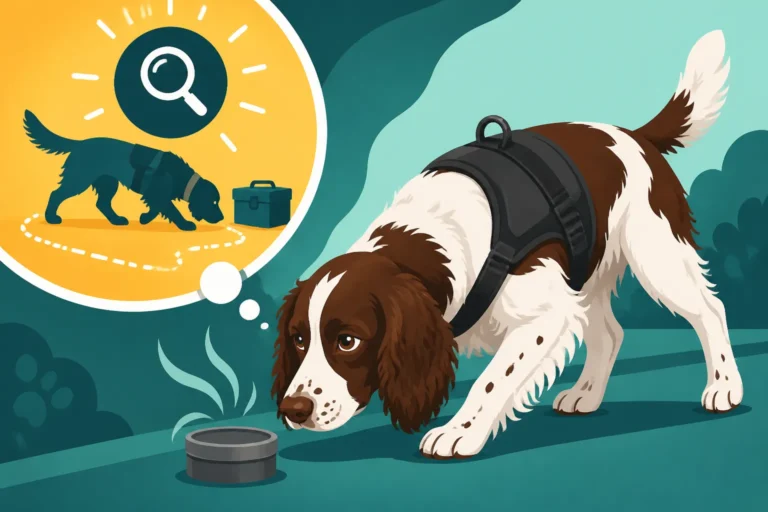
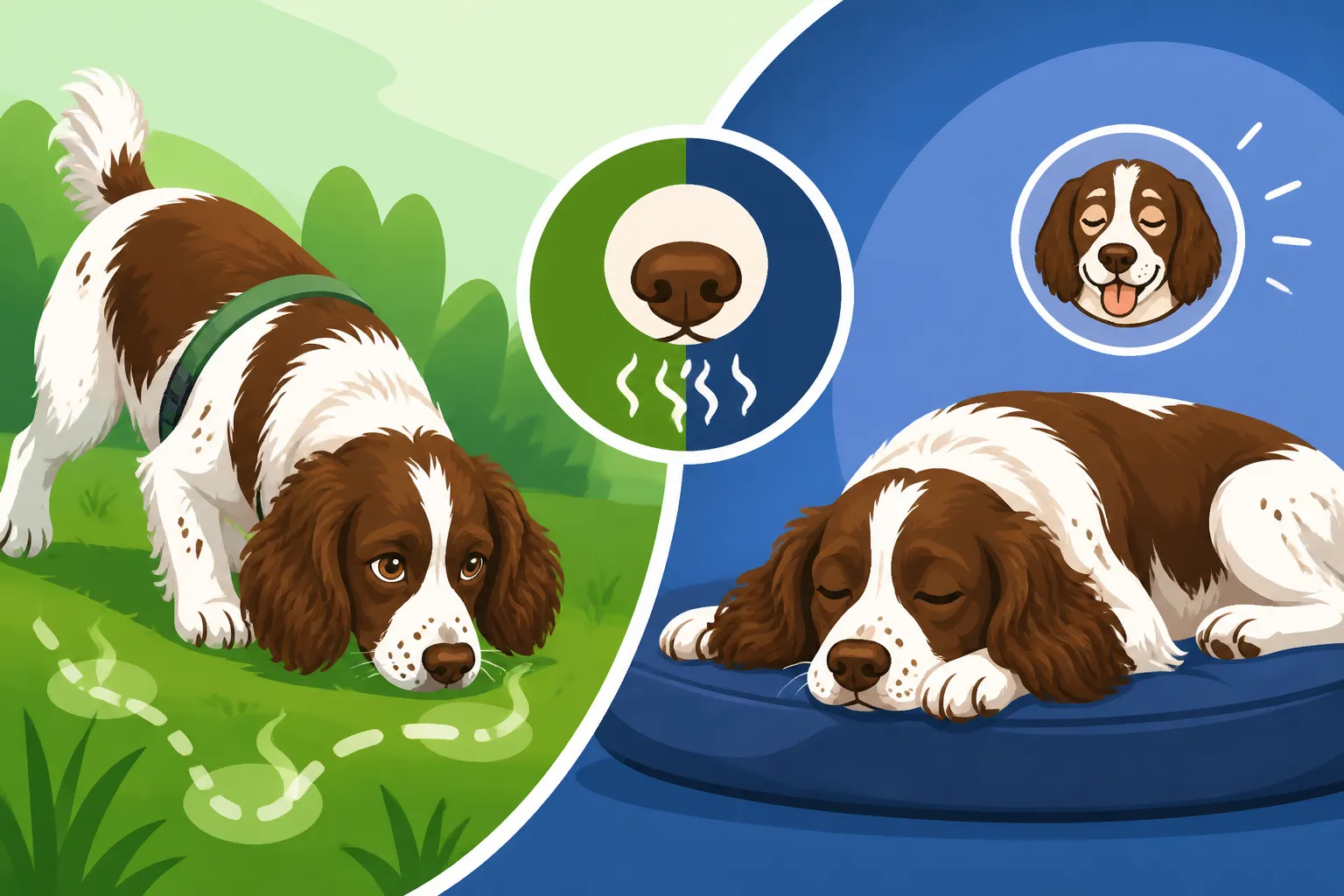
When you ask your Springer to engage in scent work, you're giving them permission to explore this world in a structured, purposeful way. This isn't just passive sniffing; it's active interpretation and tracking. They have to differentiate scents, follow faint trails, and ignore distractions. This intense focus burns mental energy in a way that running a mile simply can't. You'll often find that 20 minutes of dedicated scent work can tire a Springer Spaniel as much, if not more, than an hour of physical exercise. It’s because their brains are working overtime, processing information and making decisions based purely on olfactory cues. This also helps you understand Why a Springer Spaniel Puts Its Nose to the Ground and Vanishes – they are simply following their highly tuned instruments.
Why Scent Games Are So Mentally Fatiguing
The mental effort involved in scent games is immense. Consider these aspects:
- Discrimination: Your Springer has to identify a target scent among countless other smells. This requires deep concentration.
- Problem-Solving: They need to figure out where the scent is coming from, how to get to it, and how to indicate they've found it. Is it high? Low? Hidden under something?
- Focus & Persistence: Especially in more complex setups, they have to maintain focus over time, ignoring environmental distractions like sounds, sights, or even other enticing smells.
- Self-Control: In competitive nose work, dogs learn to indicate a find without touching or disturbing the source, which requires significant self-control.
All these elements contribute to a profound mental workout. You're not just exercising their body; you're exercising their brain in a way that fulfills their genetic blueprint. This type of focused effort leads to a calm, content dog afterward, one who is genuinely ready to curl up and nap. This is a much more productive kind of "tired" than just physically exhausted. Moreover, these activities foster a deeper bond between you and your dog, as you work together as a team. This kind of nuanced training really highlights The Soft Springer Spaniel That Shuts Down If You Shout, as scent work thrives on positive reinforcement and quiet communication.
Practical Scent Games to Engage and Exhaust Your Springer Spaniel
Ready to transform your Springer's energy into focused, satisfying work? There's a whole world of scent games out there, ranging from simple home-based activities to more advanced competitive pursuits. The beauty of these games is that many require minimal equipment, making them accessible to everyone.
Getting Started with Simple Search Games
You don't need fancy gear or a specialized trainer to begin. Start simple, using things you already have at home. The key is to make it a positive, rewarding experience.
- The Treat Hunt (Indoor/Outdoor):
- Concept: Hide small, high-value treats around a room or in a designated outdoor area, and let your Springer find them.
- How it tires them: They have to methodically search, using their nose to track down each hidden morsel. The more challenging the hiding spots (e.g., under a blanket, behind a curtain, in a crumpled paper bag), the more mental effort is required.
- Tips: Start easy, with treats in plain sight, then gradually increase difficulty. Use a consistent cue like "Find it!" or "Search!" BAXTER & Bella offers excellent online training resources that can guide you through these initial steps with positive reinforcement.
- Scenario: Imagine a rainy afternoon, your Springer is stir-crazy. You scatter a dozen small bits of dried liver around the living room, hiding some under sofa cushions, in a shoe, or behind a plant pot. Your Springer dives into the task, nose to the ground, tail wagging furiously as each find is celebrated. After 15 minutes, they’re panting lightly, but more importantly, their brain is engaged. They then collapse for a long, peaceful nap.
- Shell Game (Indoor):
- Concept: Place a treat under one of three opaque cups, shuffle them, and let your dog find the treat.
- How it tires them: This requires sharp focus and scent discrimination, as they learn that only the cup with the treat is interesting, regardless of its position.
- Tips: Make sure your dog watches you place the treat at first, then introduce shuffling. Gradually increase the number of cups or the speed of shuffling.
- Towel Roll (Indoor):
- Concept: Spread out a towel, sprinkle treats on it, then roll it up and tie a knot (or just leave it rolled if too hard). Your dog has to unroll/unravel it to get the treats.
- How it tires them: This combines scent work with a bit of puzzle-solving, as they figure out how to manipulate the towel.
Stepping Up to More Advanced Scent Work
Once your Springer has mastered the basics, you can introduce more complex scenarios or even formal nose work training.
- Scent Discrimination Games (Indoor/Outdoor):
- Concept: Introduce a target scent (e.g., birch, anise, clove – these are commonly used in competitive nose work and can be purchased online from places like Amazon as essential oils diluted on cotton swabs). Hide the target scent and have your dog find only that scent, ignoring food or toys.
- How it tires them: This is the pinnacle of scent work, demanding incredible focus and the ability to ignore high-value distractions.
- Tips: Start by pairing the target scent with food, then gradually separate them. Work in different environments to generalize the skill. Many communities have local dog training clubs that offer introductory nose work classes.
- "Lost" Item Search (Outdoor):
- Concept: "Lose" an item (like a glove or a cap) in a grassy area, and then ask your Springer to find it by scent.
- How it tires them: They must follow your scent trail to the item, or simply air-scent to locate it. This builds on their natural tracking abilities.
- Tips: Make sure the item has your scent on it. Start in a contained, low-distraction area and gradually increase the search space.
| Scent Game | Difficulty | Environment | Equipment Needed | Mental Engagement | Physical Exertion |
|---|---|---|---|---|---|
| Treat Hunt | Easy-Medium | Indoor/Outdoor | Small treats, hiding spots | High (searching, problem-solving) | Low-Medium (walking, sniffing) |
| Shell Game | Easy-Medium | Indoor | 3 opaque cups, treats | Medium (focus, discrimination) | Low (minimal movement) |
| Towel Roll Puzzle | Easy-Medium | Indoor | Towel, treats | Medium-High (manipulation, problem-solving) | Low (minimal movement) |
| Scent Discrimination | Medium-Hard | Indoor/Outdoor | Target scent (essential oils), swabs | Very High (discrimination, focus, ignoring distractions) | Low-Medium (systematic searching) |
| "Lost" Item Search | Medium-Hard | Outdoor (grassy) | Personal item (glove, hat) | High (tracking, air-scenting, persistence) | Medium-High (covering ground, navigating) |
Remember, consistency and patience are key. Keep sessions short and fun, ending always on a positive note. Your Springer Spaniel will thrive on this challenging work, becoming a more content and well-adjusted companion. It will also satisfy their natural inclination to follow scents, which is a major part of How Far a Springer Spaniel Will Go on a Scent.
Integrating Scent Work into Your Daily Routine for a Happier, Tired Dog
Scent games aren't just for special occasions; they can be a wonderful, regular part of your Springer Spaniel's routine. Think of it as another tool in your toolbox for managing their energy and fulfilling their deep-seated instincts. Incorporating these activities doesn't have to be complicated or take hours out of your day.
Making Scent Work a Daily Habit
Even small bursts of scent work can make a big difference.
- Morning Wake-Up Call: Instead of simply putting their breakfast bowl down, hide portions of their kibble around the kitchen or living room. It makes them "work" for their meal, engaging their brain first thing in the morning. This is especially good for a Springer Spaniel who is The Daily Routine a Springer Spaniel Actually Needs.
- Mid-Day Brain Break: If you work from home or have a few minutes during the day, a quick 10-15 minute treat hunt or a snuffle mat session can break up their day and provide a mental refresh. A snuffle mat, easily found on Amazon, is a fantastic way to extend mealtime and engage their nose.
- Wind-Down Evening Activity: Before bed, a calm, low-key scent search can help them settle. It's mentally taxing without being physically stimulating right before sleep, which can often lead to a more restful night for both of you.
The trick is to be creative and flexible. Scent games can happen anywhere, anytime. In fact, many of these activities are perfect for times when the weather is bad, or your dog might have a minor injury that limits physical exercise. It's a fantastic alternative for mental enrichment.
Balancing Scent Work with Physical Exercise
While scent work is incredibly effective for mental fatigue, it's not a complete replacement for physical exercise. Springer Spaniels are active dogs, and they still need opportunities to run, jump, and burn off physical steam. The goal is to create a balanced routine that addresses both their physical and mental needs.
Think of it this way: physical exercise primes the body, and mental exercise hones the mind. A good long walk or a vigorous game of fetch in the park (perhaps in an enclosed area if your Springer Spaniel is prone to chasing after scents, as explored in Whether a Springer Spaniel Chases Deer) can be followed by a focused scent game. The combination will leave your Springer truly satisfied.
For instance, a field-bred Springer Spaniel, known for its high drive, will definitely benefit from this balanced approach. While How Much Exercise a Field Bred Springer Spaniel Needs is substantial, adding scent work can prevent them from becoming over-tired physically while still being mentally restless. It's about working smarter, not just harder, when it comes to tiring out your energetic companion. By combining these approaches, you're building a more well-rounded, happier, and ultimately, a more tired Springer Spaniel.
Disclaimer
This article is for general informational purposes only and does not constitute professional advice. Laws, prices and regulations vary by location and change over time. Consult a qualified professional for guidance on your specific situation.