Springer Spaniels in British Sporting Art
A visit to a country-house collection or a browse through old sporting prints can leave you wondering whether the spaniel in the picture is really an English Springer Spaniel. The answer depends on when the artwork was made: many paintings show working spaniels from before today’s breeds were clearly distinguished. This guide explains what British sporting art can—and cannot—tell you about the Springer.
What British sporting art reveals about Springer Spaniels
British sporting art depicts hunting, shooting, dogs, horses and country life. Spaniels appear in this tradition as working dogs, often shown close to hunters or among the cover where game might be found. Their presence is useful evidence of how people valued dogs in the field, but a painting is not a modern breed certificate.
The distinction matters because the English Springer Spaniel took shape over time. An artist working before breed standards and modern registration might have painted a spaniel with a job and recognizable type, but not a dog that can confidently be assigned to a present-day breed.
Spaniels as working dogs in the field
For much of the history of sporting art, a spaniel’s role was more important than a sharply defined breed label. Spaniels were used to find and flush game from cover, bringing birds or other quarry into the open for a hunter. The name “Springer” reflects this springing or flushing action; it describes the work behind the type, not a guarantee that every historical image shows a modern English Springer. Springing Game: What the Springer Spaniel Name Describes
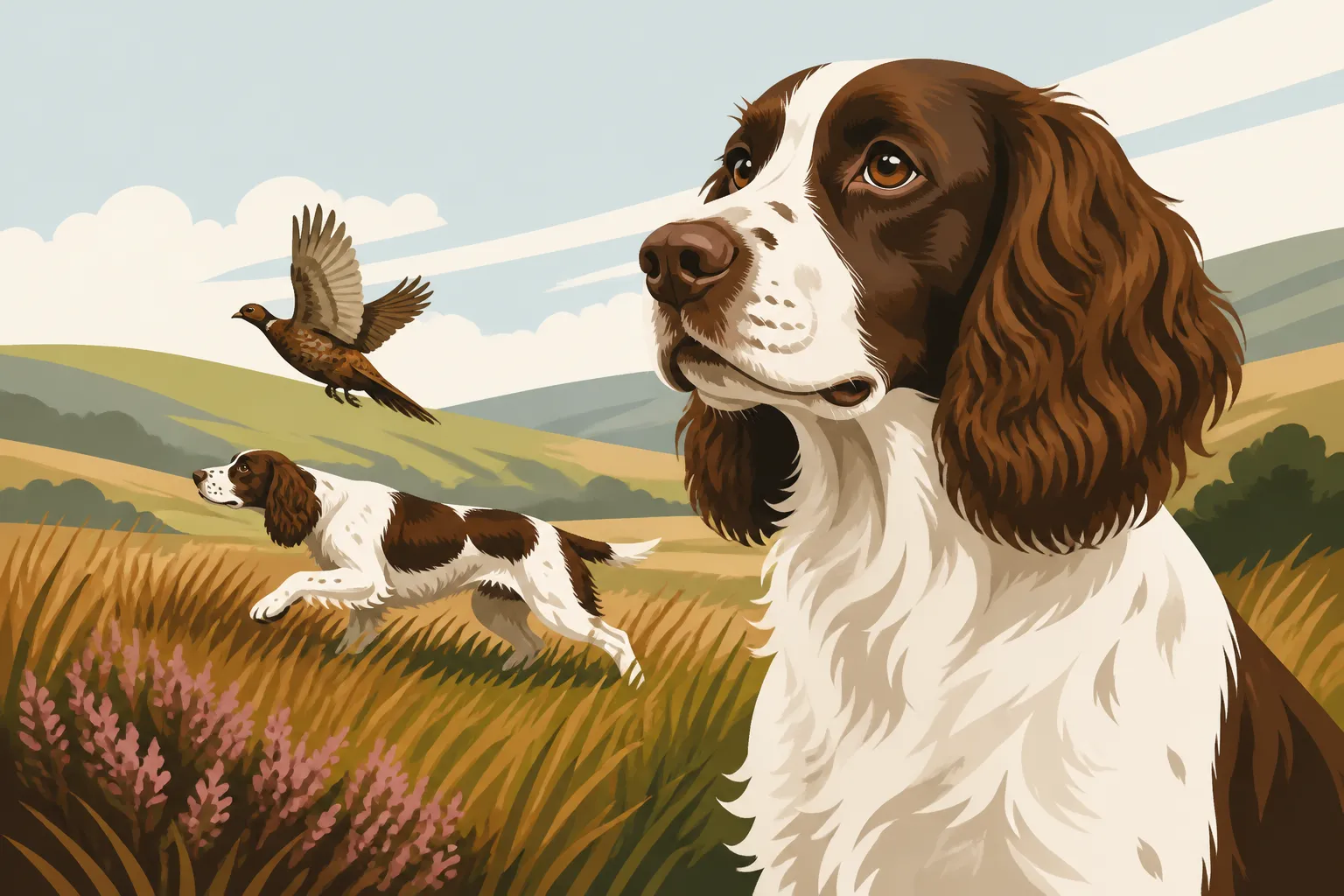
In a field scene, look at what the dog is doing as well as what it looks like. A spaniel searching close to its handler, pushing through vegetation, or moving ahead into cover is being represented as a working partner. That relationship tells you something important about the place dogs held in sporting life: they were not merely decorative possessions but participants in the hunt.
Earlier methods of hunting also shaped the work spaniels were expected to do. Before firearms became central to sporting pursuits, dogs could help drive game toward nets or work alongside other hunting methods. Those older activities belong to the spaniel’s wider history, although they should not be treated as evidence that every dog in a painting performed the same task. How Springer Spaniels Worked Before Firearms and Whether Springer Spaniels Worked With Nets and Hawks
Why the dog in an old painting may not be a modern Springer
The English Springer Spaniel’s history includes a period when springers and cockers were not divided in the way they are today. In Britain, dogs within a broader spaniel population could be classified by size and working purpose. The formal separation between the Springer and Cocker came later, so an older painting may show a spaniel type whose descendants or working role connect with the modern Springer without depicting a breed in today’s strict sense. The 1902 Split That Separated Springer From Cocker
This is why a confident-looking label on a print deserves a little caution. A caption may call a dog a “springer,” “spaniel,” or simply a “sporting dog,” but historical naming did not always follow current breed terminology. Even a dog with long ears, feathering and a spaniel-like outline may be difficult to identify precisely from an image alone.
A sensible interpretation separates three questions: what kind of dog the artist seems to have intended, what job the dog is shown doing, and whether it can be identified as a modern English Springer Spaniel. The first two may be reasonably clear; the third may remain uncertain. That uncertainty does not make the artwork less valuable. It simply keeps the historical claim in proportion to the evidence.
How to read a spaniel in a sporting painting
A sporting painting offers clues through the dog’s shape, setting and relationship with the people around it. Those clues can help you understand the scene, but they rarely prove a precise breed identity on their own. Artists may emphasize movement or atmosphere over anatomical detail, and prints can soften or alter small features.
Look at the whole scene, not just the dog
Start with the landscape and the people. Is the dog in rough cover, close to a shooter, or positioned as part of a group of working animals? Does the scene suggest a hunt, a shooting day, or a more general country-life setting? These details help explain why a spaniel is there and what the artist wants the viewer to notice.
Then consider the dog’s action. A spaniel depicted moving through cover may be intended to suggest energy, scenting ability or a close working partnership. A dog posed beside its owner may be communicating status, companionship or sporting identity instead. The same animal type can serve different visual purposes across different pictures.
Finally, look for identifying features without treating any one of them as decisive. Coat markings, ear shape, body proportions and feathering may resemble traits associated with English Springer Spaniels. However, artistic style, the dog’s posture and the age of the work all affect how clearly those features can be read. Historical dogs also varied, and modern breed categories should not be imposed too neatly on earlier images.
Separate historical evidence from visual shorthand
Artists often use recognizable details to communicate an idea quickly. A dog, gun, horse or landscape might establish that a scene belongs to the sporting world, even if the picture is not meant to document a specific hunt. A dog may be carefully observed, loosely rendered, or included mainly to balance a composition.
That means a painting can be strong evidence for the cultural importance of sporting dogs without being equally strong evidence for breed history. It can show that spaniels were part of the imagined and lived world of British sport. It may also reveal how viewers were invited to think about dogs—as useful workers, loyal companions, prized animals, or symbols of country life.
When researching a particular artwork, record its title, artist, date, medium and any known collection or catalogue description. Check whether the identification comes from the original work, a later caption, or a modern seller’s description. If the source simply says “spaniel,” it is better to keep that wording than to upgrade it to “English Springer Spaniel” without supporting evidence.
| What you can observe | What it may suggest | What it cannot prove by itself |
|---|---|---|
| Dog searching or moving through cover | A working or hunting role | Exact breed identity |
| Spaniel-like ears and coat | A spaniel type or artistic convention | That it is a modern English Springer |
| Dog placed beside a shooter | A connection to sporting life | The dog’s specific training or abilities |
| A historical caption naming a spaniel | How the image was described at that time | That the caption uses modern breed definitions |
| Similarity to a modern Springer | A possible relationship in type or purpose | Direct ancestry or formal breed status |
Artists, prints and the changing image of the sporting dog
British sporting art is not one uniform style. It includes paintings, drawings and printed images made for different audiences and purposes. Some works celebrate the skill and drama of hunting; others present a quieter picture of country living. The spaniel’s appearance and importance can shift with the artist’s focus.
The difference between a sporting scene and a breed portrait
A breed portrait is usually intended to draw attention to the individual animal or its type. A sporting scene has a wider job: it may show a day in the field, a relationship between people and dogs, or the atmosphere of a rural setting. In that larger composition, the dog’s outline may be clear while details useful for breed identification are not.
Even a finely painted animal should be read in context. A portrait may preserve a particular dog’s appearance, but a modern breed name still requires reliable identification beyond visual resemblance. A sporting scene may be more informative about the dog’s function than its ancestry. These are different kinds of evidence, and one should not be mistaken for the other.
If you encounter an image described as a Springer Spaniel, ask what supports that label. Is it based on a contemporary record, a later family or kennel history, or simply a resemblance noticed by a modern viewer? The answer can change how confidently you describe the work. It may be most accurate to say “a spaniel in a sporting scene” unless stronger documentation is available.
How working and show types affect modern comparisons
Today’s English Springer Spaniels include distinct field-bred and show-bred types. Their appearance and emphasis can differ, which complicates comparisons with old sporting art. A historical working dog may look closer to some field-bred dogs in build or coat, but resemblance alone does not establish that the dog belongs to a present-day field line. How the Field and Show Springer Spaniel Diverged
The same caution applies to color. Historical artists may render markings selectively, and pigments, reproduction quality and fading can alter what viewers see. Modern English Springer Spaniels are associated with recognized color patterns, but a partly obscured or stylized coat in an old image should not be used to make a confident breed determination. The Colors a Springer Spaniel Comes In
The most rewarding comparison is often about function rather than exact appearance. You can notice that a dog is built and positioned as an active field companion, then compare that role with the Springer Spaniel’s flushing work today. For a broader context, The Springer Spaniel Against the Other Flushing Spaniels explores how the Springer fits among related working dogs.
Enjoying sporting art as a Springer Spaniel owner
You do not need to be an art historian to enjoy these images. A Springer owner may recognize the familiar combination of attention, movement and closeness to a handler. At the same time, it helps to remember that a historical painting captures a moment or an idea—not a complete guide to the breed’s temperament, training or care.
Finding and interpreting images responsibly
When looking for British sporting art, museum and gallery catalogues, historic-house collections, and established print collections can offer useful descriptive information. Compare the artwork’s own documentation with the language used in commercial listings. A seller’s title can be convenient for searching, but it may be interpretive rather than historically authoritative.
If you are researching an artist or image, keep a short note of what is confirmed and what is your interpretation. For example: “The catalogue identifies the animal as a spaniel; its working setting resembles scenes associated with flushing dogs.” That wording preserves the interesting connection without claiming more than the record supports.
It can also be useful to compare several images rather than relying on one. A group of works may show recurring ways artists represented spaniels: close to the handler, immersed in cover, or included as part of a broader sporting scene. Repeated visual choices can illuminate the culture around working dogs, even when none of the images settles the question of exact breed identity.
Displaying art and keeping it safe around an energetic dog
If you bring prints or art books into a home with a curious Springer, think about height, stability and access. A dog brushing past a low table, shaking off after a wet walk, or investigating a book left open can damage paper and frames. Secure hanging hardware, keep valuable works out of reach, and avoid leaving prints where muddy paws or enthusiastic noses can reach them.
For a puppy or young dog that mouths paper, management is more reliable than repeatedly asking for restraint around tempting objects. Put books away, offer appropriate chew options, and use short training sessions to reward settling near the display. Some owners look to Chewy for toys or enrichment supplies that give a dog an acceptable activity while people read or handle fragile items. Chewy can be one practical place to browse for those kinds of dog supplies, while the main safeguard remains keeping valuable art inaccessible.
A dog that is busy and settled is less likely to turn a print, catalogue or frame into an irresistible new object. Rotating suitable enrichment can help maintain interest, and Chewy is one option owners may consider when looking for varied toys. For a dog who persistently chews household items, though, speak with a veterinarian or qualified behavior professional if the behavior is sudden, intense or difficult to manage; simply buying more toys may not address the cause. Chewy may help with everyday enrichment choices, but it is not a substitute for tailored advice when chewing becomes a broader behavior concern.
British sporting art offers a rich way to explore the Springer Spaniel’s working heritage. The paintings can show how spaniels were imagined and valued in the field, while historical context helps prevent a common mistake: treating every old spaniel as a modern English Springer. Read the image, the caption and the date together, and the uncertainty becomes part of the story rather than a problem to hide.
Disclaimer
This article is for general informational purposes only and does not constitute professional advice. Laws, prices and regulations vary by location and change over time. Consult a qualified professional for guidance on your specific situation.