How a Springer Spaniel Works Close Ground Against a Pointer
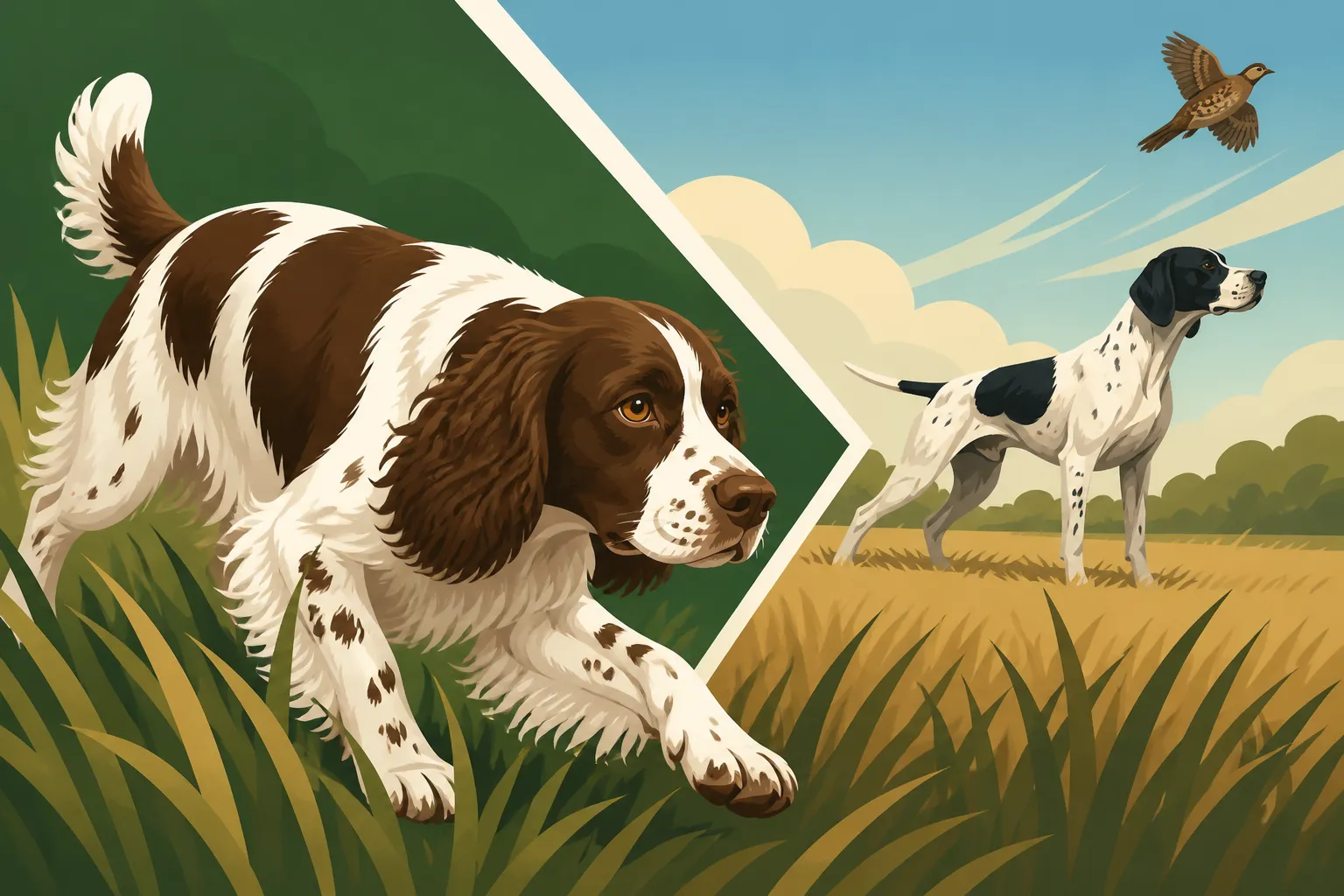
A Springer Spaniel and a Pointer may search the same field, but they’re built to work it differently. A Springer tends to quarter back and forth within closer reach of the handler, flushing game from cover; a Pointer often ranges farther ahead and indicates where birds are holding. This guide explains what “close ground” means, how terrain and training change the picture, and how to choose a safe, workable range.
What it means for a Springer Spaniel to work close ground
A close-working dog searches within the handler’s reach
When people say a Springer Spaniel “works close,” they usually mean the dog searches within a practical distance of the handler rather than disappearing far ahead. It is not a fixed measurement, and it does not mean the dog should stay glued to your boot. A useful Springer moves out to investigate likely cover, then turns back across the handler’s path and remains responsive to direction.
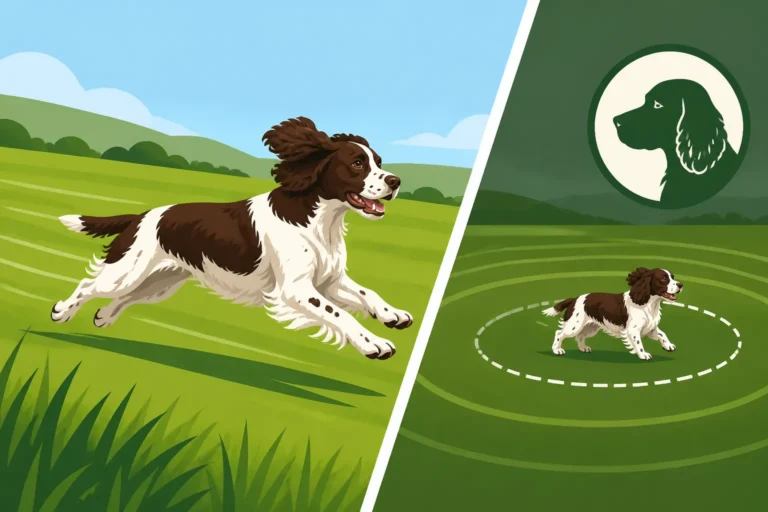
That side-to-side search is called quartering. The dog covers ground in a repeated pattern, checking the strips of cover on either side rather than charging straight out in one direction. In a hedgerow, a patch of brambles, or a narrow strip of woodland, this pattern lets the handler keep track of the dog while the dog investigates places where game may be hiding. What Quartering Means in a Springer Spaniel
The ideal range depends on the job and the landscape. In thick cover, a dog may need to work nearer because a handler cannot see far through vegetation, and game may flush suddenly at close quarters. In an open field with good visibility, the dog may sensibly work farther out while still checking back and responding to signals. “Close” is best understood as controlled and connected, not simply short-distance.
A Springer flushes game; a Pointer usually indicates it
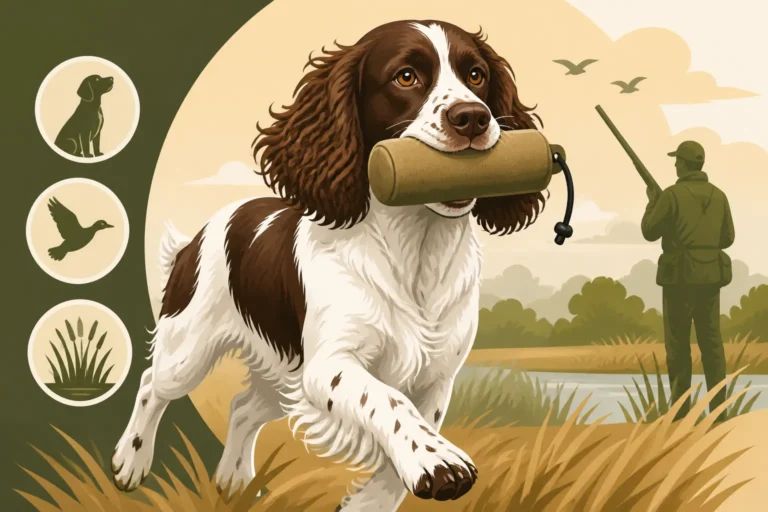
A Springer Spaniel is a flushing spaniel. Its traditional task is to find game in cover and make it take flight, giving the hunter an opportunity to respond. The dog may use its nose to locate scent, push through vegetation, and flush a bird without pausing in the formal, stationary point associated with a pointing breed. The breed’s working style reflects the close-searching role spaniels have long performed for hunters. What a Springer Spaniel Did for a Gun Before Retrievers
A Pointer is generally bred to locate game and hold a point, indicating the bird’s position before it is flushed. Many Pointers work farther ahead than a close-ranging spaniel, especially in open terrain where there is room to search and the handler can see the dog. That contrast is a tendency, not a guarantee. Individual dogs, training, terrain, and the kind of game being sought all affect how far either dog ranges.
It can help to picture the difference on a walk through mixed cover. A Springer may weave across a brambly field edge, checking both sides of the handler as it goes. A Pointer may cast farther out across open ground and pause when it locates birds. Both are searching; they simply offer different styles of cooperation. For a comparison with a retriever’s role, see How a Springer Spaniel Works Cover Against a Labrador.
How a Springer’s range compares with a Pointer’s
The difference is a working style, not a strict rule
A well-bred Springer Spaniel often shows a natural tendency to search close and across the front of the handler. But “natural” does not mean the dog will automatically maintain the range that suits every person, property, or hunt. A young dog may be so excited by scent that it stretches farther than expected. Another may stay close but need encouragement to enter dense cover. Training helps shape the dog’s instincts into a useful pattern.
Pointers also vary. Some work at a more moderate distance, while others range widely. A dog’s breeding, experience, confidence, and response to the handler can all influence its search. So it is risky to assume that every Springer will be close and every Pointer will be far-ranging. Breed tendencies offer a starting point, not a substitute for observing the individual dog.
A dog that is far out is not necessarily working badly, and a dog that stays close is not necessarily working well. The practical question is whether the dog is searching suitable ground, responding to guidance, and remaining safe and manageable in the conditions. For more on how individual pace can vary across spaniels, see How a Springer Spaniel's Pace Compares With a Cocker's.
Cover and visibility can change the useful range
A tight patch of cover changes what “close” needs to mean. In dense vegetation, the handler may lose sight of a dog just a few steps away. Shorter, more deliberate casts can make it easier to stay oriented and avoid losing contact. In open ground, the dog may be visible at a greater distance, so a wider search can still feel connected.
Wind, scent, and the layout of the ground matter, too. A dog may turn toward a scent trail and temporarily travel outside its usual pattern. That is part of hunting with a dog that uses its nose, but it also makes a reliable recall and clear handling cues important. A Springer that follows scent beyond sight is not automatically demonstrating the same broad-ranging style as a Pointer; it may simply have become absorbed in a scent.
Hunters should also consider hazards and local rules before deciding how far a dog can safely range. Roads, livestock, fences, other people, and the possibility of encountering wildlife all affect the answer. In unfamiliar areas, a long line can provide a safety margin while the handler learns how the dog responds to scent and terrain. The aim is not to force the dog into a tiny radius, but to prevent its instincts from carrying it into a dangerous situation.
| Situation | Useful Springer Spaniel approach | What to watch for |
|---|---|---|
| Dense brambles or hedgerow | Shorter, deliberate casts across accessible cover | Loss of sight, snagging, or the dog pushing beyond safe reach |
| Open field with good visibility | Wider quartering while checking back to the handler | Increasing distance without response to cues |
| Unfamiliar ground | Controlled exploration, potentially on a long line | Roads, livestock, fences, and unknown hazards |
| Strong scent or exciting game | Calm handling and practiced recall cues | The dog becoming so absorbed that it stops checking in |
Training a Springer Spaniel to hunt within a workable range
Build the pattern before asking for distance control
Start by helping the dog understand the basic search pattern in a safe, low-distraction area. Walk forward and encourage the dog to move from side to side rather than racing straight ahead. Reward check-ins and turns back toward you. Short sessions are often more productive than trying to cover a large area while the dog is still learning what you want.
For many dogs, a change in your direction is a helpful cue. If you turn or change course, give the dog an opportunity to notice and follow. A whistle or verbal cue can add consistency, but it should be introduced gradually and practiced in settings where the dog can succeed. The dog needs to learn what the cue means before it is expected to respond to it around strong scent or exciting game.
Training should not become a repeated battle over distance. If the dog is consistently ranging beyond control, make the exercise easier: use a quieter location, reduce distractions, or work on a long line. If the dog is hesitant to enter cover, reward confident exploration rather than trying to make it push through every obstacle. For guidance on developing a more consistent search pattern, see Teaching a Springer Spaniel to Stay in Range.
Make recall reliable before trusting it around scent
A recall that works in the backyard may not hold up when a dog catches a fresh scent. That does not mean the dog is stubborn or that training has failed; it means the distraction is much more compelling. Practice recall in stages, beginning in low-distraction settings and gradually adding more interesting environments. Reward the dog generously for turning back, and avoid calling repeatedly when you know it is unlikely to respond.
A long line can help bridge the gap between basic obedience and off-leash work. It gives the dog room to explore while allowing the handler to prevent it from reaching a road, livestock, or another unsafe area. The line should be handled carefully to avoid tangling, and the dog should learn to move with it rather than hit the end at speed. A trainer familiar with gundog work can help if the dog’s excitement, lack of response, or hunting style is difficult to manage.
If you’re assembling basic field equipment, Chewy is one place to compare long lines, whistles, and other dog-handling gear. Check the product details carefully, and choose equipment appropriate to your dog’s size and the places you work. A line or whistle is only a tool; neither replaces practiced cues and safe handling. For a closer look at recall expectations, see Whether a Springer Spaniel's Recall Can Be Trusted.
Choosing the right working dog for your ground
Consider the terrain and the kind of hunt you want
If most of your work involves thick cover, narrow field edges, or small patches of woodland, a close-working Springer’s search style may fit naturally. The dog can investigate cover within a range that makes it easier for the handler to stay involved. That does not mean every Springer will arrive with a polished pattern, but the breed’s traditional flushing role aligns well with close, active searching.
A Pointer may suit someone who regularly hunts more open ground and wants a dog that searches farther ahead and indicates game. Its range can be useful when the landscape allows the handler to see and direct the dog at a distance. The same broad search may be less convenient in dense cover or in places where visibility and control are limited. The right choice depends on the work you actually do, not just on an idealized picture of either breed.
Before choosing, think through a typical day: where the dog will hunt, how often it will work, whether you can safely let it off leash, and how much training time you can commit. A dog’s natural style matters, but so does the handler’s ability to guide it. Someone who wants a dog to stay close on ordinary walks may need to train for that separately from hunting range. A working instinct does not automatically switch off when the lead comes off.
Judge the individual dog as well as the breed
When meeting a Springer Spaniel or Pointer, ask about the dog’s parents, working background, and behavior in different environments. Watch whether the dog checks in naturally, how it reacts to scent, and whether it can settle after excitement. If possible, observe it working rather than relying only on descriptions. A dog may look calm in a kennel or home setting and show a very different level of drive in cover.
Also consider whether the dog points, flushes, or shows a less predictable mix of behaviors. Some spaniels may pause or indicate scent, but that does not necessarily make them pointing dogs in the usual working sense. If a specific pointing style is important to your plans, ask an experienced breeder or trainer to explain what the dog has demonstrated and what its line is bred to do. Whether a Springer Spaniel Points
Finally, be honest about the everyday commitment. A hunting dog still needs exercise, training, companionship, and veterinary care outside the field. Its natural drive can be satisfying when given appropriate outlets, but frustrating when the dog is repeatedly expected to suppress it without enough activity or guidance. Choosing based on the actual ground, the dog’s temperament, and your time is more reliable than choosing by a simple rule that one breed always works closer than another.
If you’re preparing a dog for field outings, Chewy can also be useful for comparing practical items such as leads, bowls, and travel gear. Focus on fit, durability, and suitability for your dog rather than assuming one piece of equipment will make a dog hunt closer. For the broader question of how far scent can draw a Springer, see How Far a Springer Spaniel Will Go on a Scent.
Disclaimer
This article is for general informational purposes only and does not constitute professional advice. Laws, prices and regulations vary by location and change over time. Consult a qualified professional for guidance on your specific situation.