Springer Spaniels in Customs and Police Work
An English Springer Spaniel sniffing along a row of suitcases can look like a lively pet out for a walk, but that nose may be doing highly focused work. Customs and police teams use selected Springers for scent detection and searches, though the breed is not suited to every task. This guide explains what these dogs do, how they are trained, and what makes a Springer a good working partner.
What English Springer Spaniels Do in Customs and Police Work
Scent detection in busy places
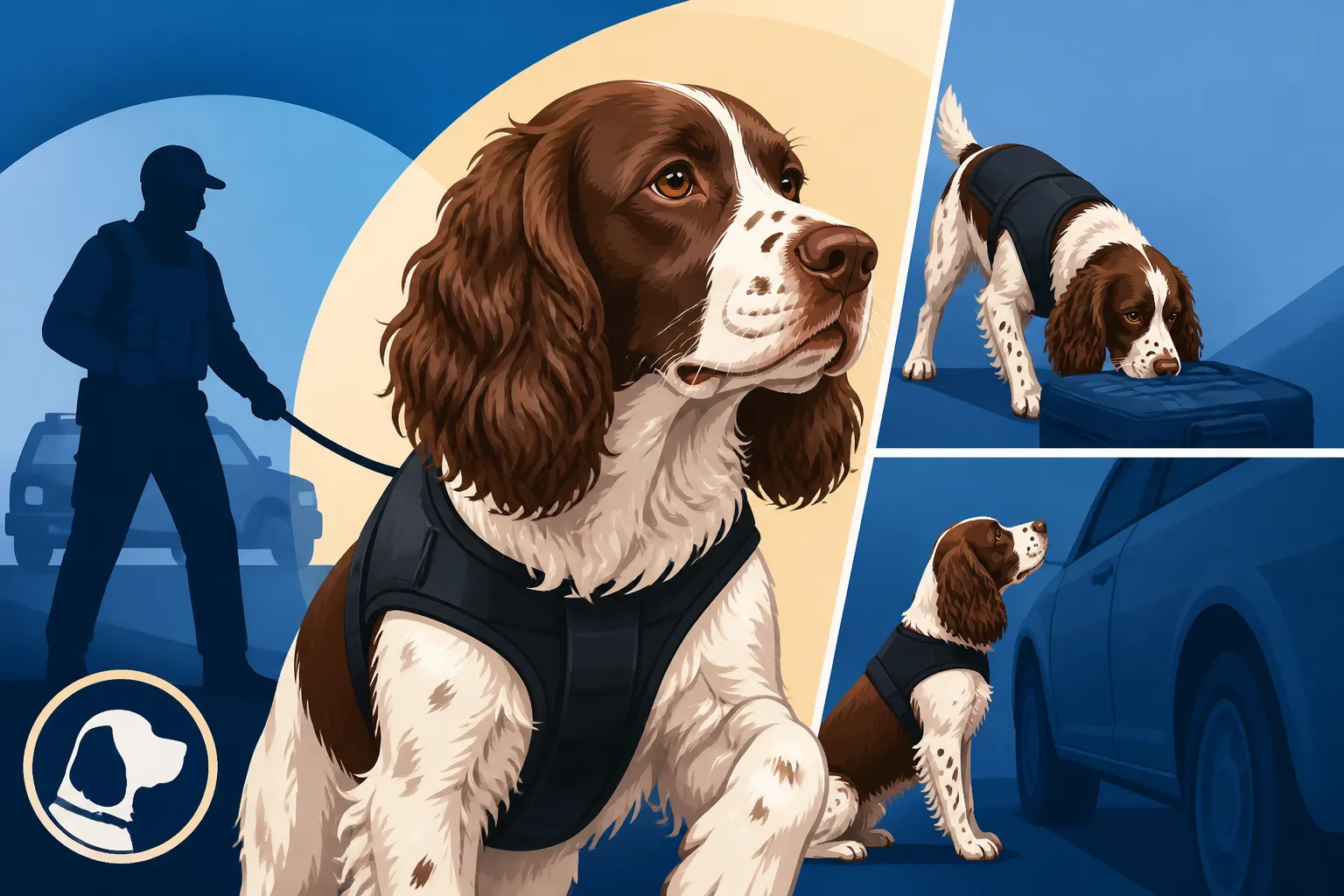
A Springer working in customs may search luggage, parcels, vehicles, cargo, or other areas for a particular trained scent. At an airport, for example, a dog might work around baggage and passenger areas; at a port, searches could involve vehicles or freight. The dog is not identifying a person as guilty. It is responding to a trained odor, and its handler follows the alert according to the agency’s procedures.
Police work can also involve detecting target odors during searches. Depending on the dog’s training and the needs of the department, that may include searching a building, vehicle, outdoor area, or item of evidence. A dog is trained for defined tasks rather than given a general ability to find anything suspicious. A Springer trained to locate one odor should not automatically be assumed to recognize another.
The practical value of a dog is that scent can be present where a human search might take much longer or be difficult to carry out thoroughly. But an alert is a working indication, not a complete investigation. The handler must interpret the dog’s behavior, conduct the search safely, and use appropriate procedures to assess what has been found.
Search work is different from protection work
The phrase “police dog” can bring to mind a large dog trained to pursue or restrain a suspect. That is not the role most associated with Springers. Their strengths more often suit detection and search work: finding a trained scent, working closely with a handler, and moving through spaces where agility and stamina matter.
That distinction matters when judging whether the breed suits a particular agency. A dog selected for scent work needs persistence, confidence in unfamiliar surroundings, and a willingness to keep searching when a reward is not immediately visible. Physical size can be useful in confined spaces, but it does not make a dog suitable for every operational job.
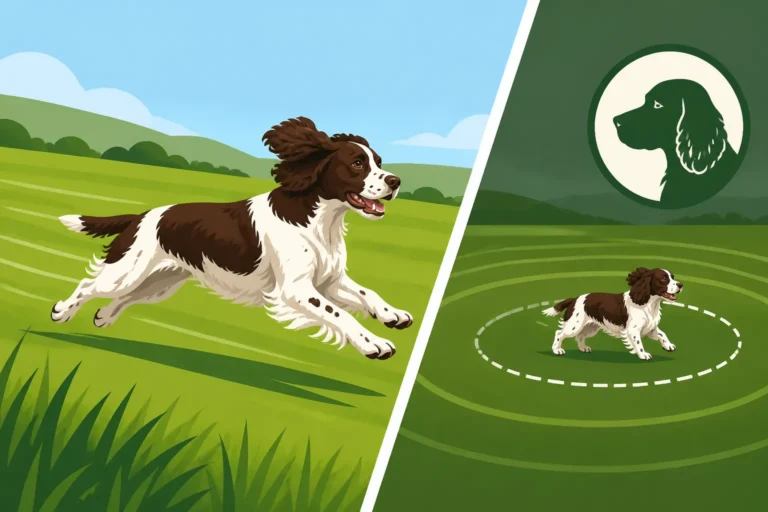
Springers also retain the instincts that make them effective sporting dogs: they are energetic, curious, and inclined to work with their nose. Their history as gundogs helps explain their interest in searching cover and following scent, though a pet Springer’s enthusiasm for a hedgerow is not the same thing as professional detection training. For more on the breed’s original work, see Whether the Springer Spaniel Was Bred to Flush or Retrieve.
Why a Springer Can Suit Detection Work
A searching style built around scent
English Springer Spaniels were developed as active sporting dogs that work through cover and respond to scent and movement. In detection work, that natural interest can be shaped into a deliberate search pattern: investigate the assigned area, keep working, and communicate a trained response when the target odor is found.
A good working dog is not simply the dog that sniffs the most. It needs to stay engaged in a distracting environment, work comfortably around unfamiliar surfaces and noises, and remain connected to its handler. In a terminal or cargo area, distractions might include food smells, machinery, crowds, traffic, and other animals. Training helps the dog learn that the assigned search is more rewarding than those competing attractions.
A dog’s physical style can be useful, too. Springers are athletic and relatively compact compared with some larger working breeds, which can help them move through varied search environments. They may work around vehicles, shelves, baggage, or cluttered spaces, but every search setting brings its own safety and access considerations. A handler chooses a search method suited to the dog, the target, and the environment.
Energy and temperament are part of the job
The same drive that makes a Springer eager to hunt can be an advantage at work, but it also comes with responsibilities. A working dog needs regular exercise, structured training, rest, and opportunities to decompress. High energy alone is not a qualification. A dog that cannot settle between searches or becomes overwhelmed by a busy environment may struggle, even if it has a strong nose.
Temperament matters as much as scenting ability. Trainers look for a dog that is confident enough to investigate new places, responsive to its handler, and motivated by an appropriate reward. A dog should be able to work around noise and movement without becoming so distracted that it cannot complete the task. The qualities that make one Springer a strong candidate may be absent in another, including dogs from the same litter.
There is also a difference between field-bred and show-bred lines, although individual dogs vary widely. Some field-bred Springers may show especially intense working drive, while a dog from a show line can still be active, trainable, and scent-oriented. Neither label guarantees suitability. The breed’s wider working-versus-companion differences are explored in How the Field and Show Springer Spaniel Diverged and How a Field Bred Springer Spaniel Differs in Drive.
| Working quality | Why it matters | What a handler may assess |
|---|---|---|
| Search motivation | Helps the dog keep investigating an assigned area | Does it return to the search after distractions? |
| Confidence | Supports work in unfamiliar or noisy places | How does it respond to new surfaces, rooms, or sounds? |
| Handler connection | Keeps the search coordinated and manageable | Does the dog respond to guidance without losing focus? |
| Reward interest | Gives training a clear way to reinforce the correct behavior | What motivates the dog reliably and safely? |
| Physical soundness | Supports repeated movement and sustained work | Can the dog work comfortably and recover appropriately? |
| Ability to settle | Makes rest and transitions between searches possible | Can it relax when the task is finished? |
How Springer Spaniels Are Trained for Police and Customs Searches
Building a clear search behavior
Training begins with the dog learning that a specific scent predicts a reward. Trainers create controlled exercises in which the target odor is available and the dog can succeed. As the dog becomes more consistent, the setup can gradually become more challenging: the odor may be placed in different locations, surrounded by other smells, or presented in less familiar settings.
The dog also needs a clear way to indicate a find. The trained response might involve sitting, stopping, staring, or another behavior that the handler can recognize. The goal is a reliable indication, not a dramatic reaction. A consistent response is easier to interpret and helps reduce confusion during a real search.
Handlers are trained alongside the dog. They learn to observe body language, manage the search area, recognize changes in the dog’s behavior, and avoid unintentionally cueing the dog. If a handler repeatedly points toward a hidden target or reacts differently when the dog approaches it, the dog may respond to those signals rather than the target scent itself. Training therefore has to develop a working partnership, not just an individual dog’s nose.
Practicing for real environments
A dog that succeeds in a training room may still need preparation for an airport, warehouse, vehicle, or outdoor search. Different surfaces and airflow can change how scent moves. A warm vehicle, an open loading area, or a crowded public space may present challenges unlike those in a quiet training location. Gradual exposure helps the team practice without expecting the dog to master every setting at once.
Training also needs to preserve the dog’s welfare. Long, repetitive sessions can make the work less effective and can leave an energetic dog overtired or frustrated. Well-planned sessions include breaks, appropriate rewards, and attention to signs of stress or fatigue. Regular veterinary care and a suitable conditioning routine are part of supporting the dog’s ability to work over time.
Search teams may also need to maintain their skills after initial training. Practice helps the dog and handler stay consistent and gives trainers a chance to notice changes in performance, health, or motivation. For Springers, daily life outside work matters as well: enough activity and thoughtful handling help channel an active dog’s needs rather than leaving it restless. Owners looking for everyday enrichment ideas can explore Whether a Springer Spaniel Needs a Job and Whether Scent Games Tire a Springer Spaniel.
Choosing and Caring for a Working Springer
Not every Springer is a working-dog candidate
A dog may be athletic, clever, and fascinated by smells without being right for police or customs work. Selection considers the whole dog: health, confidence, sociability, resilience, motivation, and ability to work with a handler. A prospective dog also needs to cope with the practical demands of the role, which may include travel, transport, unfamiliar facilities, and periods of waiting.
The agency’s needs matter, too. A dog suited to searching smaller spaces may not be the best choice for every type of operation. Training requirements, target odors, work environment, and the experience of the handler all shape what makes a suitable team. Breed provides useful tendencies, not a guarantee of performance.
A Springer’s working suitability should never be confused with a reason to push a pet dog into professional-style work. Scent games and structured activities can be enjoyable for a family dog, but operational training requires specialist instruction and controlled procedures. If you are comparing the breed’s general lifestyle needs, Whether a Springer Spaniel Needs a Job to Be Happy offers helpful context, and Whether a Springer Spaniel Suits a Suburban Home explores how active Springer traits can fit into ordinary home life.
Health, equipment, and life after service
Working dogs need care that reflects their activity. Regular checks can help catch soreness, paw injuries, skin irritation, or ear problems, especially after searches in wet or rough environments. Springer ears can be prone to moisture and irritation, so routine observation is sensible; cleaning should be guided by a veterinarian rather than done excessively. See Why a Springer Spaniel's Ears Are Never Quite Healthy for more on the breed’s ear-care concerns.
Equipment and feeding depend on the dog’s individual needs and work schedule. A handler may need practical travel gear, a safe resting area, grooming supplies, and suitable rewards. Civilian owners researching everyday dog supplies may find retailers such as Chewy useful for comparing routine items, but any food, supplement, or care product should be chosen for the individual dog and discussed with a veterinarian when health needs are involved. For working-dog nutrition questions, Feeding a Springer Spaniel That Works and One That Does Not explains why activity level can affect feeding decisions.
A working career does not last forever. Age, health, changing operational needs, and the dog’s ability to work comfortably all affect when a team should retire. A retired Springer may transition into a quieter routine, remain with its handler, or need a new home suited to its temperament and exercise needs. The transition can be an adjustment: a dog accustomed to daily searching may still need walks, training games, and predictable activity even after its formal duties end.
For a civilian Springer, everyday enrichment does not need to resemble police training. A short scent game, a well-managed walk, or a reward-based activity can provide mental work without creating unrealistic expectations. Chewy can be one place owners browse for ordinary enrichment or travel supplies, while a trainer or veterinarian can help determine what is appropriate for a particular dog. Keeping that distinction clear helps celebrate the breed’s working abilities without assuming every Springer should have a professional job.
Disclaimer
This article is for general informational purposes only and does not constitute professional advice. Laws, prices and regulations vary by location and change over time. Consult a qualified professional for guidance on your specific situation.