How a Springer Spaniel and a Labrador Divide the Work
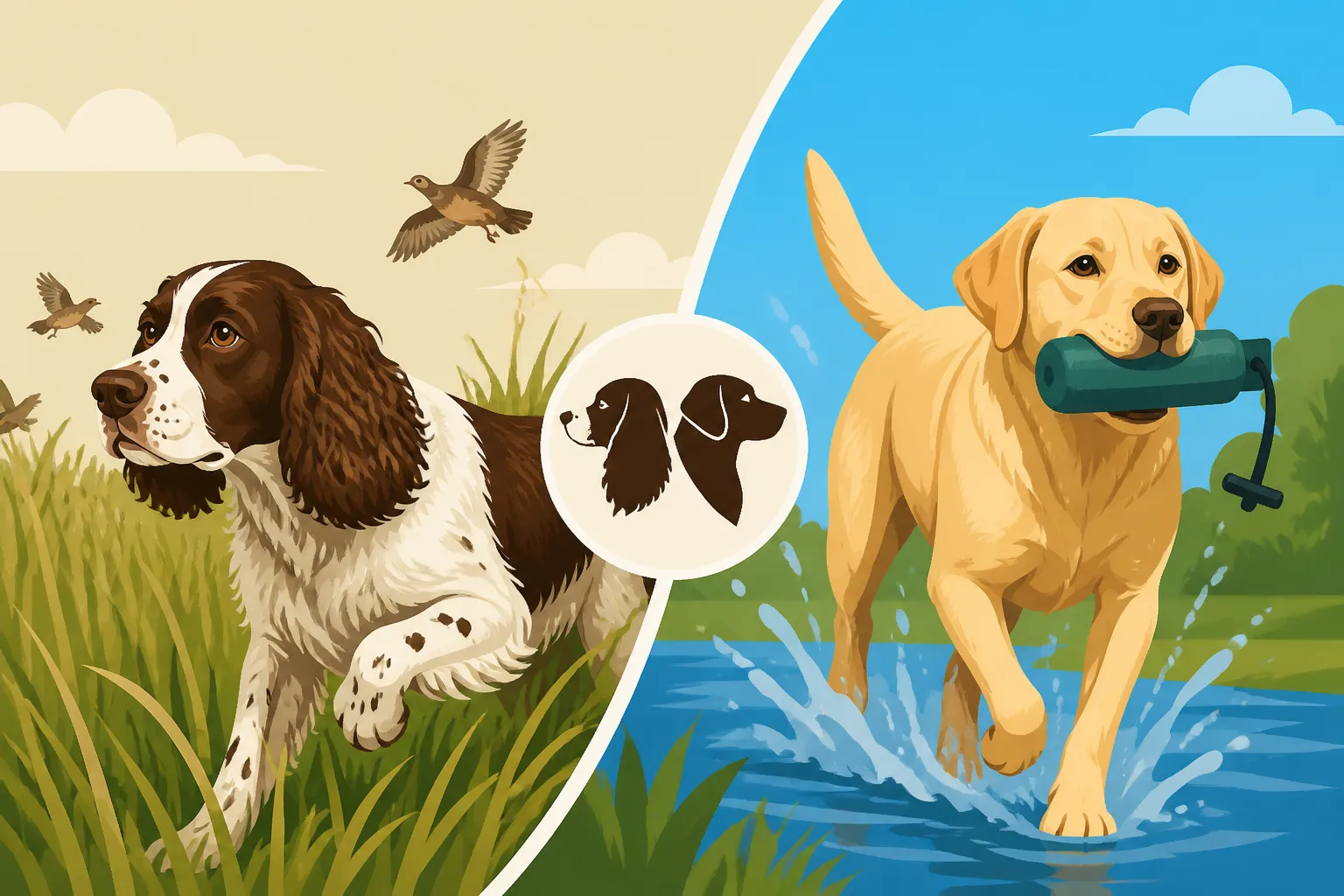
A Labrador and an English Springer Spaniel can make a useful field team, but they do not naturally divide every task neatly between them. The Springer usually excels at searching close cover and flushing game, while the Labrador is often valued for marking falls and retrieving—especially from water. Here’s how those roles work, where they overlap, and how to avoid confusion in the field.
How a Springer Spaniel and a Labrador Work Differently
The Springer searches cover and flushes game
An English Springer Spaniel is a flushing dog. In a typical hunt, the dog works in front of the handler, weaving through cover to locate game and bring it to flight. Its job is not simply to run around quickly: a useful Springer searches with purpose, responds to direction, and stays within a range where the handler can follow the action.
That work can be especially valuable in hedgerows, brambles, woodland edges, and other dense places where a person may struggle to see or reach game. The dog’s nose helps locate scent, and its movement can persuade a bird to rise. The handler then has a chance to take a safe, ethical shot if conditions allow.
A Springer’s search is often described as “quartering,” meaning the dog works from side to side in front of the handler rather than traveling in a straight line far away. The ideal width depends on the terrain, the dog, and the handler’s control. If you’re new to the term, What Quartering Means in a Springer Spaniel explains the pattern in more detail.
The goal is not to have the dog flush everything as fast as possible. A Springer that rushes ahead, ranges too widely, or ignores the handler can make a hunt harder and less safe. Training helps shape the search so the dog checks cover thoroughly while remaining responsive to whistle, voice, or hand signals.
The Labrador often specializes in marking and retrieving
A Labrador Retriever is commonly expected to watch for game falling, remember where it landed, and retrieve it when sent. This is called marking. A steady dog watches the fall rather than chasing after the bird before being released, then uses its memory and scent to locate it.
Retrieving can involve more than collecting a visible bird from open ground. A Labrador may be asked to search for a fall it did not see clearly, follow a handler’s direction, or swim to retrieve from water. These tasks reward patience, steadiness, persistence, and a willingness to carry the retrieve back.
That does not mean Labradors cannot hunt or flush, or that Springers cannot retrieve. Both breeds can perform more than one task. The distinction is a common working pattern, not a rule that every dog must follow. A Labrador may be an enthusiastic searcher, and a Springer may be an excellent marker and water retriever.
When you’re deciding which job suits a particular dog, look at the individual’s training, confidence, drive, and experience. Breed tendencies can offer a starting point, but they do not replace a clear assessment of the dog in front of you.
Their strengths overlap, but the emphasis differs
A Springer’s nose and close-cover search can help find game that a person might otherwise walk past. A Labrador’s marking and retrieving can help recover game after a shot, including in places where the handler cannot safely or easily go. Put simply, the Springer is often sent to find and flush, while the Labrador is often asked to watch, remember, and retrieve.
| Task | Springer Spaniel tendency | Labrador tendency |
|---|---|---|
| Searching dense cover | Often a central strength | Can do it, depending on training |
| Flushing game | Common working role | Possible, but not the usual emphasis |
| Watching a fall | Can learn to mark | Often a central working skill |
| Retrieving on land | Often capable and enthusiastic | Common working role |
| Retrieving from water | Many enjoy water work | Often especially suited to it |
| Working close to a handler | Typical goal for a flushing dog | Depends on the retrieve and training |
This division can be useful, but it is not automatic. Two untrained dogs may both chase the flush, crowd each other, or race for a retrieve. The handler needs to establish who is working, who is waiting, and what cue releases each dog.
If you’re comparing the breeds beyond field tasks, How a Springer Spaniel Works Cover Against a Labrador looks specifically at their different ways of working ground. For a wider breed comparison, The Springer Spaniel Against the Other Flushing Spaniels provides helpful context on the Springer’s role among spaniels.
How to Coordinate Both Dogs in the Field
Decide who searches and who waits
Before entering cover, make the arrangement predictable. If the Springer is searching, the Labrador may need to remain steady beside the handler or at a safe waiting point. When game flushes, the Labrador should not be allowed to break and chase unless it has been released for a retrieve.
This matters because the dogs may have different instincts and levels of excitement. A Springer can be highly focused on scent and movement, while a Labrador may be intensely focused on a falling bird. If both are allowed to make their own decisions, they can interfere with each other, obscure the handler’s view, or create a safety risk.
Start with simple, controlled setups before trying to coordinate both dogs during a real hunt. Practise having one dog work while the other remains settled at a distance. Then practise sending a dog for a retrieve while the other waits. Make the rules easy to understand and keep the sessions short enough that neither dog becomes overstimulated.
The key is not to assume that dogs will infer their roles from each other. They need individual training, clear release cues, and practice in the same environment where they will eventually work. Teaching a Springer Spaniel to Stay in Range and Whether a Springer Spaniel's Recall Can Be Trusted cover two important parts of that foundation.
Build reliable steadiness and retrieve cues
Steadiness means a dog can remain under control while exciting things happen. For a Labrador, that may mean watching a fall without breaking. For a Springer, it may mean stopping or turning when called rather than continuing after scent or moving game. Both dogs need to understand when they are released and when they are expected to wait.
Train each dog separately before asking them to work together. If the Labrador is still rushing toward every thrown dummy, or the Springer cannot turn away from a fresh scent, adding the second dog increases the difficulty rather than solving the problem. Each should have a dependable response to basic cues in manageable settings first.
Then introduce them together in stages. You might begin with one dog on a lead or long line while the other performs a familiar exercise. Reward calm waiting and prompt returns, not just exciting retrieves. If either dog repeatedly breaks, simplify the setup and rebuild the behavior instead of raising your voice or adding more distractions.
Equipment should support safe handling, not substitute for training. A long line, whistle, water, and a basic first-aid kit can be useful depending on the setting. If you’re assembling everyday field supplies, Chewy is one retailer you could compare with local pet and outdoor stores; check that any item suits the dog and the work you expect it to do. For Springer-specific whistle work, see Teaching a Springer Spaniel Whistle Commands.
Keep safety ahead of efficiency
Two dogs working together can make a day feel productive, but safety has to set the pace. The handler should be able to identify each dog clearly, maintain control, and know where both are before a shot is considered. Dogs should never be sent into an unsafe area simply because one seems keen to retrieve.
Terrain changes the plan. In thick cover, a dog may be difficult to see. Near roads, livestock, other hunters, or unfamiliar dogs, the safest choice may be to work one dog at a time or keep one securely under control. In water, assess the conditions carefully and avoid assuming that enthusiasm means the dog is safe to swim.
After working cover, check both dogs for cuts, ticks, burrs, and grass awns, and examine their paws and ears. Springers’ drop ears can hold moisture after swimming or heavy rain, so drying and routine checks are worth building into the outing. Chewy may be one place to compare basic grooming or first-aid supplies, but ask your veterinarian what belongs in a kit for your area and your dogs. What to Check on a Springer Spaniel After a Day in Cover offers a practical post-field checklist.
Choosing the Right Role for Each Dog
Match the job to the individual dog
A dog’s breed gives you useful clues, but its temperament and training matter just as much. One Labrador may naturally work close and wait attentively; another may be more independent. One Springer may hunt enthusiastically but need help learning to settle, while another may be naturally responsive and easy to direct.
Age and experience also matter. A young dog may not yet have the focus or self-control needed to work beside another dog. A seasoned dog can still struggle if the environment is unfamiliar or the task is too difficult. Increase complexity gradually, and avoid expecting a puppy or inexperienced dog to perform the role of a finished hunting partner.
If you already own one breed and are considering adding the other, think through the daily routine as well as the field plan. Both dogs need individual exercise, training, rest, and attention. They may share activities, but shared outings do not guarantee that each gets the specific practice it needs. How Much Exercise a Field Bred Springer Spaniel Needs and Whether a Springer Spaniel Needs a Job can help you think through the Springer’s needs outside hunting.
Don’t assume one breed will do all the “easy” work
A Labrador’s retrieving role still requires careful training. Marking, waiting, taking direction, and returning reliably are learned behaviors, not automatic results of choosing the breed. Likewise, a Springer that finds game still needs to learn range, recall, steadiness, and how to respond when the handler changes direction.
Some handlers prefer a versatile dog that can search, flush, and retrieve. Others value a clearer division between a flushing dog and a retriever. Either approach can work, but the plan should reflect the handler’s skill, the dogs’ abilities, and the kind of terrain and game involved.
If your Springer tends to take off after a scent, the answer is not necessarily to add a Labrador and hope the second dog keeps it under control. Training and management remain the handler’s responsibility. For more on the Springer’s distinctive working style, A Field Bred Springer Spaniel Is a Different Dog to Live With explores how drive can affect everyday life as well as field work.
A practical way to think about the partnership
Picture a hunt along a brushy field edge. The Springer works within a controlled range, searching the cover with the handler. The Labrador stays steady and watches. If game flushes, the handler manages the situation safely; once a retrieve is appropriate, the Labrador is sent to the fall. The Springer is not automatically allowed to chase, and the Labrador is not sent blindly into cover.
Now imagine the dogs switch roles for a training exercise. The Labrador searches a simple patch of cover while the Springer waits. Later, the Springer retrieves a visible dummy while the Labrador remains settled. These short, structured turns help each dog learn that it does not have to compete for every task.
This kind of partnership is built through repetition, not through breed labels alone. If the dogs become noisy, crowd one another, or stop responding, pause and make the exercise easier. A calm, controlled dog team is more useful than two dogs doing everything at once. Chewy can be one option to compare when you need routine supplies for training and care, but the most important tools are consistent cues, thoughtful handling, and realistic expectations.
Disclaimer
This article is for general informational purposes only and does not constitute professional advice. Laws, prices and regulations vary by location and change over time. Consult a qualified professional for guidance on your specific situation.