How an American Cocker Relates to the Springer Spaniel
The American Cocker Spaniel and the English Springer Spaniel share a long spaniel history, but one is not simply a smaller version of the other. Their names reflect different traditional jobs, and their modern types look and live differently. This guide explains how the breeds are related, where their paths diverged, and what those differences mean when you’re comparing them as family dogs.
How American Cockers and Springer Spaniels are related
A shared spaniel ancestry, not a parent-and-child relationship
American Cocker Spaniels and English Springer Spaniels belong to the broader spaniel family. Their ancestors were bred to find and flush game birds, working with people on foot. Over many generations, breeders shaped spaniels for different sizes, working styles, and local preferences. That shared background explains why the breeds can look related: both have feathered ears, expressive faces, and a natural interest in scent and movement.
But it would be misleading to describe the modern American Cocker as a miniature Springer, or the Springer as a larger American Cocker. They developed as distinct breeds with different histories. The American Cocker developed from English Cocker Spaniels brought to North America, while the English Springer followed its own path as a larger flushing spaniel. Their common ancestry reaches back through older spaniel populations rather than to one modern breed producing the other.
The history of sorting spaniels by size helps make the connection clearer. For a long time, smaller and larger spaniels could be grouped differently even when they came from related stock. The working role mattered, too: a dog’s name might reflect the game it flushed or the way it helped hunters. For more background, see Why Springer and Cocker Puppies Once Came From One Litter and How Springer and Cocker Puppies Once Shared a Litter.
What the names say about their traditional jobs
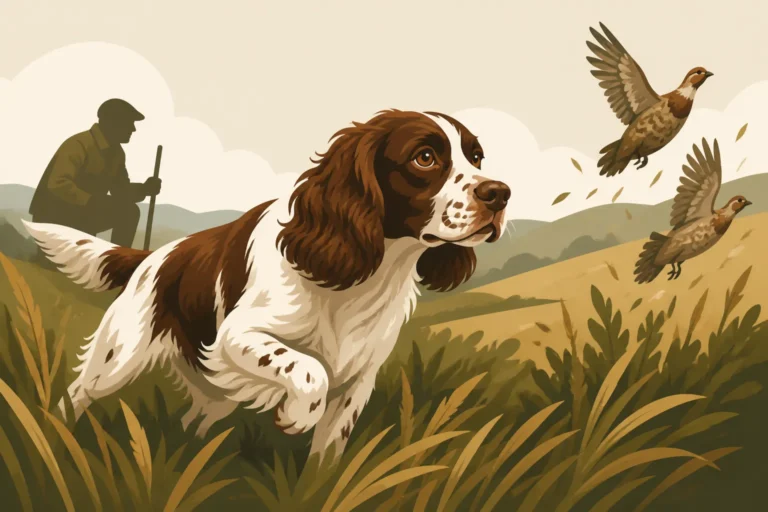
“Cocker” is associated with woodcock, a game bird smaller spaniels were used to find and flush. “Springer” refers to the action of springing game from cover so it could be pursued by a hunter. These names point to related sporting work, not identical jobs or identical breeds. Both dogs were developed to cooperate with people in the field, but their size and style could suit different kinds of cover and hunting.
A flushing dog works by searching through cover and prompting game to rise. That takes energy, a keen nose, and responsiveness to the handler. Springers are commonly associated with covering ground and flushing game at close range, while Cockers were traditionally smaller and useful in denser or tighter cover. There’s overlap in what individual dogs can do, of course; breed labels don’t dictate a dog’s entire personality or ability.
The shared sporting history is also why the breeds can have similar instincts today. A Cocker may become intensely focused on a scent, and a Springer may carry toys around or investigate a patch of grass with determination. Those behaviors are not proof that one breed is descended from the other. They reflect traits selected across spaniel lines for practical work.
How the breeds became distinct
The American Cocker developed from the English Cocker
The American Cocker’s more direct historical connection is to the English Cocker Spaniel, not the English Springer Spaniel. English Cockers were brought to North America, where preferences and breeding choices gradually shaped a distinct type. Over time, American Cockers developed a look and build that differed enough from English Cockers for them to be treated as separate breeds in the United States.
The separation became formal in the twentieth century. The American Kennel Club recognized the English Cocker and American Cocker as separate breeds in 1946. That decision reflects an established divergence in breeding and appearance; it does not mean that the American Cocker suddenly appeared as a new breed in that year. The type had been taking shape over a longer period.
It’s easy to mix up the names because both “English Cocker” and “English Springer” include the word English, and both are spaniels. But the American Cocker belongs to the Cocker branch of the family. The Springer is a separate breed. The distinction matters when you’re researching puppy backgrounds, health screening, breed standards, or expected coat care. Why an English Cocker Is Not a Small Springer Spaniel explains another common comparison that can add to the confusion.
The Springer also developed into field and show types
The English Springer Spaniel itself is not one perfectly uniform type. Field-bred and show-bred Springers have diverged in appearance and, often, in the kinds of activities breeders emphasize. Field lines are generally bred with working ability in mind, while show lines are developed to meet conformation standards. There is variation within each group, and a dog’s individual temperament and needs still depend on its breeding and experiences.
This divide within the Springer breed is separate from the American Cocker’s development. A field Springer and a show Springer are both English Springer Spaniels; an American Cocker is a different breed. When comparing dogs, it helps to ask not only “Which breed?” but also “Which type and breeding background?” A high-energy working Springer may have very different daily needs from a show-bred Springer, just as individual American Cockers can vary in activity level and temperament.
The distinction between the Springer’s field and show types is covered in How the Field and Show Springer Spaniel Diverged. For a broader look at the history of the breed, The 1902 Split That Separated Springer From Cocker explores how spaniel categories and breed recognition developed.
How American Cockers and Springers differ today
Size, build, and coat
American Cockers are generally more compact than English Springer Spaniels. Springers are larger, longer-legged dogs built to cover ground, while American Cockers have a smaller frame and a distinctive rounded head and shorter muzzle. These are broad breed tendencies, not a substitute for looking at an individual dog. Lines, sex, age, and overall condition all affect a dog’s size and shape.
Coat is another visible difference. The American Cocker is known for a long, abundant coat that often needs regular brushing and planned trimming to prevent mats, especially around the ears, legs, and underside. Springer coats also need care, especially around feathering and ears, but the amount and style of grooming can differ between field and show lines. A dog that has just come in from a wet walk may need more than a quick wipe, whichever breed it is.
| Feature | American Cocker Spaniel | English Springer Spaniel |
|---|---|---|
| Breed relationship | Developed from English Cocker Spaniel lines in North America | A distinct English spaniel breed |
| General size | Smaller and more compact | Larger and longer-legged |
| Traditional role | Small game flushing, including work associated with woodcock | Flushing game from cover |
| Coat care | Often substantial brushing and regular trimming | Regular brushing, with grooming needs varying by coat and type |
| Common comparison issue | Confused with English Cockers or smaller Springers | Confused with Cockers because of shared spaniel ancestry |
Because coat can make a dog appear heavier or larger than it is, use body condition and veterinary guidance rather than judging by the outline alone. For the Springer’s typical build, see What a Springer Spaniel Actually Weighs. If color is part of your comparison, The Colors a Springer Spaniel Comes In covers the breed’s accepted color patterns.
Energy, instincts, and life at home
Both breeds can be lively, social, and strongly interested in the world around them. A spaniel that catches a rabbit scent in the park may forget, briefly, that you were hoping for a calm stroll. That doesn’t mean every dog needs hunting work, but it does mean that a daily routine should include movement, interaction, and opportunities to use the nose and mind.
The amount and kind of exercise a dog needs can vary considerably. A field-bred Springer may have a strong drive to search and work, so a short walk around the block might not be enough to help it settle. Some show-bred Springers and American Cockers may be easier to accommodate in a quieter routine, but neither breed should be treated as automatically low-energy. Individual temperament, health, age, training, and breeding all matter.
Both dogs can make affectionate companions, but their needs are worth comparing honestly before you choose. Consider how long the dog would be alone, whether you can manage regular grooming, and how you’ll provide exercise and training on an ordinary weekday—not just on a free weekend. The family-home comparison in Springer Spaniel or Cocker for a Family can help you think through the practical fit. You may also want to read Which Springer Spaniel Type Suits a Pet Home if a Springer is on your shortlist.
Choosing between the breeds without confusing their histories
Questions to ask before choosing a puppy
If you’re considering an American Cocker or a Springer, start by asking about the individual dog’s parents and breeding goals. A responsible breeder should be able to explain whether the dog comes from show, field, or companion-focused lines and what traits they prioritize. Ask about health screening and request a chance to discuss the dogs’ temperaments, grooming needs, and exercise expectations.
For an American Cocker, make sure you understand the coat routine and what professional grooming may involve. Ask how the breeder maintains coat condition and how puppies are introduced to handling. For a Springer, ask about the parents’ activity levels and working background. A puppy from strongly working lines may suit a household that enjoys training and outdoor activities, but may be challenging if the family expects a dog to be content with minimal daily engagement.
It can also help to meet adult dogs from the line, if possible. Puppies are charming, but their grown relatives give you a more useful picture of coat, size, energy, and behavior. If you’re comparing multiple spaniel breeds, make a list of your real constraints—time for grooming, walking routes, time alone, and training experience—rather than choosing on appearance alone.
A practical comparison for everyday life
Think about an ordinary Tuesday. How will the dog spend the morning while everyone is getting ready? Who will take it out when the weather is poor? Is there time to brush a coat that has picked up leaves and burrs? Can you provide steady training and enrichment without relying on a long weekend hike to make up for quiet weekdays?
The American Cocker may be a better match for someone drawn to a smaller spaniel and prepared for its coat-care needs. The Springer may appeal to someone who wants a larger flushing spaniel and can meet its exercise and training needs, particularly if the dog comes from working lines. Neither description guarantees a perfect fit. A calm individual Springer may be easier to live with than a particularly busy Cocker, and a well-managed coat routine can make a long-coated dog much more practical.
The useful takeaway is that American Cockers and English Springer Spaniels are related through spaniel ancestry and sporting history, but they are not the same breed at different sizes. The American Cocker’s closest breed link is the English Cocker; the Springer is its own distinct breed with its own field and show variation. Knowing that history helps you compare dogs on the things that will shape daily life: temperament, exercise, training, grooming, and the breeder’s priorities.
Disclaimer
This article is for general informational purposes only and does not constitute professional advice. Laws, prices and regulations vary by location and change over time. Consult a qualified professional for guidance on your specific situation.