The Push to Breed Bigger Show Springer Spaniels
A show English Springer Spaniel can look substantial without being oversized, but the difference between a strong outline and excess bulk is easy to miss beneath a full coat. This guide explains why some breeders and buyers favor larger-looking show dogs, what breeding can change, and how to assess size without confusing height, weight, and healthy body condition.
Why bigger show Springer Spaniels attract attention
“Bigger” can mean several different things
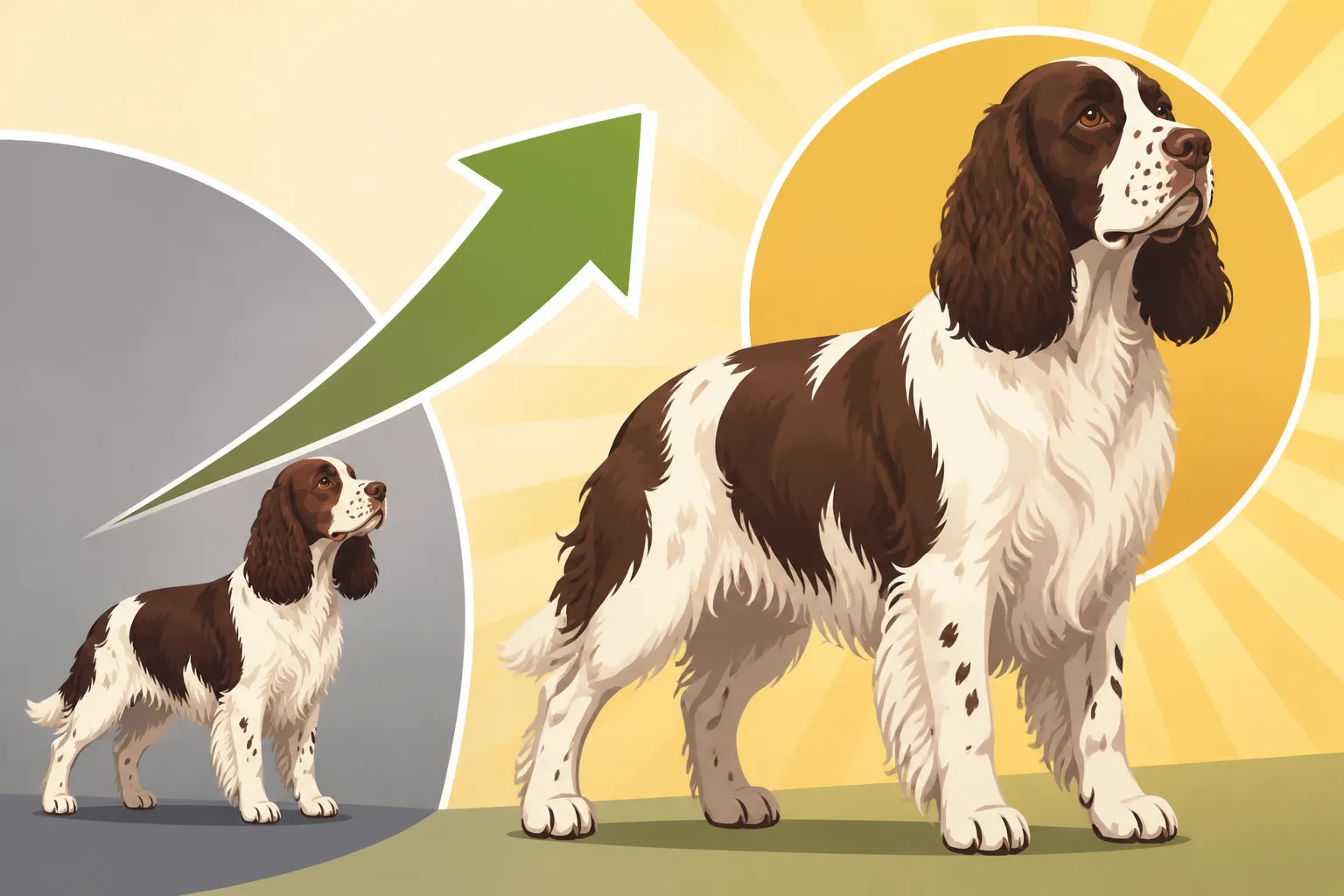
When someone says a show Springer Spaniel is getting bigger, they may mean taller at the shoulder, heavier on the scale, broader through the chest, more heavily boned, or simply fuller-coated. Those are not interchangeable traits. A dog can be relatively tall and athletic, or moderate in height but heavy because it carries excess fat.
Coat also complicates the impression. Show lines often have more feathering than field-bred dogs, and a long, full coat can make a Springer look wider and heavier than the dog is underneath. After a bath or trim, the same dog may appear much less substantial. If you are assessing a dog, look at its frame and body condition rather than judging by photographs or silhouette alone.
The word “bigger” can also carry a value judgment: that larger looks more impressive, powerful, or showy. That is a preference, not a reliable measure of quality. A well-made dog should be evaluated for proportion, movement, condition, and soundness—not simply for occupying more space.
The show and field types shape expectations
English Springer Spaniels are registered as one breed, but field-bred and show-bred dogs can look noticeably different. Show lines are often selected for a particular appearance, while field lines are commonly bred with working ability in mind. The difference is not just a matter of coat length or height; the dogs may differ in outline, bone, and overall style. For more background, see Two Breeds Registered as One: the Field and Show Springer Spaniel and How the Field and Show Springer Spaniel Diverged.
A show-bred Springer may look heavier because of a combination of traits: a broader outline, more bone, a deeper-looking chest, and fuller furnishings. That does not mean every show dog is large or every field dog is slight. There is variation within both types, and a single dog should not be treated as a template for the whole breed.
The comparison can become especially confusing when someone compares a show Springer in a stacked show pose with a lean field dog photographed after work. Pose, coat, conditioning, and camera angle all influence what the eye reads as size. How Different the Two Springer Spaniel Types Look explores why the contrast can seem so pronounced.
Breed type is not a license to maximize size
Breed standards describe an intended type and set limits or expectations for structure. They are not instructions to make every dog as large as possible. In the American show context, the Springer Spaniel standard gives an ideal height of about 20 inches for males and 19 inches for females, measured at the shoulder. A dog outside an ideal measurement is not automatically unhealthy, but size should be considered alongside the rest of the dog’s construction and movement.
That distinction matters because a breeder can favor a particular look without deliberately setting out to produce oversized dogs. If judges, buyers, or social media audiences respond to a more imposing outline, breeders may feel pressure to select for it. But that pressure is not the same as a formal change to the breed standard, nor does it mean all show breeders share the same preference.
The discussion becomes more useful when people describe the trait precisely. “I prefer a little more bone” is clearer than “I want a bigger dog.” “This dog is tall for its frame” is more informative than “the breed is getting huge.” Careful wording helps separate an aesthetic preference from a genuine concern about soundness.
What breeding can—and cannot—change about size
Size is inherited, but it is not controlled by one simple switch
A puppy’s adult size reflects many genes inherited from both parents, along with early development and general health. Even puppies in the same litter can mature into different heights and builds. A breeder can make size more likely by repeatedly choosing larger or more heavily built dogs, but no single mating guarantees an exact adult measurement.
Selection also has trade-offs. If a breeder focuses narrowly on height or bone, other qualities can receive less attention: movement, temperament, working ability, health, or the ability to maintain a useful body condition. Responsible breeding means considering the whole dog and the wider family, not just selecting whichever individual looks biggest in a photograph.
This is one reason a puppy’s paws or appearance at eight weeks cannot reliably predict its finished outline. Growth occurs at different rates, and coat, posture, and body condition change as the dog matures. A breeder familiar with their lines can talk about the range of adult sizes seen in related dogs, but even that is an estimate rather than a promise.
Height, bone, and weight need separate conversations
A scale tells you how much a dog weighs; it does not tell you whether the weight is appropriate. Height describes the dog’s measurement at the shoulder, while bone refers to the strength and thickness of the underlying frame. A broad, well-boned dog can be lean, and a lighter-framed dog can still be overweight.
For a practical starting point, What a Springer Spaniel Actually Weighs discusses why weight varies. The more useful question for an individual dog is whether its weight supports a healthy body condition. A veterinarian can help assess this by considering the dog’s frame, muscle, age, activity, and overall health.
| What you notice | What it may describe | What to check next |
|---|---|---|
| More height at the shoulder | A taller dog, not necessarily a heavier one | Measure consistently and compare with the breed’s intended proportions |
| A broad chest or substantial legs | Bone and body construction | Watch the dog move and assess whether the build looks balanced |
| A high number on the scale | Total body weight | Ask a veterinarian to assess body condition and muscle |
| A wide silhouette under long feathering | Coat, body shape, or both | Feel for the dog’s outline rather than relying on appearance alone |
| A thick waist or difficulty feeling ribs | Possible excess body fat | Arrange a veterinary body-condition assessment |
Owners may find measuring tapes, scales, and everyday feeding supplies through local retailers or Chewy, but tools do not replace a hands-on assessment. A kitchen scale can help portion food consistently, for example, while a veterinarian can determine whether a dog’s current weight is suitable for its frame.
Food does not make a dog’s genetic frame larger
It is tempting to think that feeding more will help a puppy grow into a bigger, more impressive adult. Extra calories do not reliably add healthy height or bone. They can instead contribute to excessive weight, which puts unnecessary strain on a growing dog and makes it harder to judge the puppy’s natural structure.
Puppies should receive an appropriate complete diet and have their growth monitored with veterinary guidance. The goal is steady, healthy development—not rapid growth or an adult-looking bulk while the skeleton is still maturing. If you are comparing food options on Chewy or elsewhere, focus on whether the diet suits the puppy’s life stage and health needs, rather than marketing that promises a particular body shape.
For an adult show Springer, maintaining condition may take more attention than people expect. A dog with abundant feathering can look trim in one area and carry extra weight beneath the coat. Regular weighing can be useful, but pairing it with a veterinarian’s body-condition check gives a clearer picture.
What a larger outline may mean for health and function
More size is not automatically more or less healthy
There is no single rule that says a bigger show Springer is unhealthy, or that a smaller one is automatically sound. Health depends on many factors, including inherited conditions, overall structure, body condition, exercise, and care. A dog’s size alone cannot predict its future health.
Still, breeding toward a heavier or less balanced build deserves thoughtful scrutiny. A dog should move freely and comfortably, with a coordinated stride and no obvious struggle to carry its own body. If a dog appears to tire unusually quickly, moves stiffly, or seems uncomfortable, those signs should be discussed with a veterinarian rather than explained away as “just the type.”
Health considerations also vary across families and breeding lines. A useful assessment includes health screening, family history, temperament, and observed movement. How Health Problems Differ Between Springer Spaniel Types offers context on health discussions around the two types, while Which Springer Spaniel Type Is Healthier addresses why broad claims about one type being healthier than the other can be misleading.
Bone and movement have to work together
Heavier bone can contribute to a sturdy look, but it should be in proportion to the rest of the dog. A dog that is powerful-looking in a still photograph may move differently once it is walking or trotting. Look for balanced, comfortable movement from the front, side, and rear, and notice whether the dog maintains the same ease over ordinary activity.
That does not mean every show Springer must perform as a field dog does. The purposes and selection pressures of show and field lines differ. But basic physical comfort still matters. A dog should be able to walk, play, and manage everyday exercise without obvious difficulty, whatever its type.
For more on the visual question of bone, How Heavily Boned a Show Springer Spaniel Is is a useful related read. The key point is not to pursue or reject bone as a single feature. Consider whether it fits a balanced outline and whether the dog moves well.
Bigger is not the same as better suited to work
Springer Spaniels were developed as active sporting dogs, and the breed’s type has been shaped by different priorities across show and field lines. A larger or more heavily built show dog may be perfectly comfortable in its home and activities, but size by itself does not indicate working ability, stamina, or trainability.
Likewise, a lighter field-bred dog is not automatically more capable. Working ability depends on more than build: drive, conditioning, training, experience, temperament, and the task all matter. If you are comparing types, consider what you want the dog to do rather than assuming a particular size tells the whole story. How a Show Springer Spaniel Fares in a Hunt Test looks at the relationship between show type and working performance.
The breed’s long-term health and usefulness also depend on maintaining genetic variety and avoiding overly narrow selection. The Seventy Year Gene Pool Divide Inside One Springer Spaniel Breed provides additional context for the divergence between lines and why breeding decisions are bigger than any one physical trait.
How to assess size responsibly when choosing a show Springer
Ask breeders what they mean by “bigger”
If you are speaking with a breeder, ask them to be specific. Do they mean taller than average, more bone, a wider chest, or simply a fuller coat? Ask what adult size range they see among related dogs and whether they can show you mature relatives. The answers should help you understand the line, not leave you with a vague promise that a puppy will grow into a particularly impressive dog.
It is also reasonable to ask how the breeder balances appearance with movement, temperament, health screening, and the dogs’ ability to live active, comfortable lives. A thoughtful breeder should be willing to discuss strengths and limitations across their dogs. Be cautious if the conversation centers almost entirely on size, or if a breeder guarantees an exact adult weight for a young puppy.
If a breeder says their dogs are larger than others, ask how that conclusion is measured. Measurements, adult weights, and photographs of mature dogs are more useful than comparisons based on a single puppy picture. And remember that a breeder’s preference is not a universal measure of what makes a good Springer Spaniel.
Judge condition without being fooled by feathering
When meeting an adult dog, look beyond the coat. You should be able to feel the dog’s ribs without pressing hard, and the dog should have a visible waist when viewed from above. The exact appearance varies with build and coat, so ask the breeder or veterinarian to explain what they consider healthy condition for that individual.
Observe the dog walking at a relaxed pace. Does it move comfortably? Does it seem balanced, or does its body appear awkward to carry? These observations do not diagnose a health problem, but they can help you ask better questions. If you already own a Springer and are unsure about weight beneath the feathering, a routine veterinary visit is a better place to start than reducing food based only on appearance.
For day-to-day care, owners may use a consistent home scale or record weights at veterinary visits. Chewy can be one source for basic feeding and grooming supplies, but neither a retailer’s product descriptions nor an online breed photo can tell you whether a particular Springer is at an appropriate weight. Keep a simple record of weight, food portions, activity, and veterinary advice so gradual changes are easier to notice.
Choose the dog for the life you can offer
The right Springer Spaniel is not necessarily the largest, most dramatic, or most heavily coated one. Think about your home, activity level, grooming routine, and expectations. A dog’s size is only one part of the decision; its energy, temperament, training needs, and health background will affect daily life far more than a modest difference in height.
If you are drawn to a substantial show outline, that preference is perfectly understandable. Just make sure “substantial” does not become a substitute for good construction, sound movement, health, or appropriate body condition. A responsible breeder should be able to explain why a dog is built as it is and how that build fits with the rest of its qualities.
Ultimately, the most useful question is not whether show Springer Spaniels should be bigger. It is whether breeders are making balanced choices, and whether each dog can move comfortably and live well in the body it has. Size can be part of type, but it should never be the only goal.
Disclaimer
This article is for general informational purposes only and does not constitute professional advice. Laws, prices and regulations vary by location and change over time. Consult a qualified professional for guidance on your specific situation.