What a Grass Awn Removal Costs a Springer Spaniel Owner
One of the most insidious threats to our beloved English Springer Spaniels, especially those who revel in exploring fields and dense cover, is the humble grass awn. These tiny, barbed seeds might seem harmless, but they can burrow deep into a dog's body, causing immense pain, serious infections, and requiring costly veterinary intervention. This guide is here to walk you through exactly what a grass awn removal might entail financially, what signs to watch for, and how you can work to prevent these nasty little travelers from ruining your Springer's day, and your budget.
The Silent Threat: Understanding Grass Awns and Why Springers Are So Vulnerable
If you've ever spent time in tall grass, you've probably noticed those little seed heads that cling to your clothes. For many dogs, especially our adventurous Springer Spaniels, these aren't just an annoyance; they're a significant health hazard. These sharp, arrow-shaped plant parts, often called grass awns, foxtails, or grass seeds, are perfectly designed to burrow into soft tissue and migrate through the body. Their one-way barbs make it almost impossible for them to come back out on their own.
What Makes Grass Awns So Dangerous?
Imagine a tiny, sharp fishhook that only moves forward. That's essentially a grass awn. When these seeds catch onto a dog's fur, they don't just stay there. With every movement, every shake, every step, they can push deeper. Their barbed structure means they can easily pierce skin, work their way into ear canals, get lodged between paw pads, or even be inhaled. Once they've breached the surface, they can migrate to astonishing and dangerous locations within the body, causing abscesses, infections, and inflammation wherever they go. They don't dissolve, and the body's immune system struggles to expel them.
Why Springer Spaniels Are Particularly Vulnerable
Our Springers are natural adventurers. They have a zest for life that often involves crashing through tall grass, plunging into undergrowth, and using their incredible noses to explore every scent. This very nature, combined with their breed-specific physical traits, puts them at a higher risk for grass awn problems. Their long, pendulous ears, those beautiful feathered legs, and their dense undercoats are like magnets for these plant invaders. A field-bred Springer, with its slightly coarser coat and often shorter feathering, might seem less prone, but their sheer drive to work cover makes them just as susceptible. Show-bred Springers, with their more luxurious feathering, can trap awns easily in those long hairs on their legs, belly, and ears. It's a constant battle, and it's something every Springer owner needs to be aware of.
Common Entry Points and Recognizing the Signs
A grass awn can pretty much get anywhere on a dog's body, but there are certain hotspots that are more common, and therefore, easier to spot if you know what you're looking for. Recognizing the early signs is absolutely crucial for minimizing discomfort for your dog and potentially reducing the complexity and cost of removal.
The Ear Canal Invader
The long, floppy ears of a Springer Spaniel are like perfect funnels for grass awns. It’s heart-wrenching to see your otherwise happy, energetic dog suddenly start shaking their head violently, scratching frantically at an ear, or tilting their head to one side. They might whine or even become withdrawn due to the discomfort. You might notice redness, discharge, or a foul odor if an infection has started. Sometimes, they'll hold their ear flat against their head or try to rub it on the ground or furniture. If you see these signs after a walk in grassy areas, a grass awn in the ear should be high on your suspicion list. This is particularly concerning because the awn can travel deep into the ear canal, even puncturing the eardrum, and potentially causing neurological issues if it migrates further. Ignoring it is never an option, as it can quickly lead to chronic ear disease. Why a Springer Spaniel's Ears Are Never Quite Healthy delves into the general health of their ears, but awns add a whole new layer of challenge.
The Paw Penetrator
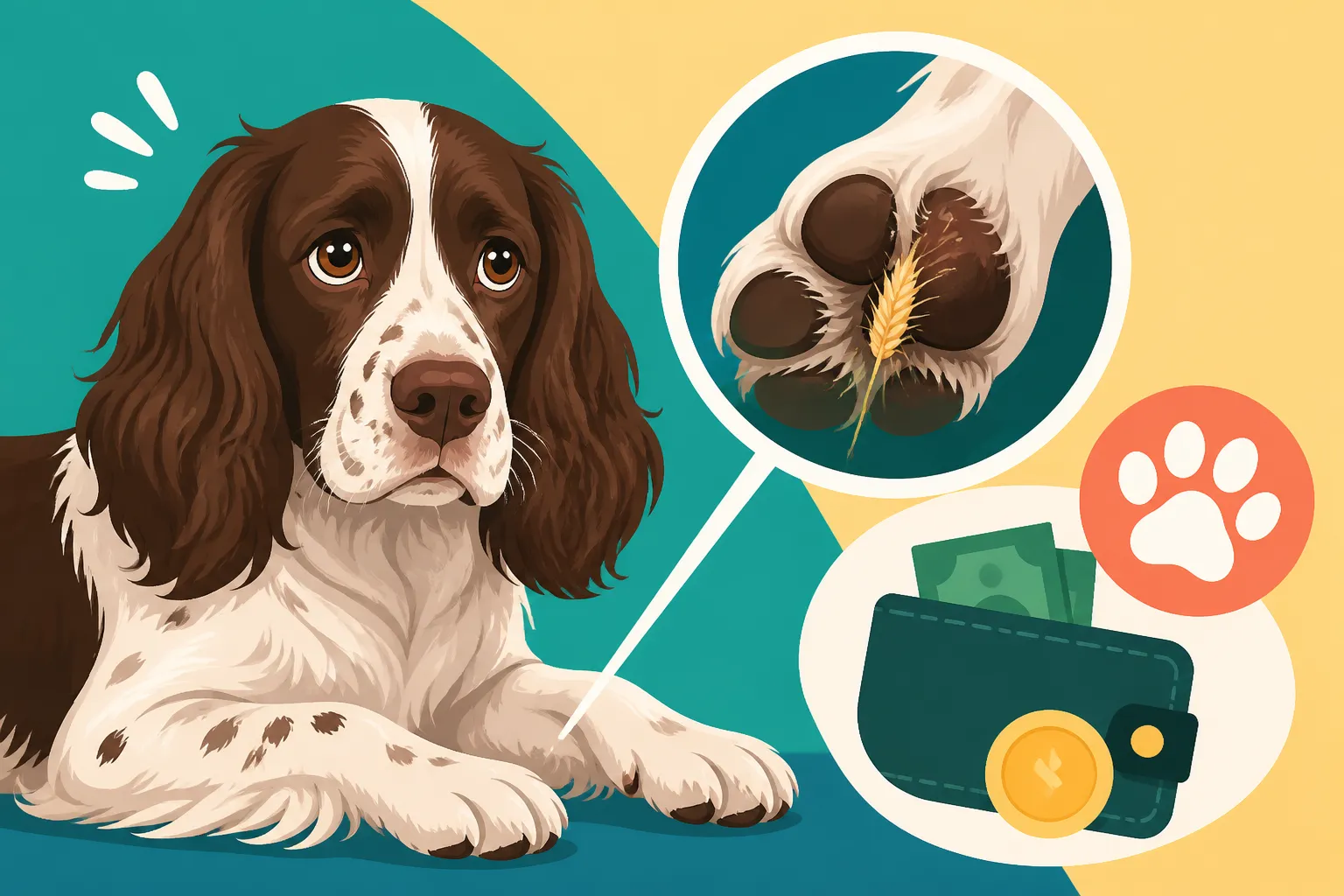
Another prime target for grass awns is the soft skin between your Springer's paw pads. After a run in the fields, your dog might start obsessively licking one paw, limping, or refusing to put weight on a leg. You might see swelling, redness, or even a small, draining lesion between their toes. The awn can burrow quite quickly, creating a painful tract. If left untreated, it can cause deep infections, abscesses, and even travel up the leg. Imagine walking with a splinter constantly digging deeper with every step – that's what your dog is enduring.
Other Stealthy Entry Points
While ears and paws are the most common, grass awns are resourceful. Keep an eye out for:
- Eyes: Awns can get under eyelids, causing irritation, excessive tearing, squinting, and rubbing of the face. This can quickly lead to corneal ulcers.
- Nose: If your Springer inhales an awn, they might have sudden, violent sneezing fits, nasal discharge (sometimes bloody), and paw at their nose. The awn can migrate into the nasal passages or even the lungs.
- Skin: Anywhere on the body, especially in areas with thinner skin or where hair is dense, an awn can penetrate. You might find a small lump, an inflamed area, or a draining tract, often mistaken for a spider bite or a localized infection. The awn can travel extensively under the skin, forming abscesses far from the initial entry point.
- Mouth/Throat: Less common, but sometimes awns can be ingested or get caught in the gums or throat, leading to gagging, difficulty swallowing, or excessive drooling.
The key takeaway is that any unusual symptom, especially after exposure to grassy areas, warrants a thorough check and often a vet visit. Early detection can save your dog a lot of pain and save you a lot of money. If you notice signs a Springer Spaniel has an ear infection, it's always worth considering an awn as a potential culprit.
The Veterinary Process: Diagnosis and Extraction
Once you suspect a grass awn, a trip to the vet is non-negotiable. This isn't something you can, or should, try to tackle at home. The complexity and cost of removal depend heavily on where the awn has lodged and how far it has traveled.
Initial Examination and Diagnostics
When you bring your Springer in, the vet will start with a thorough physical examination. They'll look for entry points, swelling, tenderness, and listen to your story about when symptoms started and where your dog was playing.
- Ear Exam: For ear awns, the vet will use an otoscope to look deep into the ear canal. Sometimes, the awn is visible and relatively easy to grasp with forceps. Other times, swelling or deeper penetration makes it difficult to see without sedation.
- Paw/Skin Exam: For paws, the vet will meticulously examine between the toes, often probing with sterile instruments to find the entry wound or a draining tract.
- Other Areas: For eyes, they'll examine the eye surface and under the lids. For nasal issues, they might examine the nostrils and listen to lung sounds.
If the awn isn't immediately visible, or if the dog is too painful or anxious to cooperate fully, sedation is often necessary. This allows the vet to conduct a more thorough and pain-free examination.
The Importance of Imaging and Sedation
Sedation isn't just for making your dog comfortable; it's often essential for effective diagnosis and safe removal. Once sedated, the vet can perform procedures that would be impossible on a wriggling, uncomfortable dog.
- Imaging: X-rays are often taken, especially if the awn is suspected to be in the chest cavity, abdomen, or deep within a limb. However, grass awns are organic material and don't always show up clearly on X-rays. Ultrasound can be more effective for locating awns in soft tissues or within organs. Advanced imaging like CT scans might be recommended for very complex cases, such as an awn that has migrated to the spine or brain (rare, but possible). These imaging steps add significantly to the cost, but they are vital for locating the elusive awn and planning its removal.
- Endoscopy: If an awn is suspected in the nasal passages, throat, or lungs, an endoscope (a tiny camera on a flexible tube) might be used to visualize and, if possible, retrieve it. This is a specialized procedure often requiring a referral to an internal medicine specialist.
Removal Methods and Potential Complications
The method of removal depends entirely on the awn's location and depth.
- Manual Extraction: If the awn is superficially located, like just inside the ear canal or skin, the vet might be able to remove it with forceps, often under light sedation or local anesthetic.
- Surgical Removal: For awns that have burrowed deeply, created an abscess, or migrated into other tissues, surgical removal is necessary. This can range from a relatively simple incision to drain an abscess and remove the awn, to a complex exploratory surgery if the awn has traveled extensively within the body. If an awn is deep in a paw, the vet might need to surgically open the inflamed tract to find and extract it. This type of procedure requires general anesthesia, sterile surgical conditions, and post-operative care.
- Flushing: For nasal awns, sometimes a retrograde flush (flushing saline from the back of the nasal passages) might dislodge it, often performed under anesthesia.
Complications can arise if the awn has caused significant infection, or if it has migrated to a vital organ. Secondary infections are common and will require antibiotics. Sometimes, despite best efforts, an awn may be missed, leading to recurring symptoms and the need for further procedures.
Understanding the Cost of Grass Awn Removal
Now, let's talk about the dreaded dollar signs. The cost of grass awn removal can vary dramatically, from a relatively minor expense to a bill that might make your jaw drop. It all depends on the complexity of the situation.
Factors Influencing the Bill
Several factors play a role in determining the final cost:
- Location of the Awn: An awn caught just inside the ear canal that can be plucked out under light sedation will be far less expensive than one that has migrated into a lung or caused a deep-seated abscess in a paw.
- Depth of Penetration: A superficial awn is easier and cheaper to remove than one that has burrowed deep into tissues or organs.
- Diagnostics Required: If X-rays, ultrasound, or even an MRI/CT scan are needed to locate the awn, the costs escalate quickly.
- Anesthesia: General anesthesia for surgical removal is significantly more expensive than light sedation for a quick extraction. This includes pre-anesthetic blood work, monitoring during the procedure, and recovery care.
- Type of Procedure: Simple manual extraction vs. complex surgery or endoscopy. Specialist involvement (e.g., an internal medicine specialist for endoscopy, or a surgical specialist) will also increase costs.
- Antibiotics and Pain Medication: Post-procedure medications are almost always necessary to prevent infection and manage pain.
- Follow-up Visits: You might need follow-up appointments to check healing, remove sutures, or address any lingering issues.
- Geographic Location: Veterinary costs can vary significantly by region, with urban areas generally having higher prices than rural ones.
A Look at Potential Expenses
To give you a clearer picture, here's a table outlining potential cost components for different grass awn scenarios. Please remember these are general ranges, and actual costs can differ. Always check with your local veterinarian for specific estimates.
| Scenario | Initial Exam | Sedation/Anesthesia | Imaging (X-ray/Ultrasound) | Removal Procedure | Medications & Follow-up | Total Estimated Cost Range |
|---|---|---|---|---|---|---|
| Simple Ear/Paw (visible) | Moderate | Low (sedation) | None/Minimal | Manual Extraction (quick) | Low | Lower End |
| Deep Ear/Paw (not visible) | Moderate | Moderate (anesthesia) | Moderate (X-ray/Ultrasound) | Minor Surgical Removal/Endoscopy | Moderate | Mid-Range |
| Migrated/Abscessed | Moderate | High (anesthesia) | High (Ultrasound/CT) | Complex Surgery | High | Upper End |
| Serious Internal Migration | Moderate | High (anesthesia) | Very High (Specialized CT/MRI) | Specialist Surgery/Multiple Procedures | High | Significantly Higher |
Please note: "Low" might mean a few hundred dollars, while "High" can easily push into the thousands.
How Pet Insurance Can Help
Looking at those potential costs, it's easy to feel overwhelmed. This is precisely where a good pet insurance policy can be an absolute lifesaver. Providers like Healthy Paws offer coverage for unexpected accidents and illnesses, and grass awn removals definitely fall under that umbrella. Having insurance means that instead of facing a daunting bill outright, you'll pay your deductible and a percentage of the remaining costs, significantly easing the financial burden. While it won't cover pre-existing conditions, getting a policy when your Springer is young can provide peace of mind for these kinds of common, yet costly, incidents. It's truly an investment in your dog's future health and your financial stability. You might also want to explore What Insuring a Springer Spaniel Runs for a broader perspective on coverage.
Proactive Prevention and Management
While grass awns can be incredibly persistent, there's a lot you can do as a Springer Spaniel owner to minimize the risk and potentially save yourself from those hefty vet bills. Prevention is always better than cure, especially when it comes to these sneaky plant invaders.
Grooming as Your First Line of Defense
Regular and thorough grooming is your most powerful weapon against grass awns. Your Springer's beautiful coat, especially the feathering, is a prime collection point for these seeds.
- Daily Brushing: Make it a habit to brush your dog daily, paying special attention to their ears, armpits, belly, and the feathering on their legs and tail. A stiff bristle brush or a slicker brush can help dislodge surface-level awns before they have a chance to burrow.
- Trimming Feathering: Consider keeping the longer feathering on their legs and belly trimmed shorter, especially during grass awn season. This reduces the "catch surface" for the seeds. Trimming a Springer Spaniel's Feathering offers excellent guidance on this. You might find a good selection of trimming shears and brushes on sites like Chewy.
- Paw Pad Maintenance: Keep the hair between your Springer's paw pads trimmed short. This not only prevents matting but also makes it harder for awns to embed themselves. Regularly check their paws for any redness or foreign objects.
Post-Outdoor Check-Ups
Every time your Springer comes in from a walk or play session in grassy areas, make it a ritual to perform a thorough "nose-to-tail" check. This might sound tedious, but it can catch an awn before it becomes a serious problem.
- Ears: Lift each ear flap and visually inspect the ear canal. Feel the leather of the ear for any bumps or swelling. Even if you checked before going out, do it again! Whether a Springer Spaniel's Ears Should Be Checked Weekly is a useful read for overall ear health.
- Paws: Carefully separate each toe and inspect the webbing and pads for any seeds, redness, or tenderness.
- Coat: Run your hands over your dog's entire body, feeling for any small burrs or seeds caught in their fur. Pay extra attention to their chest, armpits, and groin where awns often get trapped.
- Eyes and Nose: Gently examine their eyes for any foreign bodies or irritation, and watch for any persistent sneezing or pawing at their nose.
- Overall: Look for any new lumps, bumps, or areas of redness. If you're a hunting family, then After the Hunt: Checking a Springer Spaniel Over Nose to Tail is an absolutely critical read.
Environmental Awareness and Protective Gear
Sometimes, avoiding high-risk areas is the best strategy, but we know that's not always possible with our Springers who love to explore.
- Avoid Tall, Dry Grass: The worst culprits are typically tall, dry grasses that have gone to seed. During late spring, summer, and fall, try to steer clear of these areas if possible. Stick to mown paths or areas with shorter vegetation.
- Protective Gear: For working dogs or those who spend a lot of time in dense cover, protective gear can make a difference. Snoods can protect ears, and specialized vests can guard the chest and belly. Whether a Springer Spaniel Needs a Vest in Heavy Cover discusses this in more detail.
- High-Quality Nutrition: While food won't stop an awn, maintaining your Springer's overall health with good nutrition, perhaps even fresh food options like Ollie, can contribute to a robust coat and healthy skin, which are better equipped to withstand environmental challenges. This is more about general well-being than direct awn prevention.
By being diligent with grooming, performing routine checks, and being mindful of your walking environments, you can significantly reduce the chances of your Springer Spaniel becoming a victim of these painful and costly grass awn intrusions. It’s a small amount of effort that can save a lot of heartache and expense down the line. Remember, even with the best care, sometimes these things happen, and that's when understanding the costs and having pet insurance really comes into its own.
Disclaimer
This article is for general informational purposes only and does not constitute professional advice. Laws, prices and regulations vary by location and change over time. Consult a qualified professional for guidance on your specific situation.