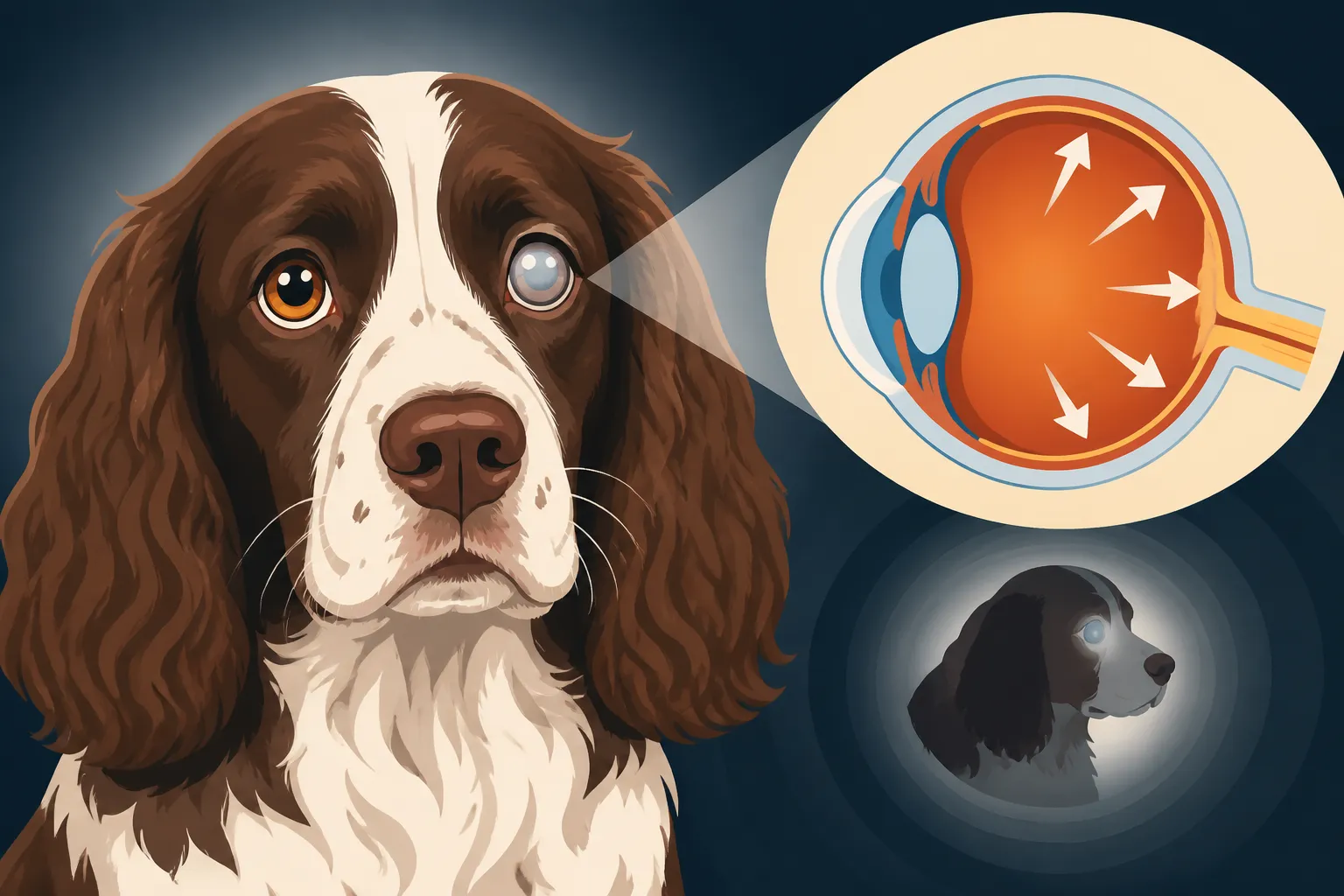
How Primary Glaucoma Blinds a Springer Spaniel
It's absolutely heartbreaking to see your beloved English Springer Spaniel start bumping into furniture they’ve known their whole life, or hesitating on stairs they once bounded up with joy. When their sparkling, intelligent eyes begin to look cloudy or red, and you can sense their confusion or even pain, it signals a deeper problem. This guide will walk you through the complexities of primary glaucoma, a painful and often blinding eye condition that disproportionately affects our Springers, explaining exactly how it robs them of their sight and what you, as a loving owner, can do.
Understanding Primary Glaucoma in Springer Spaniels
Primary glaucoma is a devastating eye condition that many Springer Spaniel owners dread. It's not just "bad eyesight"; it's a serious medical emergency that, if left untreated, inevitably leads to blindness and intense pain. As owners, it's crucial to understand what this condition entails, especially given our breed's predisposition.
What Is Primary Glaucoma?
At its core, primary glaucoma is a disease characterized by increased pressure within the eye. Imagine your dog's eye as a tiny, perfectly balanced ecosystem. Inside, there's a fluid called aqueous humor, which is constantly produced and drained to maintain a healthy internal pressure. This fluid nourishes the eye's structures and helps maintain its shape. The drainage happens through a specific structure called the iridocorneal angle, often referred to as the drainage angle. In primary glaucoma, there's a problem with this drainage system. The fluid either can't exit the eye fast enough, or the drainage angle itself becomes obstructed or malformed. This blockage leads to a buildup of aqueous humor, causing the intraocular pressure (IOP) to skyrocket. This elevated pressure then starts to damage the optic nerve and retina, which are vital for transmitting visual information to the brain. Think of it like a clogged drain; the water keeps flowing in, but it can't get out, and eventually, the whole system backs up and overflows, causing damage to the surrounding structures.
Why Springer Spaniels Are Prone
Unfortunately, English Springer Spaniels are one of the breeds genetically predisposed to developing primary glaucoma. This isn't just bad luck; it's due to specific anatomical differences in their eyes that make them more vulnerable. Unlike secondary glaucoma, which arises from another eye condition like injury, inflammation, or tumors, primary glaucoma develops spontaneously, usually affecting one eye first but almost always progressing to the other. Research, including studies often cited by organizations like the American College of Veterinary Ophthalmologists (ACVO), confirms this breed-specific vulnerability. It's believed that Springers, along with several other breeds like Cocker Spaniels, Basset Hounds, and some terriers, have an inherited abnormality in their drainage angle. This makes their eyes a ticking time bomb, susceptible to pressure spikes that can quickly destroy vision. This genetic predisposition means that even if your Springer lives a perfectly healthy life otherwise, they could still be blindsided by this condition.
The Role of Genetics: Open vs. Closed Angle Glaucoma
Understanding the genetic underpinnings of primary glaucoma is critical for breeders and owners alike. There are two main types: primary open-angle glaucoma (POAG) and primary closed-angle glaucoma (PCAG). While both lead to increased intraocular pressure, the mechanism of blockage differs. POAG involves a microscopic abnormality within the drainage angle that impedes fluid outflow, even though the angle appears structurally open. PCAG, which is more common and aggressive in Springer Spaniels, occurs when the drainage angle suddenly or gradually narrows and closes, physically blocking the aqueous humor from draining. This narrowing can be due to an abnormal development of the pectinate ligament, a mesh-like tissue in the drainage angle. The inheritance pattern for PCAG in Springers is complex, often autosomal recessive or polygenic, meaning multiple genes or a single gene with incomplete penetrance could be involved. This is precisely why The DNA Test That Should Precede Every Springer Spaniel Purchase is so important, not just for glaucoma but for other inherited conditions. Responsible breeders will screen their dogs rigorously, often performing The Four Eye Diseases a Springer Spaniel Breeder Screens For, which includes gonioscopy to evaluate the drainage angle, especially in breeds known for PCAG.
The Insidious Progression of Glaucoma
The progression of primary glaucoma in a Springer Spaniel can be incredibly fast and, frankly, terrifying. What might start as a subtle, almost imperceptible change can rapidly escalate into a full-blown emergency, leaving owners scrambling to understand what's happening to their beloved companion. It’s not always a slow decline; sometimes, it hits like a freight train.
Early, Subtle Signs Owners Often Miss
One of the most challenging aspects of primary glaucoma is its sneaky onset. Many owners understandably miss the very first, subtle indicators, because they often mimic minor irritations or allergies. Your Springer might start squinting just a little more than usual, especially in bright light, or you might notice a slight redness in the white of their eye that you might initially dismiss as dust or a stray hair. Sometimes, the pupil might appear slightly more dilated in the affected eye, or the cornea might have a very faint, hazy, or cloudy appearance. It's not a sudden, dramatic change that screams "emergency!" It's often a gradual, almost imperceptible shift that makes you second-guess what you’re seeing. They might also start to show a subtle reluctance to open their eye fully, or rub at it with a paw more frequently. These signs are easy to brush off, but for a Springer Spaniel, where Whether a Springer Spaniel's Glaucoma Comes On Suddenly is a very real possibility, paying attention to even the tiniest changes is critical.
Rapid Deterioration: When Vision Loss Becomes Obvious
Once primary glaucoma progresses past these early, subtle stages, the deterioration can be shockingly rapid. This is where the true heartache sets in. The increased pressure inside the eye causes irreversible damage to the optic nerve and retina, leading to noticeable vision loss. Your once confident Springer might suddenly start bumping into furniture they’ve navigated thousands of times, especially in low light or unfamiliar environments. They might hesitate before jumping off a couch, or show an unusual reluctance to go outside at dusk. The eye itself can become visibly enlarged and bulging, and the cornea will likely take on a pronounced cloudy or bluish hue, indicating significant internal pressure and corneal edema. At this stage, the pain is often intense, and the vision loss can be nearly complete in the affected eye. This is usually when owners realize something is terribly wrong, but by this point, significant, irreversible damage has already occurred, and the window for saving vision is closing rapidly, if it hasn't already slammed shut. It becomes a race against time, where every hour counts.
The Pain Factor
It's absolutely crucial to understand that primary glaucoma is not just about vision loss; it is intensely painful for your dog. Imagine a constant, throbbing headache localized right in your eye, combined with immense pressure. That's likely what your Springer Spaniel is experiencing. This pain is often overlooked by owners who might focus more on the visual impairment. Signs of pain can include head pressing (pressing their head against a wall or furniture), lethargy, decreased appetite, crying out when touched near the head, or an increased irritability or withdrawal. They might also become less active, unwilling to play, or even show aggression if you attempt to touch their head. This is why addressing glaucoma isn't just about saving vision; it's about alleviating suffering. Whether a Springer Spaniel's Glaucoma Is Painful is a resounding yes, and managing this pain is a primary concern for veterinarians, even if vision cannot be restored. Without intervention, the chronic pain can severely diminish your Springer's quality of life, making surgical removal of the eye (enucleation) a compassionate option in some cases to provide relief.
Diagnosing Glaucoma: Catching It Early
Early diagnosis of primary glaucoma is not just important; it’s absolutely paramount. The difference between catching it in its nascent stages and discovering it when your Springer Spaniel is already struggling to see can mean the difference between saving some vision and facing complete, irreversible blindness. Every minute truly counts when dealing with this aggressive condition.
The Importance of Regular Eye Exams
For breeds like the English Springer Spaniel, which are known to be predisposed to primary glaucoma, regular and thorough eye examinations are non-negotiable. It's not enough to just rely on your general veterinarian's annual check-up to catch something this subtle and aggressive. While your primary vet can perform a basic eye check, an appointment with a board-certified veterinary ophthalmologist is highly recommended, especially as your Springer approaches middle age. These specialists have the equipment and expertise to detect the most subtle changes that could indicate early glaucoma. They can also provide a baseline assessment of your dog's eye health, which is invaluable if symptoms do emerge later. These routine screenings should ideally be part of any comprehensive health plan for a Springer, much like checking for Hip Dysplasia in a Springer Spaniel or ensuring their ears are healthy, given Why a Springer Spaniel's Ears Are Never Quite Healthy.
Diagnostic Tools: Tonometry and Gonioscopy
When it comes to diagnosing primary glaucoma, two key diagnostic tools are indispensable: tonometry and gonioscopy.
Tonometry is the measurement of the intraocular pressure (IOP) within the eye. This is usually done with a TonoPen or another type of tonometer, which gently touches the surface of the eye. It's a quick, non-invasive procedure, often done with just a local anesthetic drop to numb the eye. High IOP readings are the definitive indicator of glaucoma. A normal IOP range for dogs is generally between 10 and 20 mmHg. Readings significantly above this, especially when coupled with other clinical signs, point directly to glaucoma. Regular tonometry can track changes over time and help monitor the effectiveness of treatment.
Gonioscopy is a specialized examination of the drainage angle of the eye. This procedure uses a goniolens (a special contact lens with mirrors) placed on the anesthetized eye, allowing the ophthalmologist to directly visualize the iridocorneal angle. This is critical for determining if your Springer has a predisposition to glaucoma (e.g., narrowed or closed angles) before a pressure spike even occurs. For any Springer Spaniel, understanding Why a Springer Spaniel Needs a Gonioscopy is vital, as it can identify those at high risk of developing primary closed-angle glaucoma. The findings from a gonioscopy can guide breeding decisions, too, as dogs with abnormal drainage angles should ideally not be bred to prevent passing on the predisposition.
Recognizing a Glaucoma Emergency
It bears repeating: primary glaucoma is an emergency. If you notice a sudden onset of symptoms – one eye looking redder or cloudier than the other, your Springer squinting intensely, rubbing their eye, becoming withdrawn or lethargic, or showing obvious signs of pain – you need to act immediately. Do not wait for your regular vet appointment. Call your veterinary ophthalmologist or an emergency veterinary clinic right away. Studies have shown that the prognosis for saving vision significantly decreases with every passing hour of elevated intraocular pressure. Early intervention, ideally within the first 24-48 hours of a sudden pressure spike, offers the best chance of preserving some sight. Waiting even a day can lead to irreversible damage. This is a situation where your gut feeling as an owner should guide you to seek immediate professional help, as ignoring it could mean permanent blindness for your dog, and continued, agonizing pain.
Treatment Options to Preserve Vision
Once primary glaucoma is diagnosed in your Springer Spaniel, the focus immediately shifts to aggressive treatment. The goal is twofold: to rapidly reduce the intraocular pressure to a safe level and to manage the pain, all while trying to preserve as much vision as possible. It's a complex, ongoing battle, and it often requires a multi-pronged approach.
Medical Management: Eye Drops and Oral Medications
The first line of defense against glaucoma is typically medical management, primarily through topical eye drops and sometimes oral medications. These medications work in different ways to lower eye pressure. Some, like prostaglandin analogs (e.g., latanoprost), increase the outflow of aqueous humor, essentially unclogging the drain. Others, such as beta-blockers (e.g., timolol) or carbonic anhydrase inhibitors (e.g., dorzolamide, brinzolamide), reduce the production of aqueous humor.
Administering these drops is a commitment; they often need to be given several times a day, sometimes for the rest of your dog's life. Consistency is key, and missing doses can lead to dangerous pressure spikes. Oral medications, like methazolamide, are also carbonic anhydrase inhibitors and might be used in conjunction with drops, especially in acute cases, though they can have systemic side effects. It’s a challenge, no doubt, remembering the schedule and making sure your Springer cooperates, but it’s critical. Whether Eye Drops Save a Springer Spaniel's Sight often depends on how early the condition is caught and how consistently the medications are given. Your veterinary ophthalmologist will tailor a specific regimen for your dog, and it's vital to follow it precisely.
Surgical Interventions
When medical management alone isn't enough to control the pressure or preserve vision, surgical intervention often becomes necessary. There are several surgical options, each with its own goals and prognosis:
- Laser cyclophotocoagulation: This procedure uses a laser to selectively destroy parts of the ciliary body, the tissue responsible for producing aqueous humor. By reducing fluid production, the laser aims to lower intraocular pressure. This is often performed when the eye still has some vision, hoping to maintain it.
- Aqueous shunts (Gonioimplants): These involve implanting a tiny device, often a tube and a reservoir, to create an alternative drainage pathway for the aqueous humor, allowing it to bypass the obstructed natural angle. Brands like Ahmed Glaucoma Valve are commonly used. These can be effective in maintaining lower pressure, but complications can occur, such as fibrosis or tube obstruction.
- Cyclocryosurgery: Similar to laser treatment, this uses extreme cold (cryotherapy) to destroy parts of the ciliary body, reducing fluid production.
- Enucleation: In cases of uncontrollable pain and irreversible blindness, the most humane option might be to surgically remove the affected eye (enucleation). While losing an eye is devastating, it provides complete relief from chronic pain and allows the dog to live a pain-free life. This is often the decision when Primary Glaucoma and the Springer Spaniel That Loses an Eye becomes a reality, prioritizing comfort over a lost cause.
- Intravitreal gentamicin injection: This is a chemical ablation where an antibiotic is injected into the eye to destroy the ciliary body. It's often chosen as a less invasive alternative to enucleation when vision is already lost and the goal is pain relief without eye removal.
The choice of surgery depends on the severity of the glaucoma, whether the eye still has vision, and the overall health of the dog. Prognosis for vision preservation with surgery varies, and many dogs still eventually lose sight, even with intervention.
The Realities of Long-Term Care
Caring for a Springer Spaniel with primary glaucoma is a lifelong commitment, fraught with emotional and financial challenges. You'll be establishing a close relationship with your veterinary ophthalmologist, as frequent follow-up appointments are essential to monitor eye pressure, adjust medications, and catch any progression in the other eye. These appointments, along with the cost of daily medications, can quickly add up, making the ownership of a dog with glaucoma a significant financial burden. Many owners find themselves navigating tough decisions about quality of life versus aggressive treatment. Pet insurance, such as through providers like Healthy Paws, can be incredibly helpful in mitigating some of these costs, particularly if the condition is covered and not considered pre-existing. It's important to remember that this journey can be emotionally draining. Seeing your vibrant Springer struggle with vision loss and pain is hard, and it's okay to seek support from your vet, online communities, or friends who understand. The reality is that for most Springer Spaniels with primary glaucoma, preventing eventual blindness in at least one eye is difficult, and often Whether a Springer Spaniel Loses Both Eyes to Glaucoma is a sad but common outcome.
Living with a Blind or Visually Impaired Springer Spaniel
The news that your Springer Spaniel is blind, or will soon be, can feel overwhelming. It’s natural to grieve the loss of their sight and worry about their future. But here’s the wonderful truth: dogs are incredibly resilient and adapt remarkably well to vision loss, especially with a little help and understanding from their human companions. A blind Springer can still live a happy, fulfilling life.
Adapting Your Home Environment
The key to helping a blind Springer thrive is to create a safe, consistent, and predictable home environment. The first step is safety:
- Remove hazards: Pad sharp corners on furniture, secure loose rugs to prevent trips, and block access to stairs, swimming pools, or dangerous areas with baby gates.
- Maintain consistency: Once you’ve arranged your furniture, try to keep it that way. Dogs rely heavily on their spatial memory when they can’t see. Moving things around can cause confusion and anxiety.
- Create clear pathways: Keep pathways clear of clutter. Consider laying down different textures of rugs or runners to create tactile cues that help your dog navigate familiar routes. For example, a rougher mat might mean "kitchen entrance," while a softer one could signal "bedroom."
- Provide designated safe zones: Ensure your Springer has a comfortable, familiar bed or crate in a quiet, accessible area where they can retreat and feel secure. This becomes their anchor.
- Use scent markers: Dab essential oils (like vanilla or lavender, diluted and vet-approved) on furniture legs or doorways to create scent markers. This gives your dog another layer of information about their surroundings.
It sounds like a lot, but once you get into the routine, it becomes second nature. Think of it as spring-proofing your home, just for a different kind of challenge.
Maintaining Quality of Life
Vision loss doesn’t mean the end of joy and activity for your Springer Spaniel. It just means you need to get creative about how you engage their other senses.
- Embrace scent games: Your Springer’s nose is their superpower! Hide treats or favorite toys around the house and encourage them to "find it." Snuffle mats and puzzle toys that dispense treats are excellent for mental stimulation. Nose work classes can be incredibly enriching and boost their confidence.
- Utilize sound cues: Use verbal cues for everything: "step up," "step down," "wait," "left," "right." You can also use bells on your shoes or a gentle verbal cue to let them know where you are. A bell on another pet can also help your blind Springer track their movements.
- Stick to routines: Predictable feeding times, potty breaks, and walks help a blind dog feel secure and confident. They thrive on knowing what to expect next.
- Safe outdoor exercise: Continue daily walks, but always on a leash, in familiar, safe areas. If you have a fenced yard, supervise them closely. Consider a "halo" device, which is a lightweight bumper attached to a vest that protects their head from bumping into obstacles.
- Companionship is key: Your presence, touch, and voice become even more important. Spend extra time cuddling, talking to them, and providing gentle reassurance. For Caring for a Springer Spaniel Past Nine, when glaucoma can become more prevalent, this companionship is vital.
Remember, Whether a Blind Springer Spaniel Copes at Home is largely dependent on the support and adaptations their family provides. With patience and thoughtful adjustments, they can continue to be happy, engaged members of the family.
| Feature / Aspect | Early Glaucoma Signs (Subtle) | Advanced Glaucoma Signs (Obvious) |
|---|---|---|
| Eye Appearance | Mild redness, slight cloudiness (cornea) | Pronounced redness, cloudy/blue cornea, enlarged globe, dilated pupil |
| Behavior | Mild squinting, increased rubbing, hesitation in low light, subtle withdrawal | Bumping into objects, head pressing, lethargy, loss of appetite, irritability, crying |
| Pain Level | Mild discomfort, possibly overlooked | Severe, chronic pain |
| Vision Impact | Reduced peripheral vision, difficulty seeing in dim light | Significant to complete blindness |
| Urgency for Vet | Important for early diagnosis & prognosis | Emergency – immediate veterinary care required |
| Prognosis for Vision | Fair to good with immediate, aggressive treatment | Poor to grave, often focused on pain management |
Emotional Support for Owners
It’s completely normal to feel a whirlwind of emotions when facing your Springer Spaniel’s blindness. Sadness, frustration, guilt, and even anger can surface. This is a significant life change for both you and your dog, and it's okay to acknowledge those feelings. You might mourn the loss of your dog’s previous abilities, or worry about how you'll manage. My advice, from years of living with these wonderful dogs, is to give yourself grace. You're doing your best for them.
Don't hesitate to reach out to your veterinary team, who can offer practical advice and emotional support. Connecting with other owners of blind dogs, either online or through local groups, can also be incredibly validating and provide a wealth of shared experience and tips. Remember, your Springer Spaniel still loves you unconditionally, and your bond remains strong, perhaps even stronger, through this challenge. They rely on your strength and consistency. Focus on the love and joy they still bring into your life, and know that you are providing them with the best possible care, allowing them to adapt and flourish.
Disclaimer
The information provided in this article is for educational and informational purposes only and does not constitute veterinary medical advice. Always consult with a qualified veterinarian or veterinary ophthalmologist for any health concerns or before making any decisions about your pet's medical care.