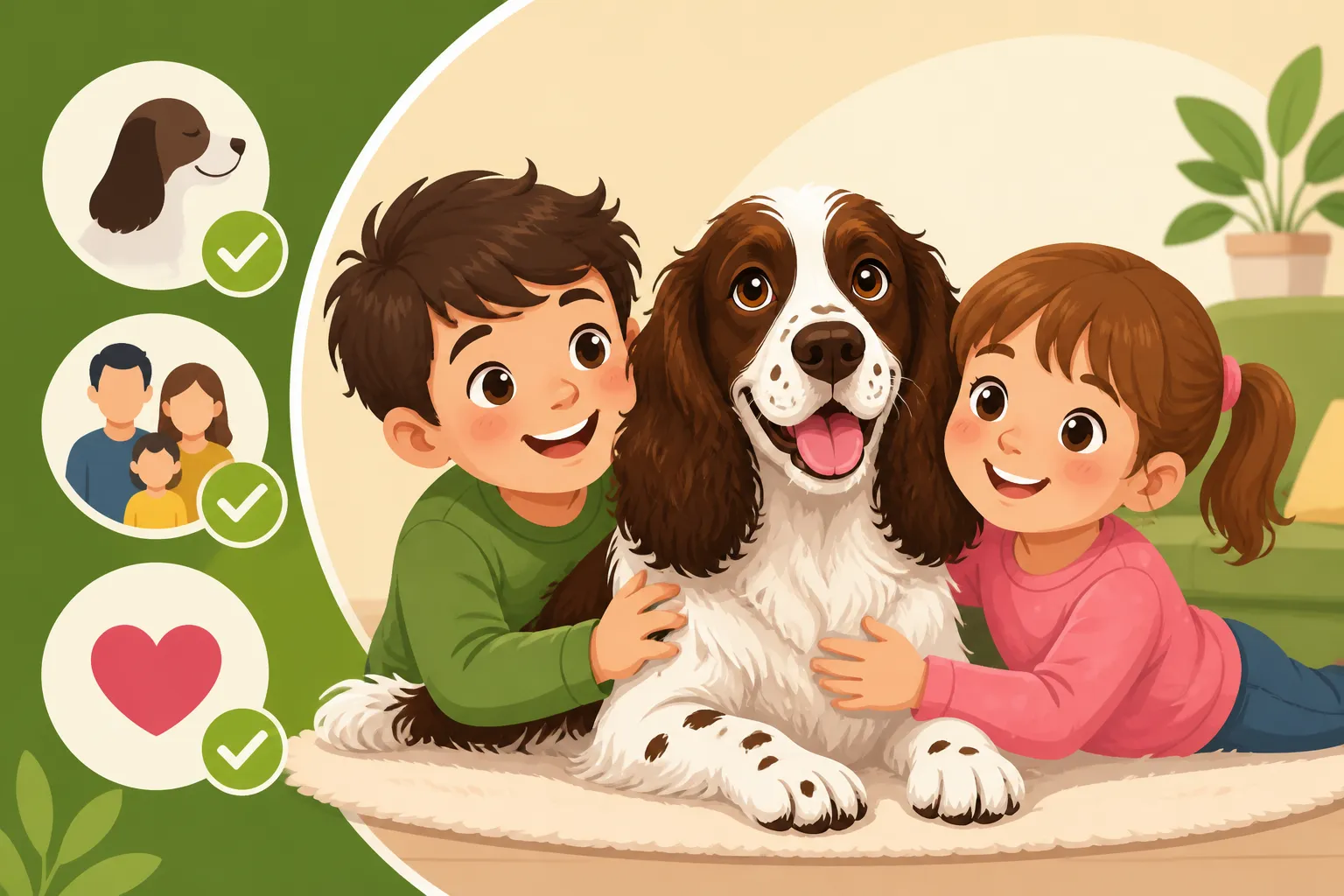
Whether a Springer Spaniel Suits a Family With Small Children
A Springer Spaniel can be a loving companion for children, but a puppy’s enthusiasm, a child’s unpredictable movements, and a busy family schedule can make the match harder than it looks. This guide explains what living with a Springer Spaniel and small children is really like, how to reduce avoidable risks, and what to consider before bringing one home.
What Springer Spaniels Are Like Around Small Children
Affectionate does not always mean gentle
Many English Springer Spaniels are social, playful dogs that enjoy being part of family life. They may follow people from room to room, seek attention, and join in games. Those qualities can make them appealing family companions, but friendliness is not the same thing as being naturally careful around a toddler.
A young Springer may rush to greet a child, bounce up when excited, or swing around during play. Even without any intention to hurt anyone, a medium-sized, energetic dog can knock over a small child. A wagging tail, a paw placed on a toddler, or a sudden dash across the room may be enough to cause a fall.
Springers also tend to notice movement. A child running, squealing, or waving a toy can be especially exciting, and the dog may respond by chasing, jumping, or grabbing at the object. The goal is not to assume the dog will behave perfectly because it is affectionate. It is to help both child and dog learn predictable, safe ways to share space.
If you are comparing family suitability across breed types, it may help to understand the difference between working and show lines. A dog’s individual temperament matters most, but activity needs and intensity can differ. Two Breeds Registered as One: the Field and Show Springer Spaniel offers more context on those differences.
Energy and excitement can be challenging in a family home
A Springer Spaniel needs more than a quick trip outside to stay content. Many enjoy walks, scent games, retrieving, training, and time spent exploring. A dog that is under-stimulated may become restless, bark, mouth toys, or look for its own entertainment. Those behaviors can be difficult to manage when parents are also caring for young children.
The family schedule matters just as much as the dog’s exercise. A long walk does not replace supervision, training, rest, and interaction. Nor should a child be expected to exercise or manage the dog. Adults need to plan for the daily routine themselves, including rainy days, school runs, illness, and the stretches of time when a baby or toddler needs a parent’s full attention.
There is no single energy level that applies to every Springer Spaniel. A calmer adult may suit a household better than a lively adolescent. Ask breeders or rescue volunteers about the individual dog’s behavior around children, recovery after excitement, comfort with handling, and ability to settle indoors. For a broader look at the breed’s activity needs, see How Much Exercise a Show Bred Springer Spaniel Needs and How Much Exercise a Field Bred Springer Spaniel Needs.
Children’s ages and behavior make a difference
A school-age child who can follow simple rules may be able to participate in supervised training and gentle games. A toddler is less predictable. They may grab ears, hug tightly, fall against the dog, or run away while squealing. Even a tolerant dog can become uncomfortable when it cannot move away.
Consider what “small children” means in your home and what changes are coming. A dog brought home when a child is a baby may later face a fast-moving toddler. A family expecting a new baby will need to prepare the dog for new sounds, equipment, visitors, and a changed routine. The question is not simply whether the dog likes children today, but whether the household can manage the next few stages of family life.
| Family situation | What may work well | Main challenge to plan for |
|---|---|---|
| Baby in the home | Adults can establish routines and boundaries early | Managing dog access around feeding, sleep, and floor time |
| Toddler | A playful dog may enjoy family activity | Preventing chasing, grabbing, jumping, and accidental knocks |
| Preschool or school-age children | Children can learn simple dog-safety rules | Adults still need to supervise and guide interactions |
| Several young children | The dog may enjoy being included in family life | More noise, movement, visitors, and competing demands |
How to Make the Home Safer for Everyone
Supervise every interaction
Young children and dogs should not be left together unsupervised, even when the dog is familiar and has behaved well before. Supervision means an adult is close enough to intervene—not simply somewhere else in the house or watching from across the room while distracted.
Pay attention to the dog’s body language and give it space if it turns away, moves off, becomes still, licks its lips repeatedly, yawns when not tired, or tries to hide. These signs do not prove that a dog is about to bite, but they can indicate discomfort or a desire for distance. Stop the interaction and help the dog retreat to a quiet area.
Use gates, pens, or closed doors to create separation when an adult cannot actively supervise. Set up those boundaries before you need them: for example, while preparing dinner, answering the door, or helping a child with a bath. Some families find it useful to keep basic management supplies together; items such as gates, a pen, and a washable bed may be available through retailers such as Chewy. Choose equipment that suits your space and follow its safety instructions.
Give the dog a child-free retreat
A dog should have a place where children are not allowed to follow. This could be a bed behind a gate, a quiet room, or a crate if the dog has been positively introduced to it and is comfortable resting there. The retreat is not a punishment. It is a reliable way for the dog to take a break from noise and activity.
Teach children that a resting dog is not available for play. They should not climb into the dog’s bed, reach through a crate, or disturb the dog while it is eating, chewing, or sleeping. Adults need to enforce these rules consistently, especially with toddlers who are still learning what boundaries mean.
A simple setup can prevent a lot of stressful moments: keep the dog’s food and water in a child-restricted area, use a gate to separate the dog during meals, and put high-value chews away when children are playing nearby. If the dog has trouble settling or becomes distressed when separated, ask a veterinarian or qualified behavior professional for guidance rather than relying on confinement alone.
Teach gentle, clear behavior on both sides
Children can learn a few straightforward rules: let the dog approach, use a gentle touch, leave the dog alone when it is eating or resting, and call an adult if the dog walks away. Young children need frequent reminders and adult help; a rule explained once is not enough.
Training the dog is equally important. Reward calm approaches, four paws on the floor, settling on a mat, and responding to a recall cue. Practice these skills when the room is quiet before trying them with children nearby. If the dog jumps, avoid letting the behavior earn attention; calmly create space and reward a more settled greeting when the dog is ready.
Do not expect a child to train, walk, or physically control a Springer Spaniel. Adults should hold the leash and manage greetings, especially outdoors, where joggers, bikes, squirrels, and other dogs may add excitement. For more on child safety and household expectations, see Whether a Springer Spaniel Is Safe With Children and Whether a Springer Spaniel Is Safe With a Toddler.
Choosing the Right Springer Spaniel for a Family
Look beyond breed reputation
A breed label cannot tell you exactly how an individual dog will behave. Ask about the dog’s history with children, response to sudden movement and noise, tolerance for handling, and ability to recover after excitement. If you are considering a puppy, ask how the breeder evaluates temperament and what kind of household the puppy’s parents are comfortable in.
A puppy can grow up to be a wonderful family dog, but puppyhood also brings nipping, chewing, house-training, interrupted sleep, and a need for frequent supervision. These demands can collide with caring for a baby or toddler. A mature dog with a known temperament may be a more manageable choice for some families, although its history and behavior still need careful assessment.
Rescue and foster organizations may be able to describe how an adult dog behaves in a home setting. Be candid about your children’s ages and routines. If a dog has not lived with young children, that does not automatically make it unsuitable, but it means you should not assume the dog is comfortable with them. A thoughtful introduction and professional advice may be needed.
Ask practical questions before committing
Whether you are speaking with a breeder, rescue group, or previous owner, ask specific questions rather than relying on broad assurances such as “good with kids.” Useful questions include:
- Has the dog lived with children of similar ages?
- What does the dog do when a child runs, shouts, or drops a toy?
- Does the dog settle when the household is busy?
- Has the dog shown guarding around food, toys, beds, or people?
- How does the dog respond when it is startled or touched unexpectedly?
- What management or training has already helped?
Meet the dog in a calm, controlled setting. Do not ask a child to hug, chase, or handle the dog as a test. An adult should manage the introduction and allow the dog to approach or move away. If the dog looks overwhelmed, pause the meeting rather than trying to force a friendly interaction.
Think about the demands of the specific Springer Spaniel you are considering. A highly driven working-line dog may need substantial outlets and training. A show-line dog may still be energetic and playful. Neither type is automatically the safer or easier choice for children. Which Springer Spaniel Type Suits a Pet Home can help you think through the differences in lifestyle fit.
Make a realistic household plan
Before bringing a dog home, decide who will handle walks, training, feeding, grooming, and veterinary care. Build a backup plan for days when a child is sick or a parent is unavailable. If the dog’s needs will depend on a routine that only works under ideal conditions, reconsider whether the timing is right.
Plan for everyday management, not just the first few weeks. You may need a safe area for the dog during playdates, a way to separate dog and child at mealtimes, and time to reinforce calm behavior as the child becomes more mobile. For some households, keeping supplies organized—such as a leash, treats, grooming tools, and cleaning products—makes the routine easier. A retailer such as Chewy may be one place families look for these essentials, but the right products will depend on the dog, the home, and advice from a veterinarian or trainer.
If a dog growls, snaps, guards resources, or appears frightened around a child, separate them calmly and seek qualified help. Do not punish warning signals or assume the dog will simply get used to the situation. A veterinarian can help rule out pain or illness, and a qualified behavior professional can advise on a safe plan. Families looking for practical home-management items may also find options through Chewy, but equipment does not replace supervision or behavior support.
When a Springer Spaniel May Not Be the Best Fit
Be honest about time and energy
A Springer Spaniel may be a poor match if adults cannot reliably provide exercise, training, companionship, and supervised family time. A young dog left to entertain itself during long, busy days may develop habits that are frustrating to manage, such as jumping, chewing, or persistent attention-seeking.
This does not mean every family needs a large garden or a hunting schedule. It does mean the dog needs regular opportunities to move, sniff, learn, and rest. Families in apartments or suburban homes can provide these needs, but they should plan the routine rather than assume a yard will do the work. For more on the breed’s home-life demands, see The Household a Springer Spaniel Was Built For.
Consider waiting or choosing an adult dog
It can be kinder to wait until children are older or family life is less demanding. That is not a failure; it is a decision to bring a dog home when the adults can set everyone up for success. A puppy needs significant time, and a household already stretched thin may find that the dog’s needs become another source of stress.
An adult dog with a known, suitable temperament may fit some families better, but there is no shortcut around careful introductions, supervision, and management. If you do proceed, make a transition plan that gives the dog space and helps children learn respectful behavior gradually. What Springer Spaniel Owners Wish They Had Known may also help families anticipate everyday realities before making a decision.
A Springer Spaniel can thrive in a home with small children when the individual dog is a good match and adults take responsibility for safety, training, and care. Affection and a playful nature are lovely qualities, but they do not replace supervision or a realistic plan for the dog’s energy and the child’s changing behavior. The best decision is the one that protects the child’s safety while giving the dog a predictable, supported life.
Disclaimer
This article is for general informational purposes only and does not constitute professional advice. Laws, prices and regulations vary by location and change over time. Consult a qualified professional for guidance on your specific situation.